
Hybrid Transparency Gaussian Splatting Code Released

HTGS gets rid of popping artifacts in 3DGS and more!

HTGS gets rid of popping artifacts in 3DGS and more!

Michael Rubloff

Michael Rubloff

Michael is the Founder and Managing Editor of Radiancefields.com

Tags

HTGS

Great news for those following advancements in 3D Gaussian Splatting— the code for Efficient Perspective-Correct 3D Gaussian Splatting Using Hybrid Transparency (HTGS) is now publicly available! We covered the paper back when it was published, last year.
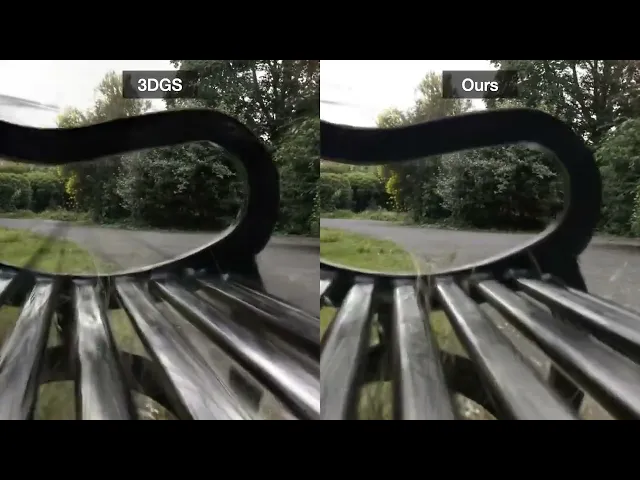
HTGS builds on previous 3DGS research by tackling popping artifacts and significantly boosting performance, with reported rendering speed increases of up to 2x, depending on the scene. This work introduces a perspective-correct projection method that eliminates depth-sorting issues and improves rendering stability without costly matrix inversions. The authors also implement a hybrid transparency model, ensuring that depth-blending is both visually accurate and computationally efficient.

The method refines key areas of 3DGS by leveraging Plücker coordinates and a novel core/tail blending approach to balance quality and real-time performance.

Key Features of HTGS

  • Perspective-Correct Projection: Ensures stable and accurate splat evaluation, particularly in challenging depth variations.

  • Hybrid Transparency Blending: Splits blending into core (top K fragments) and tail contributions, improving real-time rendering performance.

  • Optimized CUDA Kernels: Designed for speed and efficiency, reducing computational overhead.

  • Multiple Blending Modes:

    • HYBRID_BLEND: Blends top K fragments using alpha blending; remaining fragments use order-independent transparency.

    • ALPHA_BLEND_FIRST_K: Only the K foremost fragments are blended, discarding the rest.

    • ALPHA_BLEND_GLOBAL_ORDERING: Sorts Gaussians based on their Z-depth for approximate blending.

    • OIT_BLEND: Fully order-independent transparency blending for all fragments.

How to Get Started

The code is provided as an extension to the NeRFICG framework, which is required for setup. The repository includes:

  • Training and inference scripts compatible with NeRFICG.

  • Optimized CUDA implementations for efficient rendering.

  • Example configuration files for datasets like Mip-NeRF360 and Tanks & Temples.

  • Export support for .ply files (note: correct rendering requires ray-based evaluation of 3D Gaussians).

The authors have tested the implementation on an Nvidia RTX 4090 with Ubuntu 22.04 and optimized CUDA Toolkit versions. Be mindful that CUDA Driver Version 560 shows a 20% performance regression, so earlier versions are recommended for optimal results.

With the release of the HTGS code, developers and researchers can now experiment with these enhancements firsthand. As Radiance Fields continue to evolve, approaches like HTGS show how much room remains for optimization and innovation.

Check out the official code repository and start testing HTGS for yourself!

Featured

Recents

News

Eclipse Automation Opens RealitySync on iPhone, iPad, and Apple Vision Pro

Eclipse RealitySync opens as a free public preview on iPhone, iPad, and Apple Vision Pro with a customer pilot, and Eclipse says it uses Gaussian splatting.

Michael Rubloff

Oct 17, 2026

News

Eclipse Automation Opens RealitySync on iPhone, iPad, and Apple Vision Pro

Eclipse RealitySync opens as a free public preview on iPhone, iPad, and Apple Vision Pro with a customer pilot, and Eclipse says it uses Gaussian splatting.

Michael Rubloff

Platforms

Voxel51 Launches 3.0 for Physical AI

Voxel51 3.0 relaunches the platform for physical AI, and the open source FiftyOne 3D viewer beneath it has rendered Gaussian splats via Spark since 1.21.0.

Michael Rubloff

Oct 17, 2026

Platforms

Voxel51 Launches 3.0 for Physical AI

Voxel51 3.0 relaunches the platform for physical AI, and the open source FiftyOne 3D viewer beneath it has rendered Gaussian splats via Spark since 1.21.0.

Michael Rubloff

Platforms

Warpgate Labs Improves RSR VR Compatibility With Virtual Desktop and SteamVR in v0.9.1

RSR v0.9.1 requests OpenXR 1.0 instead of 1.1 to improve VR compatibility with Virtual Desktop and SteamVR, and adds multi-GPU headset routing.

Michael Rubloff

Oct 17, 2026

Platforms

Warpgate Labs Improves RSR VR Compatibility With Virtual Desktop and SteamVR in v0.9.1

RSR v0.9.1 requests OpenXR 1.0 instead of 1.1 to improve VR compatibility with Virtual Desktop and SteamVR, and adds multi-GPU headset routing.

Michael Rubloff

News

Clemson University Turns Existing Drone Imagery of Memorial Stadium Into a Gaussian Splat With Esri Drone2Map

Clemson University reprocessed existing drone imagery of Memorial Stadium into a Gaussian splat and a mesh in Esri ArcGIS Drone2Map in about 13 hours total.

Michael Rubloff

Oct 17, 2026

News

Clemson University Turns Existing Drone Imagery of Memorial Stadium Into a Gaussian Splat With Esri Drone2Map

Clemson University reprocessed existing drone imagery of Memorial Stadium into a Gaussian splat and a mesh in Esri ArcGIS Drone2Map in about 13 hours total.

Michael Rubloff

Trending Articles
  1. TRENDING
    Loading...
  2. TRENDING
    Loading...
  3. TRENDING
    Loading...
Michael Rubloff

Written by Michael Rubloff

Michael is the Founder and Managing Editor of Radiancefields.com

More from Michael Rubloff

More from Michael Rubloff

News

Eclipse Automation Opens RealitySync on iPhone, iPad, and Apple Vision Pro

Eclipse RealitySync opens as a free public preview on iPhone, iPad, and Apple Vision Pro with a customer pilot, and Eclipse says it uses Gaussian splatting.

Michael Rubloff

Oct 17, 2026

Eclipse RealitySync

News

Eclipse Automation Opens RealitySync on iPhone, iPad, and Apple Vision Pro

Michael Rubloff

Oct 17, 2026

Eclipse RealitySync

News

Eclipse Automation Opens RealitySync on iPhone, iPad, and Apple Vision Pro

Eclipse RealitySync opens as a free public preview on iPhone, iPad, and Apple Vision Pro with a customer pilot, and Eclipse says it uses Gaussian splatting.

Michael Rubloff

Oct 17, 2026

Eclipse RealitySync

Platforms

Voxel51 Launches 3.0 for Physical AI

Voxel51 3.0 relaunches the platform for physical AI, and the open source FiftyOne 3D viewer beneath it has rendered Gaussian splats via Spark since 1.21.0.

Michael Rubloff

Oct 17, 2026

Voxel51

Platforms

Voxel51 Launches 3.0 for Physical AI

Michael Rubloff

Oct 17, 2026

Voxel51

Platforms

Voxel51 Launches 3.0 for Physical AI

Voxel51 3.0 relaunches the platform for physical AI, and the open source FiftyOne 3D viewer beneath it has rendered Gaussian splats via Spark since 1.21.0.

Michael Rubloff

Oct 17, 2026

Voxel51

Platforms

Warpgate Labs Improves RSR VR Compatibility With Virtual Desktop and SteamVR in v0.9.1

RSR v0.9.1 requests OpenXR 1.0 instead of 1.1 to improve VR compatibility with Virtual Desktop and SteamVR, and adds multi-GPU headset routing.

Michael Rubloff

Oct 17, 2026

Rapid Splat Renderer

Platforms

Warpgate Labs Improves RSR VR Compatibility With Virtual Desktop and SteamVR in v0.9.1

Michael Rubloff

Oct 17, 2026

Rapid Splat Renderer

Platforms

Warpgate Labs Improves RSR VR Compatibility With Virtual Desktop and SteamVR in v0.9.1

RSR v0.9.1 requests OpenXR 1.0 instead of 1.1 to improve VR compatibility with Virtual Desktop and SteamVR, and adds multi-GPU headset routing.

Michael Rubloff

Oct 17, 2026

Rapid Splat Renderer

New to Gaussian Splatting? Start here

Radiance fields, explained from the ground up: what a Gaussian splat is, how to capture one, and which tools and gear to start with.

Newsletter

Keep up with the field.

New research, tools and captures from the Radiance Fields newsroom, in your inbox. Free, no spam.