
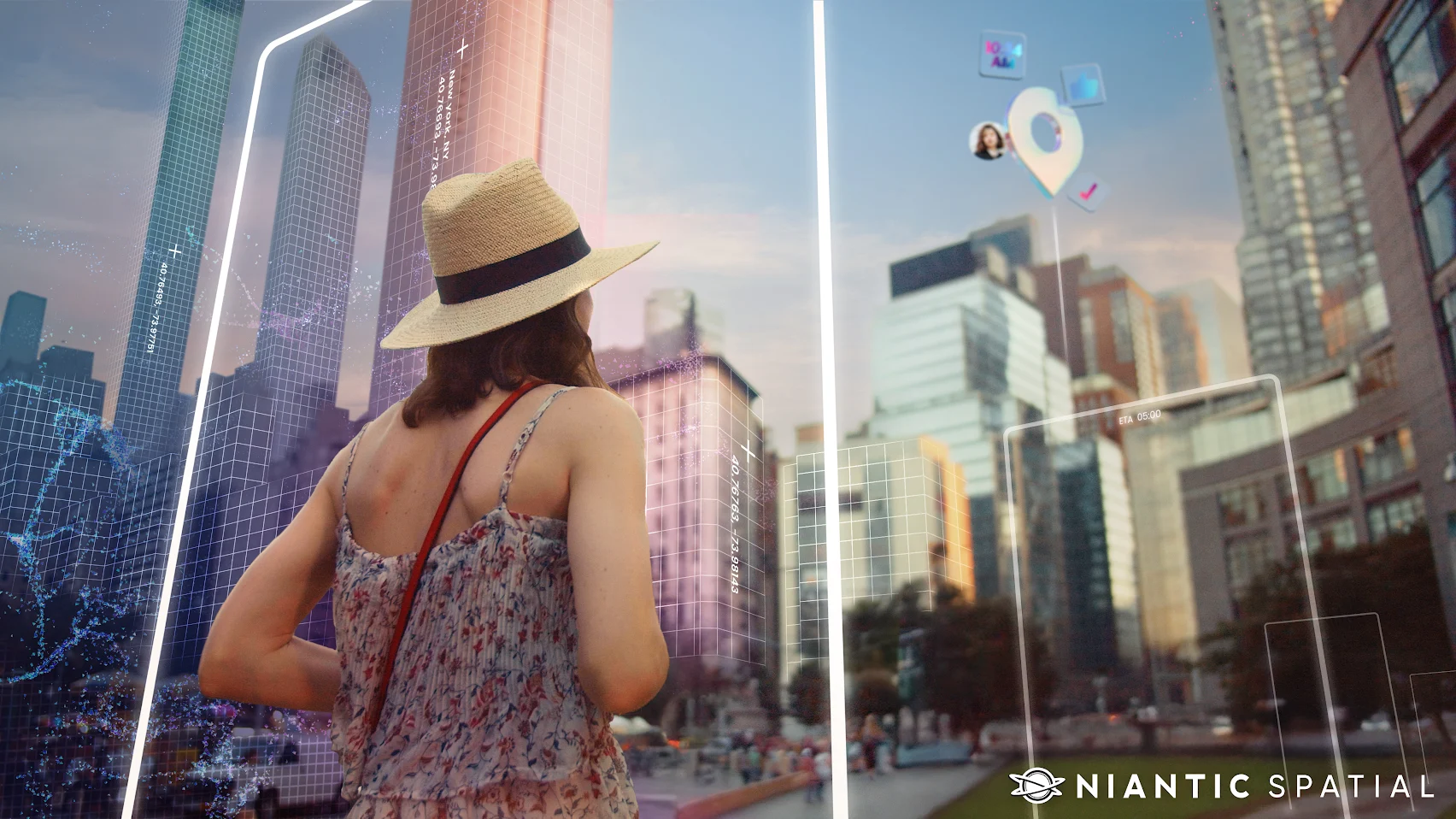
Niantic Spatial Bets Big on Scaniverse and Gaussian Splatting

Michael Rubloff

Michael Rubloff

Email
Copy Link
Twitter
Linkedin
Reddit
Whatsapp
Niantic Spatial

Today marked a significant shift in the tech landscape as Niantic announced the sale of its gaming portfolio, including massive hits like Pokémon GO, to mobile gaming giant Scopely for approximately $3.85 billion. Amid this seismic shift, one notable asset was intentionally kept separate: Scaniverse, a pioneering mobile app that leverages Gaussian Splatting, a type of radiance field representation.

The retention of Scaniverse and Niantic Spatial underline a strategic pivot. Niantic is betting heavily that the future of augmented reality and geospatial AI will rely less on traditional mapping approaches and more on high-fidelity, machine-readable 3D worlds reconstructed using lifelike 3D methods, such as Gaussian Splatting. Niantic had previously published a larger article about why they’re so excited about the Radiance Field representation.

Radiance fields, especially Gaussian Splatting, stand at the forefront of next-generation spatial computing. They offer unmatched speed, realism, and efficiency in rendering detailed 3D environments from ordinary imagery. Scaniverse, serving hundreds of thousands of users monthly, enables anyone with an iPhone or Android device to easily capture and create lifelike 3D models. These scans can then be uploaded to a crowdsourced global map.

Now funded with an initial investment of $250 million, Niantic Spatial has a clear mission: to build a “Large Geospatial Model,” an AI-driven representation of the entire physical world.

This strategic move sends a clear message to the broader tech industry and research community. Radiance fields have been ready to leave research for some time. Niantic’s decision to retain Scaniverse and aggressively invest in Niantic Spatial demonstrates that Gaussian Splatting is not only commercially viable but potentially industry-defining. It’s a strong vote of confidence in the transformative potential of radiance field-based representations.

While the gaming side of Niantic found a fitting home at Scopely, dedicated to nurturing “forever games,” the heart of Niantic’s ambitious technological vision now beats within Niantic Spatial. Radiance fields like Gaussian Splatting have officially stepped onto the main stage, backed by significant resources and the enthusiastic endorsement of a tech innovator renowned for shaping digital interactions with the real world.

Niantic and Scaniverse will be attending GDC next week. It will be interesting to see what announcements, if any, will be made at the conference. For more details, stay tuned as we follow Niantic Spatial’s journey and explore how Gaussian Splatting and other radiance field innovations continue reshaping our understanding of spatial computing.

Featured

Recents

Platforms

three.js Ships Its Native Gaussian Splat Renderer and Splat Raycasting in r186

three.js r186 ships GaussianSplat, its first native Gaussian splat renderer, adding raycasting, per-mesh frustum culling and view-dependent spherical harmonics.

Michael Rubloff

Sep 9, 2026

Platforms

three.js Ships Its Native Gaussian Splat Renderer and Splat Raycasting in r186

three.js r186 ships GaussianSplat, its first native Gaussian splat renderer, adding raycasting, per-mesh frustum culling and view-dependent spherical harmonics.

Michael Rubloff

Platforms

PlayCanvas Releases SuperSplat 3.0

SuperSplat 3.0 rewrites PlayCanvas's Gaussian splat editor on WebGPU only, removing the WebGL2 path, cutting peak memory, and adding sort-free Stochastic Alpha.

Michael Rubloff

Sep 8, 2026

Platforms

PlayCanvas Releases SuperSplat 3.0

SuperSplat 3.0 rewrites PlayCanvas's Gaussian splat editor on WebGPU only, removing the WebGL2 path, cutting peak memory, and adding sort-free Stochastic Alpha.

Michael Rubloff

XGRIDS Adds WebXR Support to the LCC Web SDK in v0.6.3

XGRIDS LCC Web SDK v0.6.3 adds WebXR support to its Three.js and Cesium renderer, bringing browser-based headset viewing to LCC and LCC2 Gaussian splat scenes.

Michael Rubloff

Sep 8, 2026

XGRIDS Adds WebXR Support to the LCC Web SDK in v0.6.3

XGRIDS LCC Web SDK v0.6.3 adds WebXR support to its Three.js and Cesium renderer, bringing browser-based headset viewing to LCC and LCC2 Gaussian splat scenes.

Michael Rubloff

Splat Box Editor for Unity Now Ships Full Source Code

Simulacrum's $199 Splat Box Editor for Unity now includes full source code, with PLY and SPZ import and export, real-time relighting, shadow mapping and SSAO.

Michael Rubloff

Sep 4, 2026

Splat Box Editor for Unity Now Ships Full Source Code

Simulacrum's $199 Splat Box Editor for Unity now includes full source code, with PLY and SPZ import and export, real-time relighting, shadow mapping and SSAO.

Michael Rubloff

Michael Rubloff

Written by Michael Rubloff

Michael is the Founder and Managing Editor of Radiancefields.com

Email
Copy Link
Twitter
Linkedin
Reddit
Whatsapp

More from Michael Rubloff

More from Michael Rubloff

Platforms

three.js Ships Its Native Gaussian Splat Renderer and Splat Raycasting in r186

three.js r186 ships GaussianSplat, its first native Gaussian splat renderer, adding raycasting, per-mesh frustum culling and view-dependent spherical harmonics.

Michael Rubloff

Sep 9, 2026

three.js Gaussian Splatting

Platforms

three.js Ships Its Native Gaussian Splat Renderer and Splat Raycasting in r186

Michael Rubloff

Sep 9, 2026

three.js Gaussian Splatting

Platforms

three.js Ships Its Native Gaussian Splat Renderer and Splat Raycasting in r186

three.js r186 ships GaussianSplat, its first native Gaussian splat renderer, adding raycasting, per-mesh frustum culling and view-dependent spherical harmonics.

Michael Rubloff

Sep 9, 2026

three.js Gaussian Splatting

Platforms

PlayCanvas Releases SuperSplat 3.0

SuperSplat 3.0 rewrites PlayCanvas's Gaussian splat editor on WebGPU only, removing the WebGL2 path, cutting peak memory, and adding sort-free Stochastic Alpha.

Michael Rubloff

Sep 8, 2026

Supersplat 3.0

Platforms

PlayCanvas Releases SuperSplat 3.0

Michael Rubloff

Sep 8, 2026

Supersplat 3.0

Platforms

PlayCanvas Releases SuperSplat 3.0

SuperSplat 3.0 rewrites PlayCanvas's Gaussian splat editor on WebGPU only, removing the WebGL2 path, cutting peak memory, and adding sort-free Stochastic Alpha.

Michael Rubloff

Sep 8, 2026

Supersplat 3.0

XGRIDS Adds WebXR Support to the LCC Web SDK in v0.6.3

XGRIDS LCC Web SDK v0.6.3 adds WebXR support to its Three.js and Cesium renderer, bringing browser-based headset viewing to LCC and LCC2 Gaussian splat scenes.

Michael Rubloff

Sep 8, 2026

XGRIDS

XGRIDS Adds WebXR Support to the LCC Web SDK in v0.6.3

Michael Rubloff

Sep 8, 2026

XGRIDS

XGRIDS Adds WebXR Support to the LCC Web SDK in v0.6.3

XGRIDS LCC Web SDK v0.6.3 adds WebXR support to its Three.js and Cesium renderer, bringing browser-based headset viewing to LCC and LCC2 Gaussian splat scenes.

Michael Rubloff

Sep 8, 2026

XGRIDS