
WHERENESS: Share Your Spaces

Michael Rubloff

Michael Rubloff

Email
Copy Link
Twitter
Linkedin
Reddit
Whatsapp
WHERENESS

As digital spaces are becoming able to match the fidelity of physical locations, WHERENESS is emerging with a mission to bring art and experience to everyone, regardless of their location. WHERENESS is a spatial sharing cloud, designed to give users the ability to effortlessly upload, organize, and share both 360º content and 3D Gaussian splatting files.

WHERENESS didn’t appear overnight— it grew out of a deep rooted commitment to preserving and sharing artistic spaces. The platform's origins trace back to ART360°, an exhibition archiving project developed by the Nishieda Foundation. ART360° was created to ensure that exhibitions could live beyond their physical constraints, allowing audiences to revisit and engage with them digitally.

That same spirit of preservation and accessibility is at the heart of WHERENESS. By expanding beyond the realm of art and into broader applications, WHERENESS provides a space where art, architecture, digital twins, and interactive storytelling can thrive. The transition from ART360° to WHERENESS marks a shift from simple archiving to dynamic spatial sharing, opening up new possibilities for creators and organizations alike.

Longtime readers of this site might remember when we went through how Radiance Field representations can bring so much to the museum and cultural heritage experience. Museums often only show ~4% of their collection at a time to the public. While we might be constrained physically, we have the ability to bring these exhibits and pieces into lifelike digital environments, so that we can all enjoy the past work of our ancestors.

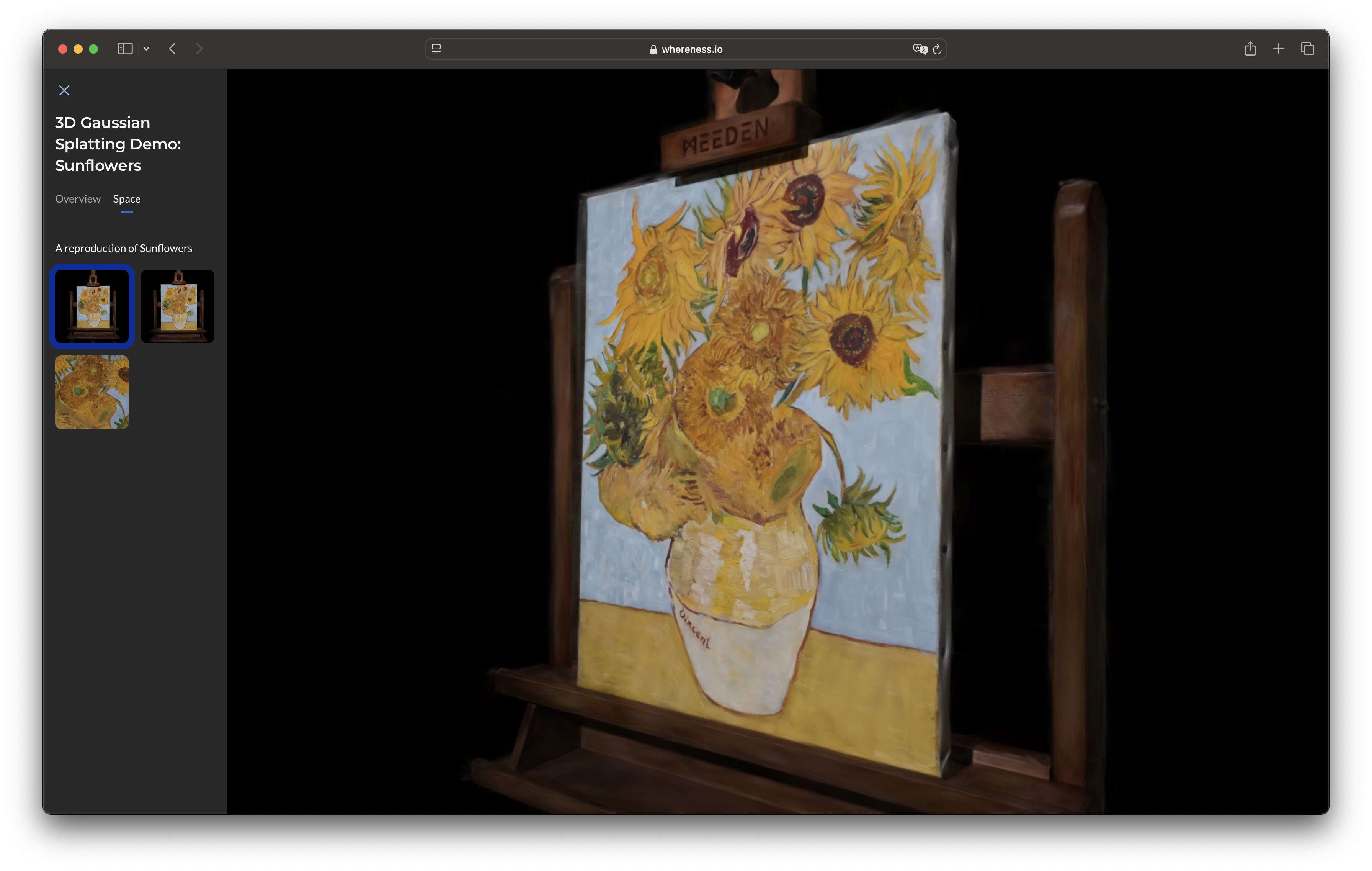
Check out their reconstruction of Van Gogh's Sunflowers, an example of how the platform seamlessly brings digital spaces to life: Explore Here. For a more in depth look at its capabilities, watch the teaser video, 3DGS - The Thinker:

WHERENESS is designed to make spatial content management effortless and engaging. Users can upload and organize 360º content and 3D Gaussian splatting files, creating structured digital catalogs that house multiple projects in a single, streamlined interface. Sharing is just as intuitive, with the ability to generate direct URLs that allow anyone to access immersive environments instantly. Businesses that need extra security can also protect their projects with password restrictions.

WHERENESS also delivers a high-quality visual experience, supporting high-resolution 3D Gaussian Splatting, across different splat counts for strikingly detailed environments. To keep everything running smoothly, the platform integrates with most of the standard 3DGS outputs, ranging from .ply, .splat, .ksplat, and Niantic’s .SPZ format.

For those looking to leverage spatial engagement, WHERENESS allows for interactive storytelling by embedding annotations, and links directly into digital spaces. A planned update will introduce hotspots for 3D Gaussian splatting files, further enhancing interactive possibilities. This is one of my favorite uses of lifelike 3D and I am so excited to see another platform bringing in these capabilities.

By bridging the gap between archival integrity and modern digital interaction, WHERENESS is allowing more information and experiences to translate over to educational experiences. WHERENESS provides the tools to go beyond static documentation and bring digital spaces to life. It is currently free to use and people can get started with their platform, through their website.

Featured

Recents

Platforms

Nuke 17.1 Open Beta Adds Dynamic Gaussian Splats and Basic Relighting

Nuke 17.1 open beta extends Foundry's 3D Gaussian splatting toolset with animated splats via GeoSequencer, SPLAT file export, splat relighting, and a Hydra 2.0 viewport.

Michael Rubloff

Jul 3, 2026

Platforms

Nuke 17.1 Open Beta Adds Dynamic Gaussian Splats and Basic Relighting

Nuke 17.1 open beta extends Foundry's 3D Gaussian splatting toolset with animated splats via GeoSequencer, SPLAT file export, splat relighting, and a Hydra 2.0 viewport.

Michael Rubloff

Platforms

OTOY Releases OctaneRender 2026.4 Bringing SPZ V4 and Lowering VRAM Usage

OctaneRender 2026.4 adds SPZ v4 Gaussian splat support, cuts splat GPU memory, fixes rendering of 30M+ splat scenes, and brings Neural Radiance Cache to macOS.

Michael Rubloff

Jul 2, 2026

Platforms

OTOY Releases OctaneRender 2026.4 Bringing SPZ V4 and Lowering VRAM Usage

OctaneRender 2026.4 adds SPZ v4 Gaussian splat support, cuts splat GPU memory, fixes rendering of 30M+ splat scenes, and brings Neural Radiance Cache to macOS.

Michael Rubloff

Platforms

fVDB v0.5.0 Turns NVIDIA's Library Into Multi-GPU Gaussian Splatting Stack

NVIDIA has released V0.5 of fVDB, bringing several updates, including multi-GPU gaussian splatting training and rendering stack with gsplat-parity rasterization inside the core.

Michael Rubloff

Jul 2, 2026

Platforms

fVDB v0.5.0 Turns NVIDIA's Library Into Multi-GPU Gaussian Splatting Stack

NVIDIA has released V0.5 of fVDB, bringing several updates, including multi-GPU gaussian splatting training and rendering stack with gsplat-parity rasterization inside the core.

Michael Rubloff

News

CyArk Launches America 250 Tapestry Collection With Gaussian Splatting

CyArk launches the America 250 Tapestry Collection, three heritage interiors reconstructed with gaussian splatting and walkable in-browser.

Michael Rubloff

Jun 30, 2026

News

CyArk Launches America 250 Tapestry Collection With Gaussian Splatting

CyArk launches the America 250 Tapestry Collection, three heritage interiors reconstructed with gaussian splatting and walkable in-browser.

Michael Rubloff

Trending Articles
  1. TRENDING
    Loading...
  2. TRENDING
    Loading...
  3. TRENDING
    Loading...
Michael Rubloff

Written by Michael Rubloff

Michael is the Founder and Managing Editor of Radiancefields.com

Email
Copy Link
Twitter
Linkedin
Reddit
Whatsapp

More from Michael Rubloff

More from Michael Rubloff

Platforms

Nuke 17.1 Open Beta Adds Dynamic Gaussian Splats and Basic Relighting

Nuke 17.1 open beta extends Foundry's 3D Gaussian splatting toolset with animated splats via GeoSequencer, SPLAT file export, splat relighting, and a Hydra 2.0 viewport.

Michael Rubloff

Jul 3, 2026

Nuke 17.1 Beta

Platforms

Nuke 17.1 Open Beta Adds Dynamic Gaussian Splats and Basic Relighting

Michael Rubloff

Jul 3, 2026

Nuke 17.1 Beta

Platforms

Nuke 17.1 Open Beta Adds Dynamic Gaussian Splats and Basic Relighting

Nuke 17.1 open beta extends Foundry's 3D Gaussian splatting toolset with animated splats via GeoSequencer, SPLAT file export, splat relighting, and a Hydra 2.0 viewport.

Michael Rubloff

Jul 3, 2026

Nuke 17.1 Beta

Platforms

OTOY Releases OctaneRender 2026.4 Bringing SPZ V4 and Lowering VRAM Usage

OctaneRender 2026.4 adds SPZ v4 Gaussian splat support, cuts splat GPU memory, fixes rendering of 30M+ splat scenes, and brings Neural Radiance Cache to macOS.

Michael Rubloff

Jul 2, 2026

OctaneRender 2026.4

Platforms

OTOY Releases OctaneRender 2026.4 Bringing SPZ V4 and Lowering VRAM Usage

Michael Rubloff

Jul 2, 2026

OctaneRender 2026.4

Platforms

OTOY Releases OctaneRender 2026.4 Bringing SPZ V4 and Lowering VRAM Usage

OctaneRender 2026.4 adds SPZ v4 Gaussian splat support, cuts splat GPU memory, fixes rendering of 30M+ splat scenes, and brings Neural Radiance Cache to macOS.

Michael Rubloff

Jul 2, 2026

OctaneRender 2026.4

Platforms

fVDB v0.5.0 Turns NVIDIA's Library Into Multi-GPU Gaussian Splatting Stack

NVIDIA has released V0.5 of fVDB, bringing several updates, including multi-GPU gaussian splatting training and rendering stack with gsplat-parity rasterization inside the core.

Michael Rubloff

Jul 2, 2026

NVIDIA Logo

Platforms

fVDB v0.5.0 Turns NVIDIA's Library Into Multi-GPU Gaussian Splatting Stack

Michael Rubloff

Jul 2, 2026

NVIDIA Logo

Platforms

fVDB v0.5.0 Turns NVIDIA's Library Into Multi-GPU Gaussian Splatting Stack

NVIDIA has released V0.5 of fVDB, bringing several updates, including multi-GPU gaussian splatting training and rendering stack with gsplat-parity rasterization inside the core.

Michael Rubloff

Jul 2, 2026

NVIDIA Logo