Field meet Explicit Geometric Representations (FEGR) enables Novel View Relighting and Virtual Object Insertion

Michael Rubloff

Michael Rubloff

FEGR

NeRFs off the bat bake in the lighting and while creators such as Jonathan Stephens have explored relighting a scene through Instant-NGP, today there is another paper that not only allows for Novel View Relighting, but also extends to Virtual Object Insertion.

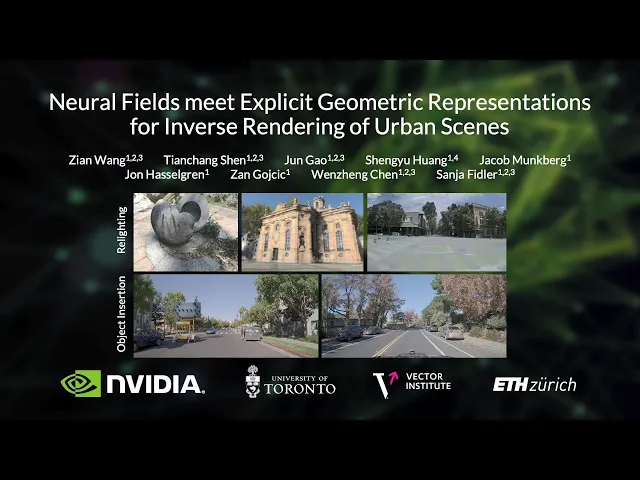
NVIDIA, the University of Toronto, Vector Institute, and ETH Zurich present Fields meet Explicit Geometric Representations (FEGR). It reconstructs and decomposes scenes from captured images, enabling various applications like relighting and virtual object insertion.
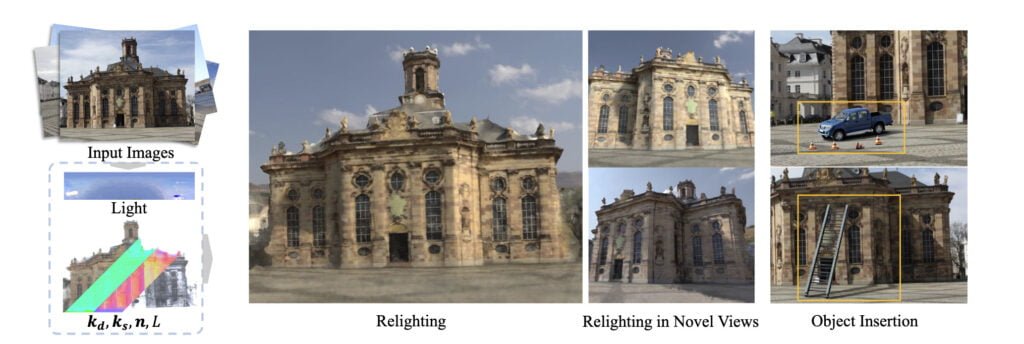
FEGR combines the strengths of both NeRF and mesh-based methods to enable photorealistic relighting with specular and shadow effects.

Traditional methods face challenges in handling outdoor scenes or may have limitations in separating lighting and shadows from the scene. FEGR can effectively reconstruct scene geometry, materials, and lighting from a set of images, using a combination of neural fields and explicit mesh. This method enables photorealistic relighting and shadow effects on outdoor scenes and supports realistic virtual object insertion with accurate shadow casting. The technology is important because it can enhance the quality of various digital media and augmented reality applications, making them more immersive and visually appealing.

For those that are wondering how FEGR is pronounced, their paper states "feature".

FEGR also extends to use cases for VR and AR to create either more immersive experiences through lighting or climate changes as well as inserting 3D objects. For those looking to bring FEGR into other platforms, it is able to be exported into most modern pipelines and is exportable into gltf and USD.

FEGR, improves the realism of virtual objects placed into NeRFs. FEGR can accurately represent the location of light sources, like the sun, creating more realistic shadows and reflections on the inserted objects. A user study showed that the majority of participants found FEGR's results more realistic than other methods, highlighting its superior lighting estimation. This technology is important because it can enhance the quality of virtual object insertion in augmented reality applications and other digital media, making them more immersive and convincing.

While the virtual object insertion has almost infinite use cases, it is immediately obvious how much it impacts the autonomous driving industry. By allowing for a variety of scenarios and conditions, the simulations become all the more accurate and hopefully safer for humans.

However, the method does have limitations, such as being limited to static scenes and relying on manually designed priors. In the future, researchers hope to address these limitations by learning from more data and incorporating advances in dynamic neural fields.

We continue to see a trend of NeRFs focusing on large urban scenes, such as Grid-NeRF and Google Maps. All of these continue to show both researchers and corporations dedication to improving large scale immersive views.

I'm personally excited to see how large scale NeRFs impact the live ticketing and event industry.

Featured

Recents

Platforms

Esri Brings 3D Analysis to Gaussian Splat Layers in ArcGIS Maps SDK for JavaScript 5.1

ArcGIS Maps SDK for JavaScript 5.1 adds 3D analysis; shadow, slice, line of sight, and elevation profiles to Gaussian splat layers, moving them toward parity with other 3D layers.

Michael Rubloff

Jun 29, 2026

Platforms

Esri Brings 3D Analysis to Gaussian Splat Layers in ArcGIS Maps SDK for JavaScript 5.1

ArcGIS Maps SDK for JavaScript 5.1 adds 3D analysis; shadow, slice, line of sight, and elevation profiles to Gaussian splat layers, moving them toward parity with other 3D layers.

Michael Rubloff

Platforms

GSOPs Brings Native Gaussian Splatting to TouchDesigner

GSOPs brings native Gaussian splatting to TouchDesigner, loading and rendering .ply/.spz splats through node operators with particle system and shader effects, in beta now.

Michael Rubloff

Jun 27, 2026

Platforms

GSOPs Brings Native Gaussian Splatting to TouchDesigner

GSOPs brings native Gaussian splatting to TouchDesigner, loading and rendering .ply/.spz splats through node operators with particle system and shader effects, in beta now.

Michael Rubloff

Platforms

SplatKing 1.1 Adds Single Camera Support

The free gaussian splatting app now works with many more iPhones.

Michael Rubloff

Jun 26, 2026

Platforms

SplatKing 1.1 Adds Single Camera Support

The free gaussian splatting app now works with many more iPhones.

Michael Rubloff

Platforms

COLMAP 4.1.0 Ships Caspar GPU Bundle Adjustment and Native 360 Reconstruction

COLMAP 4.1.0 adds Caspar, a GPU bundle adjustment backend up to two orders of magnitude faster than Ceres, plus native equirectangular SfM for 360 captures.

Michael Rubloff

Jun 26, 2026

Platforms

COLMAP 4.1.0 Ships Caspar GPU Bundle Adjustment and Native 360 Reconstruction

COLMAP 4.1.0 adds Caspar, a GPU bundle adjustment backend up to two orders of magnitude faster than Ceres, plus native equirectangular SfM for 360 captures.

Michael Rubloff

Trending Articles
  1. TRENDING
    Loading...
  2. TRENDING
    Loading...
  3. TRENDING
    Loading...
Michael Rubloff

Written by Michael Rubloff

Michael is the Founder and Managing Editor of Radiancefields.com

More from Michael Rubloff

More from Michael Rubloff

Platforms

Esri Brings 3D Analysis to Gaussian Splat Layers in ArcGIS Maps SDK for JavaScript 5.1

ArcGIS Maps SDK for JavaScript 5.1 adds 3D analysis; shadow, slice, line of sight, and elevation profiles to Gaussian splat layers, moving them toward parity with other 3D layers.

Michael Rubloff

Jun 29, 2026

Esri

Platforms

Esri Brings 3D Analysis to Gaussian Splat Layers in ArcGIS Maps SDK for JavaScript 5.1

Michael Rubloff

Jun 29, 2026

Esri

Platforms

Esri Brings 3D Analysis to Gaussian Splat Layers in ArcGIS Maps SDK for JavaScript 5.1

ArcGIS Maps SDK for JavaScript 5.1 adds 3D analysis; shadow, slice, line of sight, and elevation profiles to Gaussian splat layers, moving them toward parity with other 3D layers.

Michael Rubloff

Jun 29, 2026

Esri

Platforms

GSOPs Brings Native Gaussian Splatting to TouchDesigner

GSOPs brings native Gaussian splatting to TouchDesigner, loading and rendering .ply/.spz splats through node operators with particle system and shader effects, in beta now.

Michael Rubloff

Jun 27, 2026

GSOPs TouchDesginer

Platforms

GSOPs Brings Native Gaussian Splatting to TouchDesigner

Michael Rubloff

Jun 27, 2026

GSOPs TouchDesginer

Platforms

GSOPs Brings Native Gaussian Splatting to TouchDesigner

GSOPs brings native Gaussian splatting to TouchDesigner, loading and rendering .ply/.spz splats through node operators with particle system and shader effects, in beta now.

Michael Rubloff

Jun 27, 2026

GSOPs TouchDesginer

Platforms

SplatKing 1.1 Adds Single Camera Support

The free gaussian splatting app now works with many more iPhones.

Michael Rubloff

Jun 26, 2026

Gaussian SplatKing

Platforms

SplatKing 1.1 Adds Single Camera Support

Michael Rubloff

Jun 26, 2026

Gaussian SplatKing

Platforms

SplatKing 1.1 Adds Single Camera Support

The free gaussian splatting app now works with many more iPhones.

Michael Rubloff

Jun 26, 2026

Gaussian SplatKing