
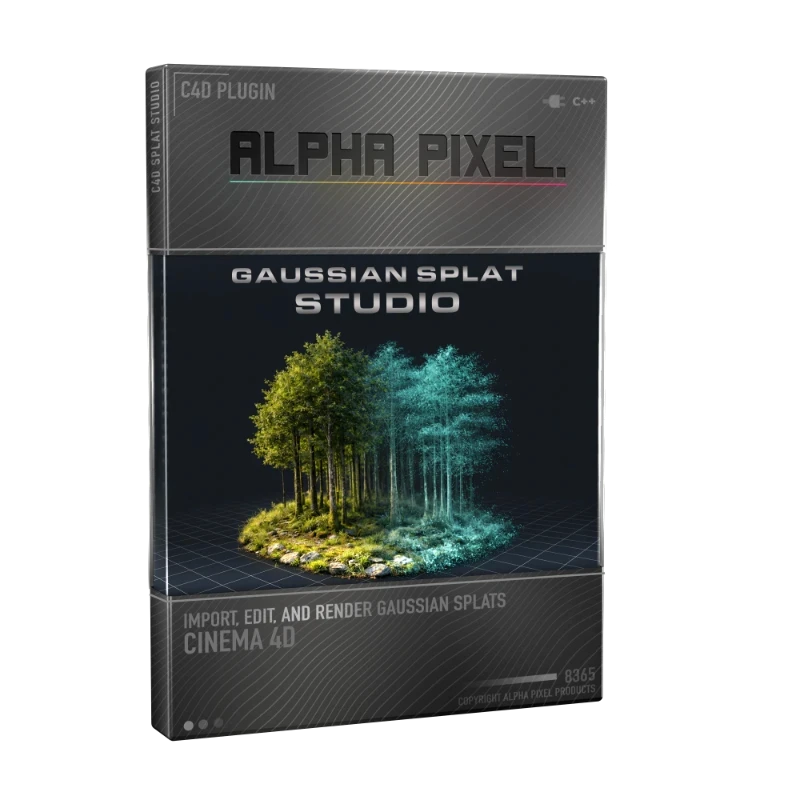
For much of the past two years, gaussian splatting has expanded through capture apps, web viewers, and game engines. That has been expanded yet again today with Gaussian Splat Studio for Cinema 4D, offering a procedural workflow for importing, viewing, rendering, and exporting gaussian splat point data directly inside C4D.
According to Alpha Pixel’s documentation, the plugin is built around nondestructive iteration, dedicated viewport and render controls, support for Redshift and Standard or Physical workflows, and compatibility with Cinema 4D 2024, 2025, and 2026 on both Windows and Mac.
Alpha Pixel describes controls for density, size, opacity, orientation, preview behavior, and final render behavior, with the ability to keep viewport settings separate from final output. One of the persistent friction points in splat workflows is that dense captures can be visually rich but cumbersome to manipulate interactively.
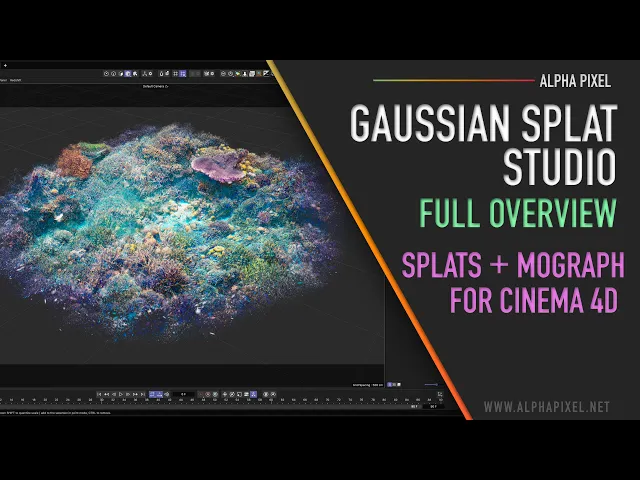
The creative angle is where Gaussian Splat Studio becomes especially interesting. The plugin ties splats into Cinema 4D’s broader procedural vocabulary through MoGraph effectors, fields, and force-based controls. Alpha Pixel says artists can use those tools to animate, isolate, distort, and refine portions of a splat scene directly in C4D, while also generating depth maps from effectors and choosing between multiple rendering looks such as scan faithful gaussian splats, faster point cloud views, and geometry driven alternatives for broader shading control.
That shift speaks to a larger pattern across the radiance field ecosystem. As Gaussian splats mature, the question is no longer only how to reconstruct them, but how to direct them. Artists want to relight them, composite them, stylize them, mask them, and integrate them into established production workflows without flattening what made the capture compelling in the first place. Gaussian Splat Studio appears to lean directly into that need with relighting support, fast preview modes, viewport mattes, automatic shader construction, and export back out to PLY or splat PLY for downstream delivery.
There is also something broader worth watching here. Cinema 4D has long occupied an important place in motion graphics, broadcast design, product visualization, and look development. If gaussian splats can become comfortable inside that environment, they may find a new audience beyond the communities that have already embraced them through standalone tools and web first workflows.
Gaussian splatting continues to spread throughout industries. The plugin is available for purchase at the Gumroad.