
SuperSplat has steadily evolved from a capable in-browser editor into one of the most accessible platforms for publishing Gaussian splats on the web. With the launch of SuperSplat Studio, the platform takes a major step forward. The focus is no longer just on editing or viewing splats, but on authoring full interactive experiences around them.
Studio introduces a dedicated environment for building guided, narrative driven presentations directly on top of published splats. This shifts gaussian splatting from being static artifacts to something closer to a structured, interactive medium.
SuperSplat Studio introduces a new annotation system that allows creators to place hotspots directly onto a splat scene. Each annotation includes a title, descriptive text, and a saved camera viewpoint. When a viewer selects a hotspot, the camera transitions smoothly to the predefined perspective and reveals the associated content.
This approach feels closer to a guided museum tour than a free roaming 3D model. Educational walkthroughs, product showcases, architectural highlights, or artistic commentary can now be embedded directly into the scene itself. Up to 25 annotations can be added per experience and reordered to shape a deliberate narrative sequence rather than a loose collection of points.
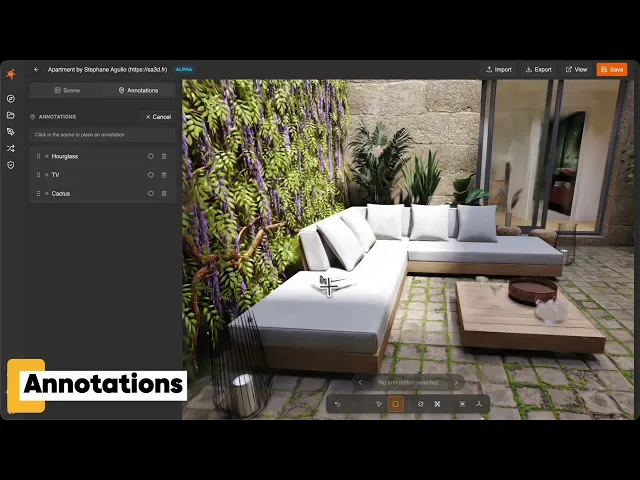
On the viewer side, a new navigation bar allows audiences to move through annotations in sequence. Instead of relying entirely on open exploration, creators can now direct attention intentionally, structuring how a splat unfolds for the viewer.
SuperSplat Studio also introduces a comprehensive set of post effects powered by the PlayCanvas Engine. Bloom, sharpening, vignette, chromatic fringing, and detailed color grading controls are now available directly within the authoring environment.
These controls update in real time. Adjusting bloom intensity or fine tuning saturation immediately changes the rendered splat.
Tonemapping options further expand the aesthetic range. Operators such as Linear, Filmic, ACES, ACES 2.0, Hejl, and Neutral allow authors to define how light and color respond across the scene. Combined with customizable background colors and optional high precision rendering for HDR dependent effects, Studio provides a level of polish that previously required deeper engine integration.
SuperSplat’s trajectory has consistently moved toward broader usability across a variety of industries. With Studio, that trajectory becomes infinitely more powerful. Splats are no longer just something to capture, refine, and host.
This shift matters because Gaussian splatting is increasingly being adopted across industries that utilize 2D. Product teams, educators, cultural institutions, and creative studios are experimenting with splats as a publishing medium. An annotation layer and real time cinematic controls lower the barrier to producing experiences that feel intentional and complete.
The workflow remains straightforward. After uploading and publishing a splat through the SuperSplat editor, creators can open the new Studio interface from their manage page. From there, annotations, post effects, tonemapping, and scene adjustments can be layered on without leaving the browser. SuperSplat Studio is also backwards compatible with previously uploaded data.
As 2026 continues to shape up as a pivotal year for radiance field adoption, tools like SuperSplat Studio signal that the conversation is rapidly advancing. I believe this will have a large impact on people deploying gaussian splatting in the world and I am excited to see SuperSplat Studio released. Start checking out captures at SuperSplat’s website.