
LocalMesh 2.0 Generates Its Mesh From the Photograph

Michael Rubloff

Michael Rubloff

LocalMesh

LocalMesh has released version 2.0, which generates its textured mesh directly from a reference photograph. When the beta opened in August, the mesh was carved out of the gaussian splat. LocalMesh rendered depth maps from 60 virtual cameras through gsplat and fused them into a 768 cubed TSDF volume before extracting a surface. Shape, color and material now arrive together from the picture.

The mesh generator is TRELLIS.2, Microsoft's 4B parameter image to 3D model, coming in at just about 9GB. TRELLIS.2 encodes an asset as a sparse voxel and emits full PBR materials with the geometry. TripoSplat still generates the splat, at 4.5 GB, and the splat is now a separate deliverable. Two settings disappeared with the change, the color source selector and the metal and roughness control, since color and material now come from the same pass as the shape.

Quentin Colus has since open-sourced the LocalMesh Engine under Apache 2.0, on GitHub and on Hugging Face as Qtn-Cls/LocalMeshEngine. The release covers the mesh path only, and TripoSplat and the gaussian splat deliverable are not in it. One photograph runs TRELLIS.2 and four run TencentARC's Pixal3D, an MIT licensed multi-view model that LocalMesh converts to FP8 locally so the whole path fits on an 8 GB card. What the engine adds around Pixal3D is the fusion, which puts front, right, left and back on a single grid and lets the model decide there, on the coarse volume first and then in each of the two passes that carve the surface. Depth Anything 3 reads the viewing angle of each photograph out of the pixels and falls back to a clean quarter turn when the reading is ambiguous, reporting which of the two it used. Each crop is then sized on the height of the subject, since turning an object around does not change its height. 

The material check forces to zero the metal value of 0.6 to 0.8 the model writes onto a resin figure, and drops the transparency it bakes by copying luminance. The triangle count is 150,000 at the Standard tier. Building the engine takes Python 3.12, the CUDA 12.8 toolkit, a C++ compiler and three CUDA extensions compiled locally, no weights ship with the code, about 9.5 GB is downloaded by hand for the single image path and 14.3 GB for four, and DINOv3 waits on Meta approving access. The engine is measured on Windows, and should work on Linux.

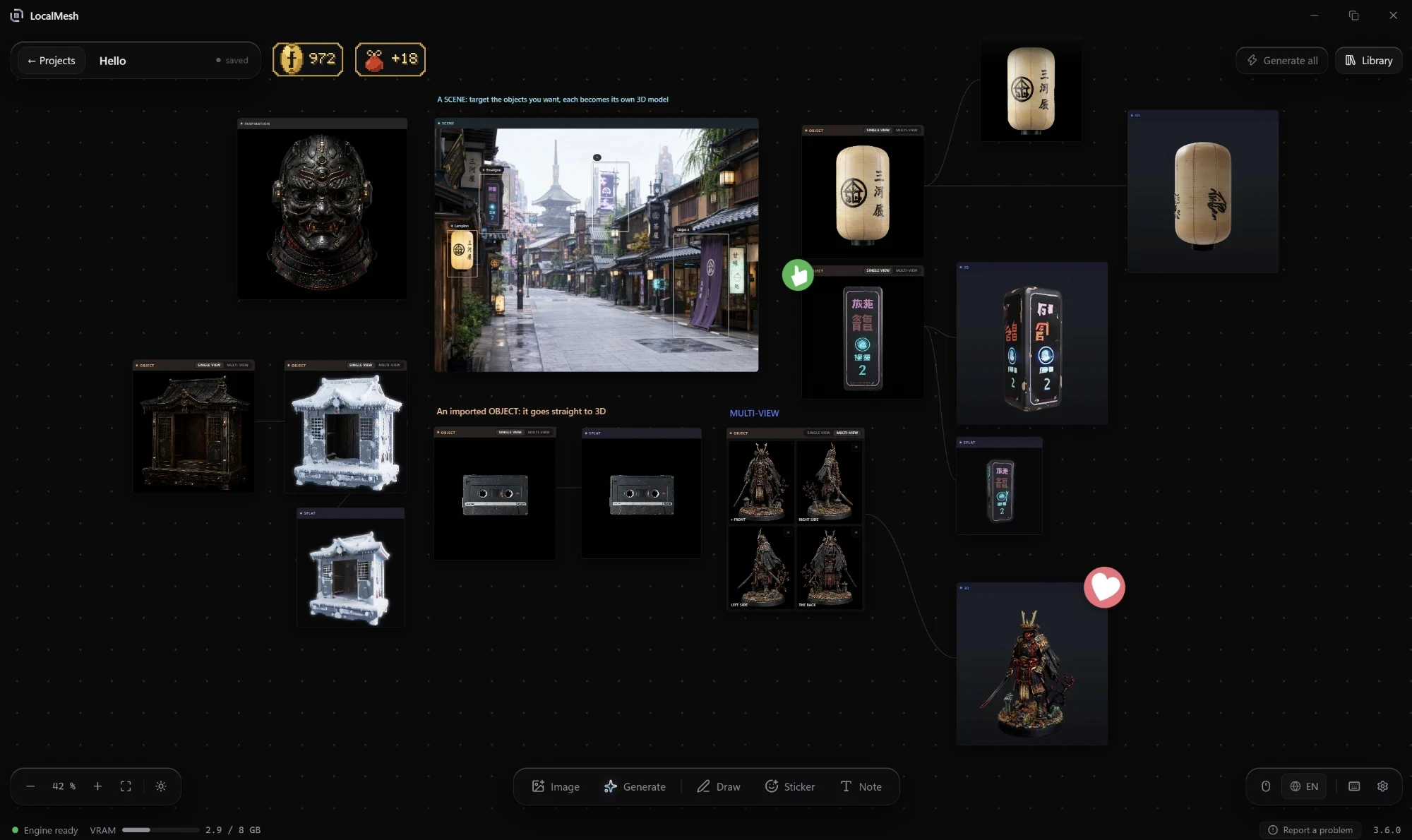
The front of the pipeline is a local image studio running FLUX.2 Klein. The studio isolates the framed object from a reference, straightens the perspective to a three quarter view on black, and generates an image from a text prompt when no photograph exists. A wand added in 1.0.44 applies weather, time of day and wear presets as a linked variant beside the original. It benchmarks 20 seconds an image on a laptop RTX 4060, the smallest card LocalMesh runs on, though obviously mileage will vary. The studio model unloads after eight minutes idle, hands its VRAM back to the conversion engine, and wakes in about five seconds.

Meshes export as OBJ and GLB with quad topology and five separate maps for color, normals, roughness, metallic and occlusion, and splats export as PLY for Postshot, SuperSplat or Blender.

The trial for LocalMesh is now 14 days, extended retroactively for anyone mid trial, and the license remains $39 one time for one machine with a year of updates. It is available now from the LocalMesh website.

Featured

Recents

Platforms

Arcturus Vision Converts Steam Frame Captures to 3DGS

Arcturus Vision ships an official script turning Steam Frame camera recordings into a 3DGS scene.sog, using COLMAP and LichtFeld Studio on a Linux workstation.

Michael Rubloff

Sep 16, 2026

Platforms

Arcturus Vision Converts Steam Frame Captures to 3DGS

Arcturus Vision ships an official script turning Steam Frame camera recordings into a 3DGS scene.sog, using COLMAP and LichtFeld Studio on a Linux workstation.

Michael Rubloff

Platforms

Esri Adds Gaussian Splat Layers to the ArcGIS Maps SDK for Unity 2.4.0

ArcGIS Maps SDK for Unity 2.4.0 adds a georeferenced Gaussian splat layer that reads 3D Tiles, and ships with no identify, no filtering, and no mesh collider.

Michael Rubloff

Sep 16, 2026

Platforms

Esri Adds Gaussian Splat Layers to the ArcGIS Maps SDK for Unity 2.4.0

ArcGIS Maps SDK for Unity 2.4.0 adds a georeferenced Gaussian splat layer that reads 3D Tiles, and ships with no identify, no filtering, and no mesh collider.

Michael Rubloff

Platforms

XGRIDS Unveils the Lixel L3 Scanner

XGRIDS unveiled the Lixel L3 at INTERGEO 2026, a spatial scanner producing a true-color point cloud, a mesh, and a 3DGS model from a single capture pass.

Michael Rubloff

Sep 15, 2026

Platforms

XGRIDS Unveils the Lixel L3 Scanner

XGRIDS unveiled the Lixel L3 at INTERGEO 2026, a spatial scanner producing a true-color point cloud, a mesh, and a 3DGS model from a single capture pass.

Michael Rubloff

Platforms

GeoLibre v3.0.0 Renders Gaussian Splat Tilesets Natively on a Cesium Globe

GeoLibre v3.0.0 renders Gaussian splat tilesets on a Cesium globe through KHR_gaussian_splatting, and adds native I3S scene layers and COPC point clouds.

Michael Rubloff

Sep 15, 2026

Platforms

GeoLibre v3.0.0 Renders Gaussian Splat Tilesets Natively on a Cesium Globe

GeoLibre v3.0.0 renders Gaussian splat tilesets on a Cesium globe through KHR_gaussian_splatting, and adds native I3S scene layers and COPC point clouds.

Michael Rubloff

Trending Articles
  1. TRENDING
    Loading...
  2. TRENDING
    Loading...
  3. TRENDING
    Loading...
Michael Rubloff

Written by Michael Rubloff

Michael is the Founder and Managing Editor of Radiancefields.com

More from Michael Rubloff

More from Michael Rubloff

Platforms

Arcturus Vision Converts Steam Frame Captures to 3DGS

Arcturus Vision ships an official script turning Steam Frame camera recordings into a 3DGS scene.sog, using COLMAP and LichtFeld Studio on a Linux workstation.

Michael Rubloff

Sep 16, 2026

Platforms

Arcturus Vision Converts Steam Frame Captures to 3DGS

Michael Rubloff

Sep 16, 2026

Platforms

Arcturus Vision Converts Steam Frame Captures to 3DGS

Arcturus Vision ships an official script turning Steam Frame camera recordings into a 3DGS scene.sog, using COLMAP and LichtFeld Studio on a Linux workstation.

Michael Rubloff

Sep 16, 2026

Platforms

Esri Adds Gaussian Splat Layers to the ArcGIS Maps SDK for Unity 2.4.0

ArcGIS Maps SDK for Unity 2.4.0 adds a georeferenced Gaussian splat layer that reads 3D Tiles, and ships with no identify, no filtering, and no mesh collider.

Michael Rubloff

Sep 16, 2026

Esri Unity Gaussian Splatting

Platforms

Esri Adds Gaussian Splat Layers to the ArcGIS Maps SDK for Unity 2.4.0

Michael Rubloff

Sep 16, 2026

Esri Unity Gaussian Splatting

Platforms

Esri Adds Gaussian Splat Layers to the ArcGIS Maps SDK for Unity 2.4.0

ArcGIS Maps SDK for Unity 2.4.0 adds a georeferenced Gaussian splat layer that reads 3D Tiles, and ships with no identify, no filtering, and no mesh collider.

Michael Rubloff

Sep 16, 2026

Esri Unity Gaussian Splatting

Platforms

LocalMesh 2.0 Generates Its Mesh From the Photograph

LocalMesh 2.0 generates its mesh straight from the photo with TRELLIS.2, makes the TripoSplat Gaussian splat a deliverable and adds a FLUX.2 Klein image studio.

Michael Rubloff

Sep 16, 2026

LocalMesh

Platforms

LocalMesh 2.0 Generates Its Mesh From the Photograph

Michael Rubloff

Sep 16, 2026

LocalMesh

Platforms

LocalMesh 2.0 Generates Its Mesh From the Photograph

LocalMesh 2.0 generates its mesh straight from the photo with TRELLIS.2, makes the TripoSplat Gaussian splat a deliverable and adds a FLUX.2 Klein image studio.

Michael Rubloff

Sep 16, 2026

LocalMesh