

NVIDIA Formally Releases NCore

A complete picture of NCore V4 from NVIDIA has been released.

A complete picture of NCore V4 from NVIDIA has been released.

Michael Rubloff

Michael Rubloff

Michael is the Founder and Managing Editor of Radiancefields.com

Tags

NVIDIA

When we covered NVIDIA 3DGRUT’s NCore v4 dataset support in March, NCore appeared as a format, a standardized way to describe multi sensor capture data that NVIDIA’s reconstruction pipelines could consume. NVIDIA’s Spatial Intelligence Lab has open sourced NCore itself, releasing the platform that defines the format, the associated tooling, and the SDK that ties it together.

NCore is NVIDIA’s answer to a persistent problem in real world 3D reconstruction of sensors not agreeing with one another. A typical capture rig for autonomous vehicle research or outdoor scene reconstruction combines lidar, multiple cameras in pinhole, fisheye, and equirectangular configurations, GNSS and IMU positioning data, and sometimes radar. Each sensor has its own calibration, coordinate system, and data format. Getting that heterogeneous data into a reconstruction pipeline requires significant per project engineering. NCore standardizes the interface so that pipelines like NuRec, which reconstructs radiance fields from multi-sensor inputs, don’t have to reinvent that glue layer for every dataset.
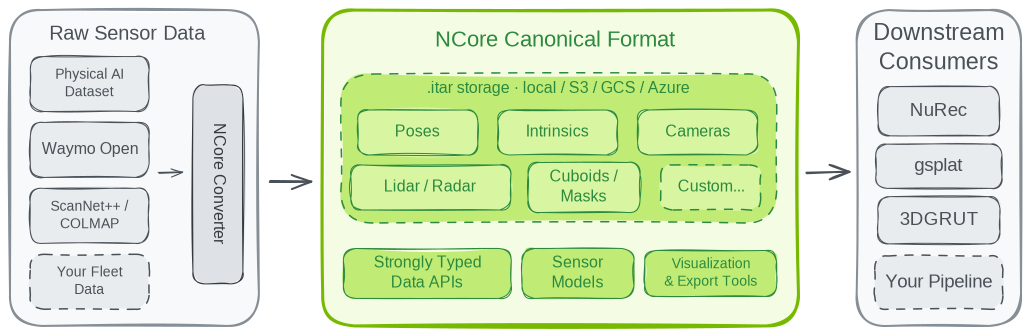
The open source release includes the NCore data model (the format specification itself), a C++ SDK for reading and writing NCore datasets, Python bindings, and a set of tools for sensor intrinsic and extrinsic calibration. The calibration tooling handles the geometric relationships between sensors and each sensor’s internal parameters in a unified way.

NuRec, which powers the AlpaSim reconstruction pipeline NVIDIA showcased at GTC, uses NCore as its native data format. Open sourcing NCore means that researchers and teams building their own Gaussian splat reconstruction pipelines can now feed NuRec, or other NVIDIA tools, without needing proprietary capture hardware or first party dataset formats. The format is generic enough to accommodate a wide range of capture setups. The NVIDIA implementation details are in the SDK.

Large scale outdoor reconstruction requires exactly the kind of multi sensor fusion NCore enables. Single camera capture works well for rooms and objects. For anything at street scale, LiDAR depth and multi camera coverage become load bearing, and the tooling to fuse those sources has been the bottleneck.

NVIDIA’s move to open source NCore is consistent with a recent pattern visible across their spatial AI work to release the infrastructure layer openly. NCore being open means the community can build interoperable capture pipelines. The repository is available on GitHub under the NVIDIA organization, but can also be found in gsplat and 3DGRUT.

Thumbnail for Gaussian Splatting News episode 14

18:23

Watch · New every Monday

Open Source 4D Gaussian Splatting

Episode 14 · Nov 23, 2026

Open4DGS is out: an open-source pipeline for 4D Gaussian splatting from Arizona State University’s Narrative and Emerging Media program, with Contrast Media Labs writing the code.

Thumbnail for Gaussian Splatting News episode 14

18:23

Watch · New every Monday

Open Source 4D Gaussian Splatting

Episode 14 · Nov 23, 2026

Featured

Recents

Platforms

KIRI Engine 4.4 Brings 360 Video to 3DGS Scan

KIRI Engine 4.4 adds 360 video input to 3DGS Scan on the web and raises the scan limit to 500 photos or 5 minutes of video, alongside Manual Capture video.

Michael Rubloff

Nov 26, 2026

Platforms

KIRI Engine 4.4 Brings 360 Video to 3DGS Scan

KIRI Engine 4.4 adds 360 video input to 3DGS Scan on the web and raises the scan limit to 500 photos or 5 minutes of video, alongside Manual Capture video.

Michael Rubloff

Platforms

NVIDIA NCore 20.0.0 Adds Asynchronous Reads and zarr v3

NVIDIA NCore 20.0.0 adds zarr-python 3 support, zarr format v3 stores and asynchronous reading APIs, with faster reads of local and remote .itar archives.

Michael Rubloff

Nov 26, 2026

Platforms

NVIDIA NCore 20.0.0 Adds Asynchronous Reads and zarr v3

NVIDIA NCore 20.0.0 adds zarr-python 3 support, zarr format v3 stores and asynchronous reading APIs, with faster reads of local and remote .itar archives.

Michael Rubloff

Platforms

MicroPasts Releases a Splat Viewer for Cultural Heritage

MicroPasts splat-viewer 0.1.2 is a React viewer for 3D Gaussian splats built on Three.js and SparkJS, with a paradata record, a scale bar and splat telemetry.

Michael Rubloff

Nov 26, 2026

Platforms

MicroPasts Releases a Splat Viewer for Cultural Heritage

MicroPasts splat-viewer 0.1.2 is a React viewer for 3D Gaussian splats built on Three.js and SparkJS, with a paradata record, a scale bar and splat telemetry.

Michael Rubloff

Research

HiGS Splits the Splat Tile Three Ways to Render Faster

NVIDIA's HiGS renders Mip-NeRF 360 scenes 2.2x faster than SHARP-GS at 1080p and trains 2.3x to 3.0x faster than Faster-GS across three benchmark datasets.

Michael Rubloff

Nov 26, 2026

Research

HiGS Splits the Splat Tile Three Ways to Render Faster

NVIDIA's HiGS renders Mip-NeRF 360 scenes 2.2x faster than SHARP-GS at 1080p and trains 2.3x to 3.0x faster than Faster-GS across three benchmark datasets.

Michael Rubloff

Thumbnail for Gaussian Splatting News episode 14

18:23

Watch · New every Monday

Open Source 4D Gaussian Splatting

Episode 14 · Nov 23, 2026

Michael Rubloff

Written by Michael Rubloff

Michael is the Founder and Managing Editor of Radiancefields.com

More from Michael Rubloff

More from Michael Rubloff

Platforms

KIRI Engine 4.4 Brings 360 Video to 3DGS Scan

KIRI Engine 4.4 adds 360 video input to 3DGS Scan on the web and raises the scan limit to 500 photos or 5 minutes of video, alongside Manual Capture video.

Michael Rubloff

Nov 26, 2026

A phone in landscape showing a Gaussian splat street scene with palm trees generated from 360 video in KIRI Engine

Platforms

KIRI Engine 4.4 Brings 360 Video to 3DGS Scan

Michael Rubloff

Nov 26, 2026

A phone in landscape showing a Gaussian splat street scene with palm trees generated from 360 video in KIRI Engine

Platforms

KIRI Engine 4.4 Brings 360 Video to 3DGS Scan

KIRI Engine 4.4 adds 360 video input to 3DGS Scan on the web and raises the scan limit to 500 photos or 5 minutes of video, alongside Manual Capture video.

Michael Rubloff

Nov 26, 2026

A phone in landscape showing a Gaussian splat street scene with palm trees generated from 360 video in KIRI Engine

Platforms

NVIDIA NCore 20.0.0 Adds Asynchronous Reads and zarr v3

NVIDIA NCore 20.0.0 adds zarr-python 3 support, zarr format v3 stores and asynchronous reading APIs, with faster reads of local and remote .itar archives.

Michael Rubloff

Nov 26, 2026

NCore point-to-camera projection of lidar points onto a camera image from NVIDIA Hyperion data

Platforms

NVIDIA NCore 20.0.0 Adds Asynchronous Reads and zarr v3

Michael Rubloff

Nov 26, 2026

NCore point-to-camera projection of lidar points onto a camera image from NVIDIA Hyperion data

Platforms

NVIDIA NCore 20.0.0 Adds Asynchronous Reads and zarr v3

NVIDIA NCore 20.0.0 adds zarr-python 3 support, zarr format v3 stores and asynchronous reading APIs, with faster reads of local and remote .itar archives.

Michael Rubloff

Nov 26, 2026

NCore point-to-camera projection of lidar points onto a camera image from NVIDIA Hyperion data

Platforms

MicroPasts Releases a Splat Viewer for Cultural Heritage

MicroPasts splat-viewer 0.1.2 is a React viewer for 3D Gaussian splats built on Three.js and SparkJS, with a paradata record, a scale bar and splat telemetry.

Michael Rubloff

Nov 26, 2026

MicroPasts

Platforms

MicroPasts Releases a Splat Viewer for Cultural Heritage

Michael Rubloff

Nov 26, 2026

MicroPasts

Platforms

MicroPasts Releases a Splat Viewer for Cultural Heritage

MicroPasts splat-viewer 0.1.2 is a React viewer for 3D Gaussian splats built on Three.js and SparkJS, with a paradata record, a scale bar and splat telemetry.

Michael Rubloff

Nov 26, 2026

MicroPasts

New to Gaussian Splatting? Start here

Radiance fields, explained from the ground up: what a Gaussian splat is, how to capture one, and which tools and gear to start with.

Newsletter

Keep up with the field.

New research, tools and captures from the Radiance Fields newsroom, in your inbox. Free, no spam.

Gaussian Splatting News on YouTube

The week in radiance fields, every Monday.

Gaussian Splatting News on YouTube

The week in radiance fields, every Monday.

Gaussian Splatting News on YouTube

The week in radiance fields, every Monday.

Gaussian Splatting News on YouTube

The week in radiance fields, every Monday.