
Splatshop: Photoshop for 3DGS

Michael Rubloff

Michael Rubloff

Tags

Email
Copy Link
Twitter
Linkedin
Reddit
Whatsapp
Splatshop

A new open-source tool has quietly dropped on GitHub that could become essential for anyone working with Gaussian Splatting: Splatshop. Created by a team of researchers and developers with roots in Radiance Field rendering, Splatshop is an early but ambitious step toward editable, modular, and artist-friendly Gaussian Splat workflows.

Splatshop is a desktop and VR editor for Gaussian Splat models, built with performance and flexibility in mind. Splatshop lets users load large-scale Gaussian Splat models and perform a range of editing operations: selecting splats via brush or shape-based tools, deleting outliers or floaters, duplicating and translating selections, rotating and scaling assets, and organizing models into named layers. It supports both desktop workflows and VR editing. Currently Windows only for VR, with performance optimized for up to a hundred million splats on desktop and around ten million in VR on high-end GPUs like the RTX 4090.
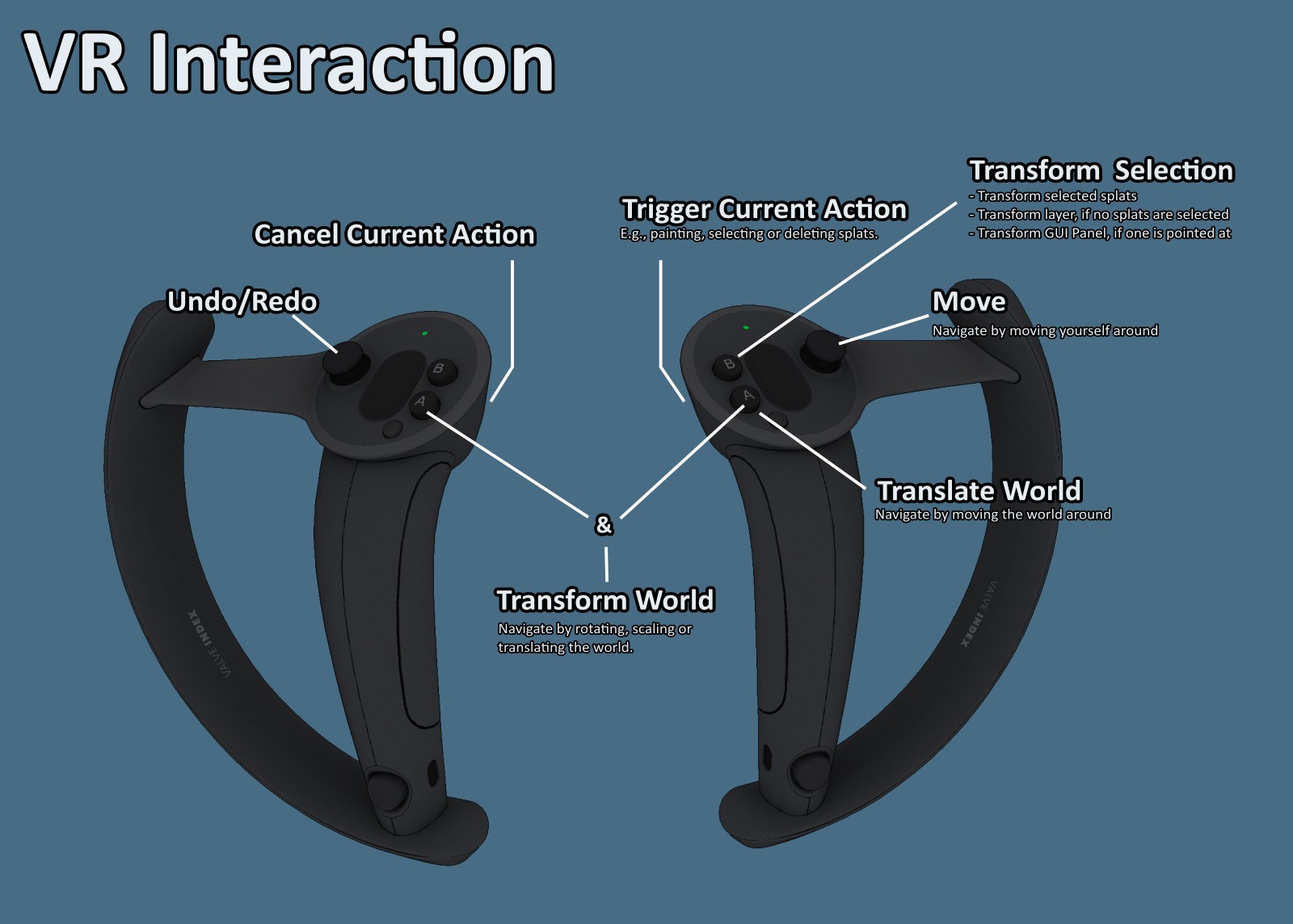
The tool includes built-in painting functionality and features like perspective correct Gaussian rendering, provided the splat models were trained with the appropriate methods. There’s also native CUDA integration, allowing users to hot reload CUDA code much like shaders. Notably, Splatshop does not depend on Python, pip, or conda, making it refreshingly straightforward for developers accustomed to C++ and CUDA-based workflows.

As you might expect from an academic prototype, there are limitations. Undo and redo functionality is implemented, but not yet exhaustive. Transform operations like scaling can suffer from lossy precision, especially when models are scaled down too far. Startup times can be a bit long, since CUDA code compiles on launch, and Linux users may run into additional setup requirements such as ensuring compatibility with specific versions of GCC, CUDA, and TBB.

Despite these early caveats, the development team has released Splatshop now in order to gather feedback and prioritize future features and fixes.

The workflow, while currently relying on hardcoded shortcuts and CMake-based builds, is impressively usable. Users can drag and drop .ply files into the interface, perform local edits, clean up noise using selection tools, and organize parts of their scenes into reusable assets. One example use case: selecting a patch of reconstructed grass, duplicating it, and layering it into another part of the scene to patch a hole or missing region. Layered editing, combined with real-time feedback, makes this kind of scene repair more accessible than ever for Gaussian Splatting pipelines.

There’s also support for creating asset libraries. Once a layer is defined, it can be named and converted into a reusable asset, forming the basis for more complex scene compositions. For developers interested in extending the editor, Splatshop provides hooks for adding custom toolbar actions, interface widgets, and ImGui-based settings panels, encouraging further experimentation and feature development.

Splatshop draws inspiration from other open-source efforts, including SuperSplat and the WebGL renderer from Mark Kellogg, while incorporating key tools like GPUSorting for efficient splat management.

For those eager to try it, the GitHub repository offers a sample dataset and precompiled Windows binary, with the caveat that CUDA 12.4 or later is required. A visual studio build setup is provided for Windows users, while Linux users will need to follow a slightly more manual process involving setting environment variables and dependencies.

Even in this early stage, Splatshop stands out. It fills a critical gap in the radiance field landscape: the need for editable, artist-friendly tooling. As real-time radiance fields continue to grow in popularity, tools like this one will become increasingly important.

You can find the full source code, example models, and installation instructions on GitHub.

Featured

Recents

NouerA's ".exe" Uses 4D Gaussian Splatting — With 21 Cameras in Seoul

I speak to Evercoast CEO, Ben Nunez, about the production.

Michael Rubloff

Aug 10, 2026

NouerA's ".exe" Uses 4D Gaussian Splatting — With 21 Cameras in Seoul

I speak to Evercoast CEO, Ben Nunez, about the production.

Michael Rubloff

Captures Studio Releases Multi Splat for Aligning, Comparing and Viewing 3DGS

Captures Studio's Multi Splat aligns Gaussian splat captures on control points, compares them across a draggable seam, and renders the set as a 4D timelapse.

Michael Rubloff

Aug 10, 2026

Captures Studio Releases Multi Splat for Aligning, Comparing and Viewing 3DGS

Captures Studio's Multi Splat aligns Gaussian splat captures on control points, compares them across a draggable seam, and renders the set as a 4D timelapse.

Michael Rubloff

Esri Adds Georeferenced Gaussian Splat Layers to the ArcGIS Maps SDK for Unreal Engine at 2.4

Esri ArcGIS Maps SDK for Unreal Engine 2.4.0 adds a georeferenced Gaussian splat layer type with C++ and Blueprint APIs, on desktop only, with opacity locked.

Michael Rubloff

Aug 10, 2026

Esri Adds Georeferenced Gaussian Splat Layers to the ArcGIS Maps SDK for Unreal Engine at 2.4

Esri ArcGIS Maps SDK for Unreal Engine 2.4.0 adds a georeferenced Gaussian splat layer type with C++ and Blueprint APIs, on desktop only, with opacity locked.

Michael Rubloff

Lightcraft Opens the Spark Story Beta, Putting Gaussian Splat Scans at the Center of Browser Previs

Lightcraft Spark Story enters rolling beta, building browser previs around Gaussian splat scans of locations, with real-time iOS compositing at $29.95 a month.

Michael Rubloff

Aug 10, 2026

Lightcraft Opens the Spark Story Beta, Putting Gaussian Splat Scans at the Center of Browser Previs

Lightcraft Spark Story enters rolling beta, building browser previs around Gaussian splat scans of locations, with real-time iOS compositing at $29.95 a month.

Michael Rubloff

Trending Articles
  1. TRENDING
    Loading...
  2. TRENDING
    Loading...
  3. TRENDING
    Loading...
Michael Rubloff

Written by Michael Rubloff

Michael is the Founder and Managing Editor of Radiancefields.com

Email
Copy Link
Twitter
Linkedin
Reddit
Whatsapp

More from Michael Rubloff

More from Michael Rubloff

NouerA's ".exe" Uses 4D Gaussian Splatting — With 21 Cameras in Seoul

I speak to Evercoast CEO, Ben Nunez, about the production.

Michael Rubloff

Aug 10, 2026

Nouera .exe gaussian splatting

NouerA's ".exe" Uses 4D Gaussian Splatting — With 21 Cameras in Seoul

Michael Rubloff

Aug 10, 2026

Nouera .exe gaussian splatting

NouerA's ".exe" Uses 4D Gaussian Splatting — With 21 Cameras in Seoul

I speak to Evercoast CEO, Ben Nunez, about the production.

Michael Rubloff

Aug 10, 2026

Nouera .exe gaussian splatting

Captures Studio Releases Multi Splat for Aligning, Comparing and Viewing 3DGS

Captures Studio's Multi Splat aligns Gaussian splat captures on control points, compares them across a draggable seam, and renders the set as a 4D timelapse.

Michael Rubloff

Aug 10, 2026

Captures Studio

Captures Studio Releases Multi Splat for Aligning, Comparing and Viewing 3DGS

Michael Rubloff

Aug 10, 2026

Captures Studio

Captures Studio Releases Multi Splat for Aligning, Comparing and Viewing 3DGS

Captures Studio's Multi Splat aligns Gaussian splat captures on control points, compares them across a draggable seam, and renders the set as a 4D timelapse.

Michael Rubloff

Aug 10, 2026

Captures Studio

Esri Adds Georeferenced Gaussian Splat Layers to the ArcGIS Maps SDK for Unreal Engine at 2.4

Esri ArcGIS Maps SDK for Unreal Engine 2.4.0 adds a georeferenced Gaussian splat layer type with C++ and Blueprint APIs, on desktop only, with opacity locked.

Michael Rubloff

Aug 10, 2026

Esri

Esri Adds Georeferenced Gaussian Splat Layers to the ArcGIS Maps SDK for Unreal Engine at 2.4

Michael Rubloff

Aug 10, 2026

Esri

Esri Adds Georeferenced Gaussian Splat Layers to the ArcGIS Maps SDK for Unreal Engine at 2.4

Esri ArcGIS Maps SDK for Unreal Engine 2.4.0 adds a georeferenced Gaussian splat layer type with C++ and Blueprint APIs, on desktop only, with opacity locked.

Michael Rubloff

Aug 10, 2026

Esri