
AirVis for Gaussian Splatting Reconstruction

Michael Rubloff

Michael Rubloff

Tags

Email
Copy Link
Twitter
Linkedin
Reddit
Whatsapp
AirVis Logo

There’s a new way to experience cloud based Gaussian Splatting on your phone and it’s called AirVis. Like many cloud reconstruction platforms, it lets you capture a short video and upload it to their processing pipeline. But unlike most, AirVis also allows you to download your original video afterward, a small but welcome touch for archiving and re-use.

It’s one of the first mobile apps to combine Apple’s Object Capture pipeline and the app is approachable for anyone curious about the technology that’s been defining the next generation of 3D reconstruction.

Once your capture has been uploaded and processed, you can view it directly in their built in viewer or, if you’re using an Apple device, step inside your own scan with Apple Vision Pro.

The app runs on iOS, macOS, and visionOS, and is also free to download. Capture and processing are available at no cost, with optional in app upgrades for longer uploads and advanced exports. The free plan supports up to 80 seconds of video, while the paid version ($19.99/month) extends that to 150 seconds and enables saving captures locally. The only current limitation is that existing videos can’t be uploaded from outside the app.
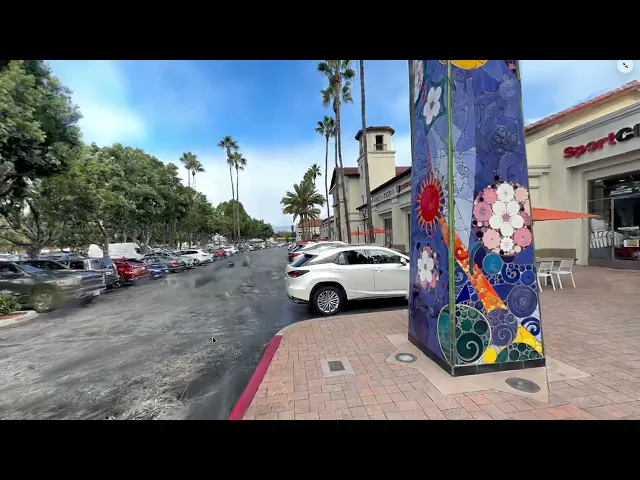
Recent updates have notably improved quality and performance, adding tile based rendering for stability on larger scenes, higher average splat counts, and skybox support for enhanced realism. macOS users can also upload existing scans for immersive viewing on Vision Pro, and all users have the option to make their files private.

You can get started with AirVis for free today on the iOS App Store or Google Play Store.

Featured

Recents

Platforms

three.js Ships Its Native Gaussian Splat Renderer and Splat Raycasting in r186

three.js r186 ships GaussianSplat, its first native Gaussian splat renderer, adding raycasting, per-mesh frustum culling and view-dependent spherical harmonics.

Michael Rubloff

Sep 9, 2026

Platforms

three.js Ships Its Native Gaussian Splat Renderer and Splat Raycasting in r186

three.js r186 ships GaussianSplat, its first native Gaussian splat renderer, adding raycasting, per-mesh frustum culling and view-dependent spherical harmonics.

Michael Rubloff

Platforms

PlayCanvas Releases SuperSplat 3.0

SuperSplat 3.0 rewrites PlayCanvas's Gaussian splat editor on WebGPU only, removing the WebGL2 path, cutting peak memory, and adding sort-free Stochastic Alpha.

Michael Rubloff

Sep 8, 2026

Platforms

PlayCanvas Releases SuperSplat 3.0

SuperSplat 3.0 rewrites PlayCanvas's Gaussian splat editor on WebGPU only, removing the WebGL2 path, cutting peak memory, and adding sort-free Stochastic Alpha.

Michael Rubloff

XGRIDS Adds WebXR Support to the LCC Web SDK in v0.6.3

XGRIDS LCC Web SDK v0.6.3 adds WebXR support to its Three.js and Cesium renderer, bringing browser-based headset viewing to LCC and LCC2 Gaussian splat scenes.

Michael Rubloff

Sep 8, 2026

XGRIDS Adds WebXR Support to the LCC Web SDK in v0.6.3

XGRIDS LCC Web SDK v0.6.3 adds WebXR support to its Three.js and Cesium renderer, bringing browser-based headset viewing to LCC and LCC2 Gaussian splat scenes.

Michael Rubloff

Splat Box Editor for Unity Now Ships Full Source Code

Simulacrum's $199 Splat Box Editor for Unity now includes full source code, with PLY and SPZ import and export, real-time relighting, shadow mapping and SSAO.

Michael Rubloff

Sep 4, 2026

Splat Box Editor for Unity Now Ships Full Source Code

Simulacrum's $199 Splat Box Editor for Unity now includes full source code, with PLY and SPZ import and export, real-time relighting, shadow mapping and SSAO.

Michael Rubloff

Trending Articles
  1. TRENDING
    Loading...
  2. TRENDING
    Loading...
  3. TRENDING
    Loading...
Michael Rubloff

Written by Michael Rubloff

Michael is the Founder and Managing Editor of Radiancefields.com

Email
Copy Link
Twitter
Linkedin
Reddit
Whatsapp

More from Michael Rubloff

More from Michael Rubloff

Platforms

three.js Ships Its Native Gaussian Splat Renderer and Splat Raycasting in r186

three.js r186 ships GaussianSplat, its first native Gaussian splat renderer, adding raycasting, per-mesh frustum culling and view-dependent spherical harmonics.

Michael Rubloff

Sep 9, 2026

three.js Gaussian Splatting

Platforms

three.js Ships Its Native Gaussian Splat Renderer and Splat Raycasting in r186

Michael Rubloff

Sep 9, 2026

three.js Gaussian Splatting

Platforms

three.js Ships Its Native Gaussian Splat Renderer and Splat Raycasting in r186

three.js r186 ships GaussianSplat, its first native Gaussian splat renderer, adding raycasting, per-mesh frustum culling and view-dependent spherical harmonics.

Michael Rubloff

Sep 9, 2026

three.js Gaussian Splatting

Platforms

PlayCanvas Releases SuperSplat 3.0

SuperSplat 3.0 rewrites PlayCanvas's Gaussian splat editor on WebGPU only, removing the WebGL2 path, cutting peak memory, and adding sort-free Stochastic Alpha.

Michael Rubloff

Sep 8, 2026

Supersplat 3.0

Platforms

PlayCanvas Releases SuperSplat 3.0

Michael Rubloff

Sep 8, 2026

Supersplat 3.0

Platforms

PlayCanvas Releases SuperSplat 3.0

SuperSplat 3.0 rewrites PlayCanvas's Gaussian splat editor on WebGPU only, removing the WebGL2 path, cutting peak memory, and adding sort-free Stochastic Alpha.

Michael Rubloff

Sep 8, 2026

Supersplat 3.0

XGRIDS Adds WebXR Support to the LCC Web SDK in v0.6.3

XGRIDS LCC Web SDK v0.6.3 adds WebXR support to its Three.js and Cesium renderer, bringing browser-based headset viewing to LCC and LCC2 Gaussian splat scenes.

Michael Rubloff

Sep 8, 2026

XGRIDS

XGRIDS Adds WebXR Support to the LCC Web SDK in v0.6.3

Michael Rubloff

Sep 8, 2026

XGRIDS

XGRIDS Adds WebXR Support to the LCC Web SDK in v0.6.3

XGRIDS LCC Web SDK v0.6.3 adds WebXR support to its Three.js and Cesium renderer, bringing browser-based headset viewing to LCC and LCC2 Gaussian splat scenes.

Michael Rubloff

Sep 8, 2026

XGRIDS