Beginning with Hyperscape Capture, interest in capturing directly with a headset has exploded. In that context, Splatara has been steadily building one of the most accessible capture pipelines in the Quest ecosystem. Users can capture directly on the headset and decide later whether they want to process locally, inside Splatara’s own viewer, or export the raw data into an entirely different reconstruction stack. With its latest major viewer update, Splatara now takes a meaningful step from “capture utility” toward a more complete end to end workflow.
The newest release is focused almost entirely on the SplataraScan Viewer. The interface has been fully redesigned. The updated layout makes it easier to move between scans, preview results, and adjust refinement settings without feeling like you’re navigating a debug tool.
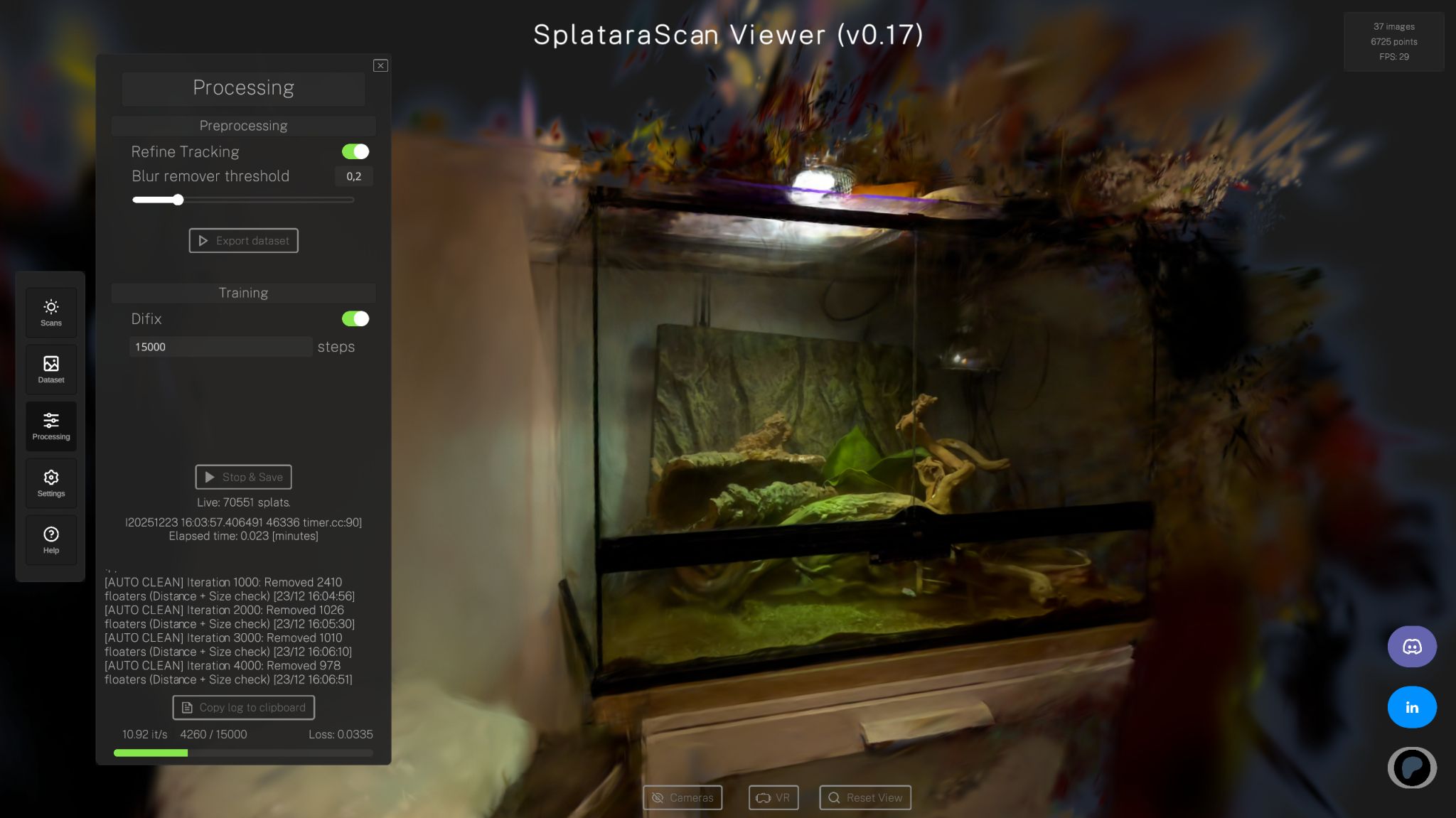
More consequential, however, is the addition of in app Gaussian splatting training. Splatara now allows users to train splats directly inside the application using FastGS and Difix3D+. This is a wild combination, pairing fast training times with the diffusion aided reconstruction you get from Difix. As far as I’m aware, this is the only platform that has integrated Difix into a training loop at all, let alone one that’s being driven from Quest captured data.
That iteration loop is further tightened by the new quick preview system. Scans can now be inspected directly from the list view, reducing the friction of opening half finished captures just to check coverage or alignment. The viewer also introduces improved point cloud mixing between refined and raw data, producing noticeably cleaner outputs with fewer artifacts. On top of that, you can step inside the reconstruction while training is still in progress, making it much easier to spot scale issues, alignment drift, or coverage gaps that are easy to miss on a flat monitor. For a capture workflow that starts in VR, closing the loop back into VR feels like the obvious choice.
These viewer upgrades land on top of an already aggressive cadence of capture side improvements. Recent Quest updates introduced IMU driven smart capture to ensure meaningful overlap, live statistics during scanning, adjustable capture rates, and a new .rawscan format designed for faster saving and cleaner downstream handling. Earlier foundational work rewrote the capture logic entirely, bringing sub millimeter precision through hardware clock synchronization, adaptive exposure control, spline based motion modeling, and motion blur rejection tuned specifically for Quest 3 sensors.
As the Quest continues to prove itself as a surprisingly capable capture device, it’s easy to imagine more people gravitating toward Splatara as their entry point into headset-based scanning. You can learn more about the project directly from Splatara’s site.