Artec 3D Launches Artec Twins, Its First Software to Generate and Render Gaussian Splats

Artec Twins is the first Artec 3D software to generate and render Gaussian splats, built from Artec Jet LiDAR or photos alongside point clouds and meshes.

Artec Twins is the first Artec 3D software to generate and render Gaussian splats, built from Artec Jet LiDAR or photos alongside point clouds and meshes.

Michael Rubloff

Michael Rubloff

Michael is the Founder and Managing Editor of Radiancefields.com

Artec

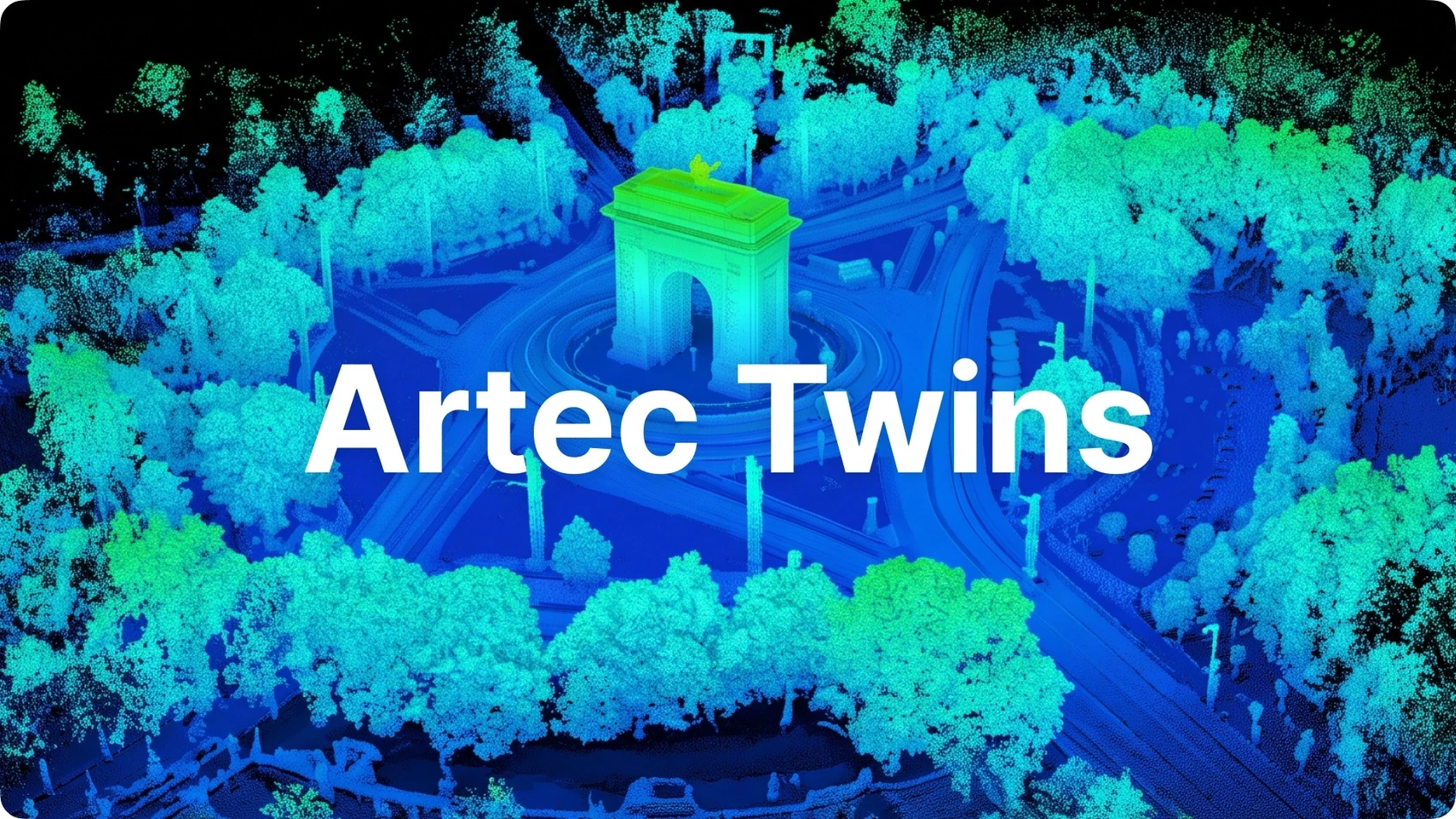
Artec 3D has released Artec Twins, large scale digital twin software that is the first Artec application to generate and render gaussian splats.

Artec Studio remains the company's software for professional 3D scanning. Artec Twins was initially conceived for Artec Jet, the mobile SLAM LiDAR scanner Artec launched in April, and builds on Artec Studio algorithms while adding gaussian splatting, analysis tools and handling for very large datasets. Among other survey vendors, CHCNAV's CoMeta generates splats from the same aerial triangulation as its orthomosaic, DSM and mesh, and SHARE3DCAM lists gaussian splatting among the deliverables of its C10 backpack scanners.

Artec Twins generates splats inside the application from either Artec Jet LiDAR data or photos and video, with no external software involved. Point clouds, meshes and splats sit in a single project and can be switched on demand, which Artec frames as measurement and presentation drawn from the same data. Splats import and export as PLY, alongside E57, LAS, LAZ, PTX, BTX, XYZ and RCP for point clouds and OBJ, PLY, STL, USD and USDZ among the mesh formats.

Artec Twins fuses data from any Artec scanner with smartphone, drone and satellite sources. Artec pairs satellite or Jet data for wide context with the static Ray II for structural detail and the handheld Leo for submillimeter accuracy, and scans from other manufacturers import if they use standard formats. Analysis covers distance maps against point cloud, mesh or CAD references, cross sections, volumes, primitive fitting, ground control points and as built comparison against design files.

Artec says Artec Twins renders point clouds of billions of points at up to 200 frames per second without decimation, and keeps environments of 100 square kilometers or more interactive. Artec publishes no equivalent figure for splats.

All processing runs on the local machine. The product page lists an Intel Core i7 class CPU with an RTX 4060 8 GB as the minimum and an RTX 4090 24 GB as recommended, and notes that splat generation can be more demanding.

Artec lists Artec Twins at US $6,840 a year by subscription or US $17,100 for a lifetime license, and both include splat creation from photos or point clouds.

Artec Twins is available now from Artec and its resellers.
Featured

Recents

Platforms

ComfyUI-InfiniSplat Brings the InfiniSplat Single-Image Gaussian Splatting Model to ComfyUI

ComfyUI-InfiniSplat 0.1.3 brings the InfiniSplat single-image Gaussian splatting model to ComfyUI, with native Preview Splat output and Gaussian PLY export.

Michael Rubloff

Oct 12, 2026

Platforms

ComfyUI-InfiniSplat Brings the InfiniSplat Single-Image Gaussian Splatting Model to ComfyUI

ComfyUI-InfiniSplat 0.1.3 brings the InfiniSplat single-image Gaussian splatting model to ComfyUI, with native Preview Splat output and Gaussian PLY export.

Michael Rubloff

Platforms

CHCNAV Releases CoViewer, a Free Desktop Viewer for Gaussian Splats

CHCNAV CoViewer is a free Windows desktop 3DGS viewer that opens PLY, 3D Tiles, and HSC models, with elevation clipping and offline access to CoCloud projects.

Michael Rubloff

Oct 10, 2026

Platforms

CHCNAV Releases CoViewer, a Free Desktop Viewer for Gaussian Splats

CHCNAV CoViewer is a free Windows desktop 3DGS viewer that opens PLY, 3D Tiles, and HSC models, with elevation clipping and offline access to CoCloud projects.

Michael Rubloff

Platforms

TACTYC Gaussian Splat v2.0 Renders and Relights Gaussian Splats in Cinema 4D With Redshift

TACTYC Gaussian Splat v2.0 renders and relights Gaussian splats in Cinema 4D with Redshift, building one textured card per splat with SH view-dependent color.

Michael Rubloff

Oct 10, 2026

Platforms

TACTYC Gaussian Splat v2.0 Renders and Relights Gaussian Splats in Cinema 4D With Redshift

TACTYC Gaussian Splat v2.0 renders and relights Gaussian splats in Cinema 4D with Redshift, building one textured card per splat with SH view-dependent color.

Michael Rubloff

Platforms

WebODM 3.3.0 Brings Gaussian Splatting to Open-Source Drone Mapping

WebODM 3.3.0 adds Gaussian splatting support, exporting COLMAP training sets for OpenSplat or Brush and tiling uploaded splats into Spark's RAD format.

Michael Rubloff

Oct 9, 2026

Platforms

WebODM 3.3.0 Brings Gaussian Splatting to Open-Source Drone Mapping

WebODM 3.3.0 adds Gaussian splatting support, exporting COLMAP training sets for OpenSplat or Brush and tiling uploaded splats into Spark's RAD format.

Michael Rubloff

Trending Articles
  1. TRENDING
    Loading...
  2. TRENDING
    Loading...
  3. TRENDING
    Loading...
Michael Rubloff

Written by Michael Rubloff

Michael is the Founder and Managing Editor of Radiancefields.com

More from Michael Rubloff

More from Michael Rubloff

Platforms

ComfyUI-InfiniSplat Brings the InfiniSplat Single-Image Gaussian Splatting Model to ComfyUI

ComfyUI-InfiniSplat 0.1.3 brings the InfiniSplat single-image Gaussian splatting model to ComfyUI, with native Preview Splat output and Gaussian PLY export.

Michael Rubloff

Oct 12, 2026

ComfyUI

Platforms

ComfyUI-InfiniSplat Brings the InfiniSplat Single-Image Gaussian Splatting Model to ComfyUI

Michael Rubloff

Oct 12, 2026

ComfyUI

Platforms

ComfyUI-InfiniSplat Brings the InfiniSplat Single-Image Gaussian Splatting Model to ComfyUI

ComfyUI-InfiniSplat 0.1.3 brings the InfiniSplat single-image Gaussian splatting model to ComfyUI, with native Preview Splat output and Gaussian PLY export.

Michael Rubloff

Oct 12, 2026

ComfyUI

Platforms

CHCNAV Releases CoViewer, a Free Desktop Viewer for Gaussian Splats

CHCNAV CoViewer is a free Windows desktop 3DGS viewer that opens PLY, 3D Tiles, and HSC models, with elevation clipping and offline access to CoCloud projects.

Michael Rubloff

Oct 10, 2026

CoViewer

Platforms

CHCNAV Releases CoViewer, a Free Desktop Viewer for Gaussian Splats

Michael Rubloff

Oct 10, 2026

CoViewer

Platforms

CHCNAV Releases CoViewer, a Free Desktop Viewer for Gaussian Splats

CHCNAV CoViewer is a free Windows desktop 3DGS viewer that opens PLY, 3D Tiles, and HSC models, with elevation clipping and offline access to CoCloud projects.

Michael Rubloff

Oct 10, 2026

CoViewer

Platforms

Artec 3D Launches Artec Twins, Its First Software to Generate and Render Gaussian Splats

Artec Twins is the first Artec 3D software to generate and render Gaussian splats, built from Artec Jet LiDAR or photos alongside point clouds and meshes.

Michael Rubloff

Oct 10, 2026

Artec

Platforms

Artec 3D Launches Artec Twins, Its First Software to Generate and Render Gaussian Splats

Michael Rubloff

Oct 10, 2026

Artec

Platforms

Artec 3D Launches Artec Twins, Its First Software to Generate and Render Gaussian Splats

Artec Twins is the first Artec 3D software to generate and render Gaussian splats, built from Artec Jet LiDAR or photos alongside point clouds and meshes.

Michael Rubloff

Oct 10, 2026

Artec

New to Gaussian Splatting? Start here

Radiance fields, explained from the ground up: what a Gaussian splat is, how to capture one, and which tools and gear to start with.

Newsletter

Keep up with the field.

New research, tools and captures from the Radiance Fields newsroom, in your inbox. Free, no spam.