
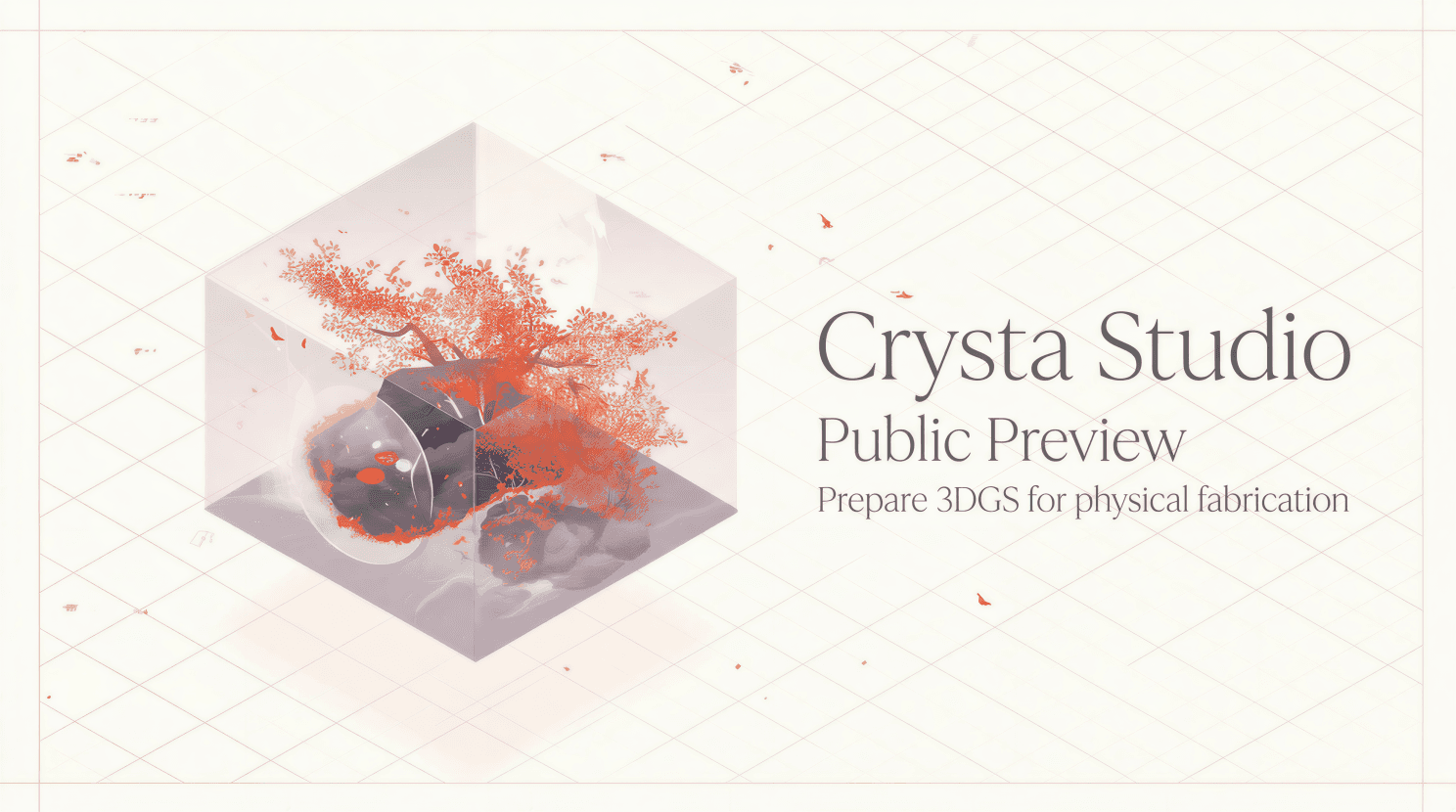
Radiance fields have dramatically expanded how the world can be captured and reconstructed in three dimensions. Techniques such as NeRF and, more recently, 3D Gaussian Splatting allow scenes to be preserved with remarkable fidelity, capturing not only geometry but also view dependent lighting and volumetric detail.
Despite these advances, nearly every radiance field today ultimately lives on a screen. Crysta AI is pushing the medium beyond that limitation. The company has announced the public preview of Crysta Studio, a browser based workspace designed to prepare 3D Gaussian Splatting scenes for physical fabrication. The platform represents an early step toward turning volumetric radiance field captures into tangible objects.
Readers of RadianceFields may recognize the company from our earlier coverage when they won Best in Show at SIGGRAPH 2025, where the team first demonstrated experimental workflows for translating radiance fields into physical prints.
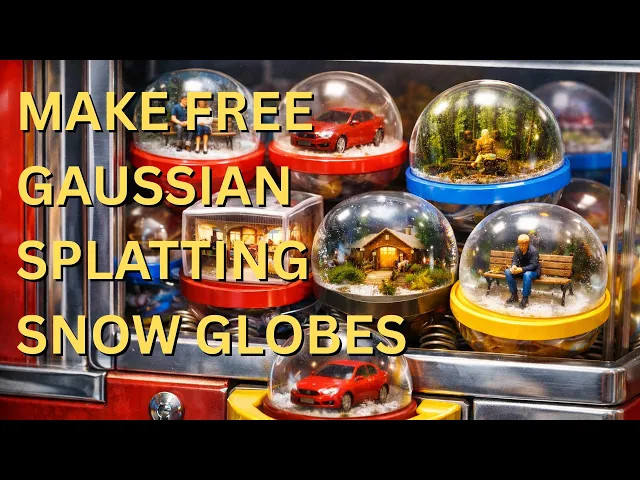
In the current public preview, users can upload .ply Gaussian splat datasets, inspect them in a browser workspace, transform and scale the scene, and place it within a chosen or imported encasement. The platform supports a transform editor based on SuperSplat to help fit the enclosure around the splat scene and allows creators to define real world dimensions before generating a fabrication estimate.
The public preview follows several months of internal experimentation by the Crysta team exploring how volumetric scenes translate into physical objects. In collaboration with artist VoxelKei, the team converted a radiance field capture of a stone shrine into a physical volumetric print. Another project recreated a procedural tornado generated in EmberGen, originally produced by JangaFX, turning the dynamic simulation into a frozen volumetric artifact.
The approach has also been tested with scientific data. Medical CT scans processed with BioxelNodes were converted into physical objects, making internal anatomical structures visible within a transparent volume. The experiments extend even to everyday captures. In one example, a radiance field scan of a co-founder’s cat was turned into a physical piece, preserving the appearance of the volumetric capture in a tangible form.
The current release does not include a checkout system, and users cannot yet order prints directly through the platform. Instead, the preview is designed to let creators explore the preparation workflow and understand the fabrication constraints involved in turning volumetric scenes into physical objects.
The company is inviting creators working with spatial media to experiment with the platform and share their use cases. To encourage participation, the team plans to select several submitted scenes and produce them as physical prints, shipping them to creators at no cost.
Crysta AI is exploring how radiance fields might exist as physical artifacts rather than purely digital media. For now, the public preview provides an early look at how 3D Gaussian Splatting scenes might transition from interactive digital representations into physical objects that can be held, displayed, and preserved.


