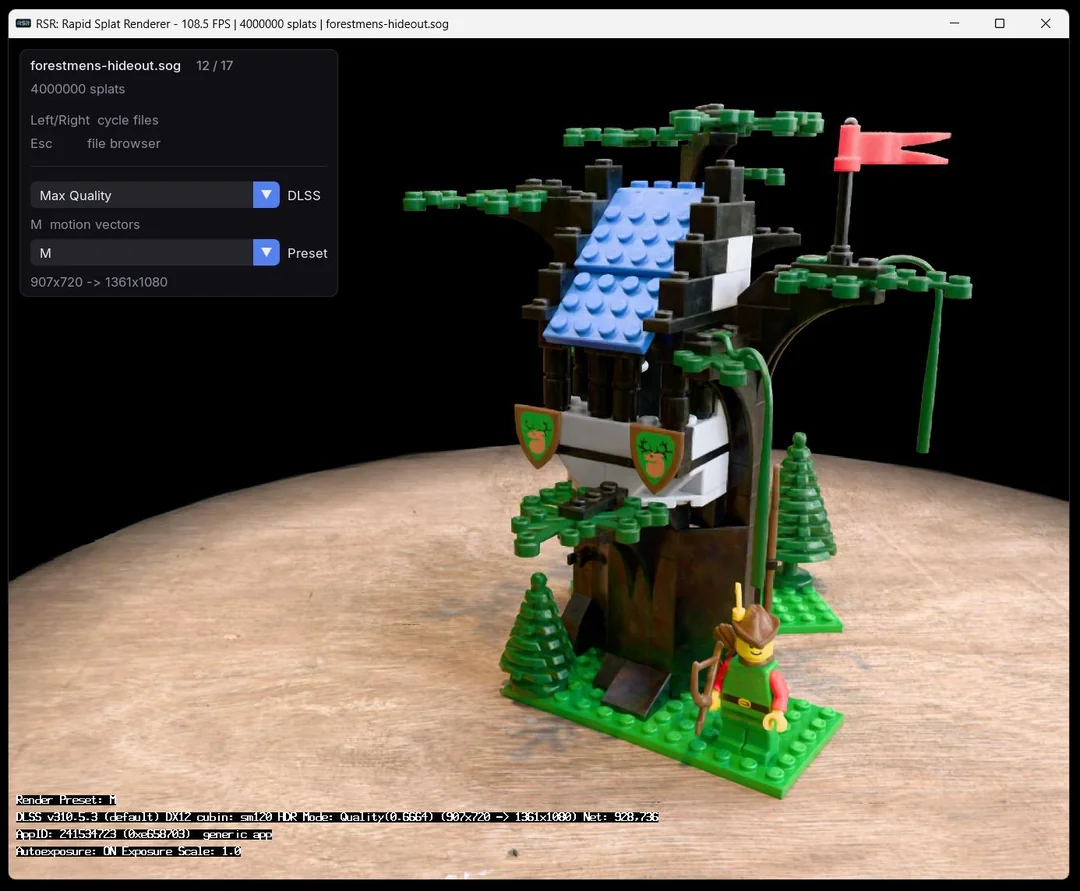
RSR 0.9.0, released by Warpgate Labs, raises end to end frame rate from approximately 80 FPS to 143 FPS on a 5.99M splat scene at 4K. Scenes with higher splat counts and denser geometry see the largest gains. The native Direct3D 12 splat viewer for Windows, also adds desktop navigation controls and a quality selector in this release.
The new fly cam uses WASD for horizontal movement and QE for vertical, with Shift tripling movement speed. Step size on desktop scales with orbit distance; in VR the same inputs mirror the thumbstick math already in use there. Left mouse button drag now handles first person look, while middle mouse button drag continues to orbit the target.
A debugging tool ships alongside. The L key freezes the cull frustum in place, letting you fly the camera freely and observe which geometry the culling pass is rejecting. Building and testing that feature exposed two correctness bugs in the culling implementation, both fixed in 0.9.0.
The controls panel is now collapsible. A chevron in the title row rolls it down to just the title, filename, and splat count, recovering screen real estate during normal viewing. A Splat Quality dropdown (Low / Medium / High) appears in both the desktop overlay and the VR companion window, defaulting to High. Lower settings trade visual fidelity for additional performance headroom on top of what the pipeline rewrite already provides.
RSR loads standard PLY files and PlayCanvas SOG compressed files, renders spherical harmonics up to order 3, and sorts splats with a GPU radix sort without CPU round trips. DLSS Super Resolution is available on NVIDIA RTX hardware. The viewer is free for personal and non-commercial use; commercial licensing is handled separately.