
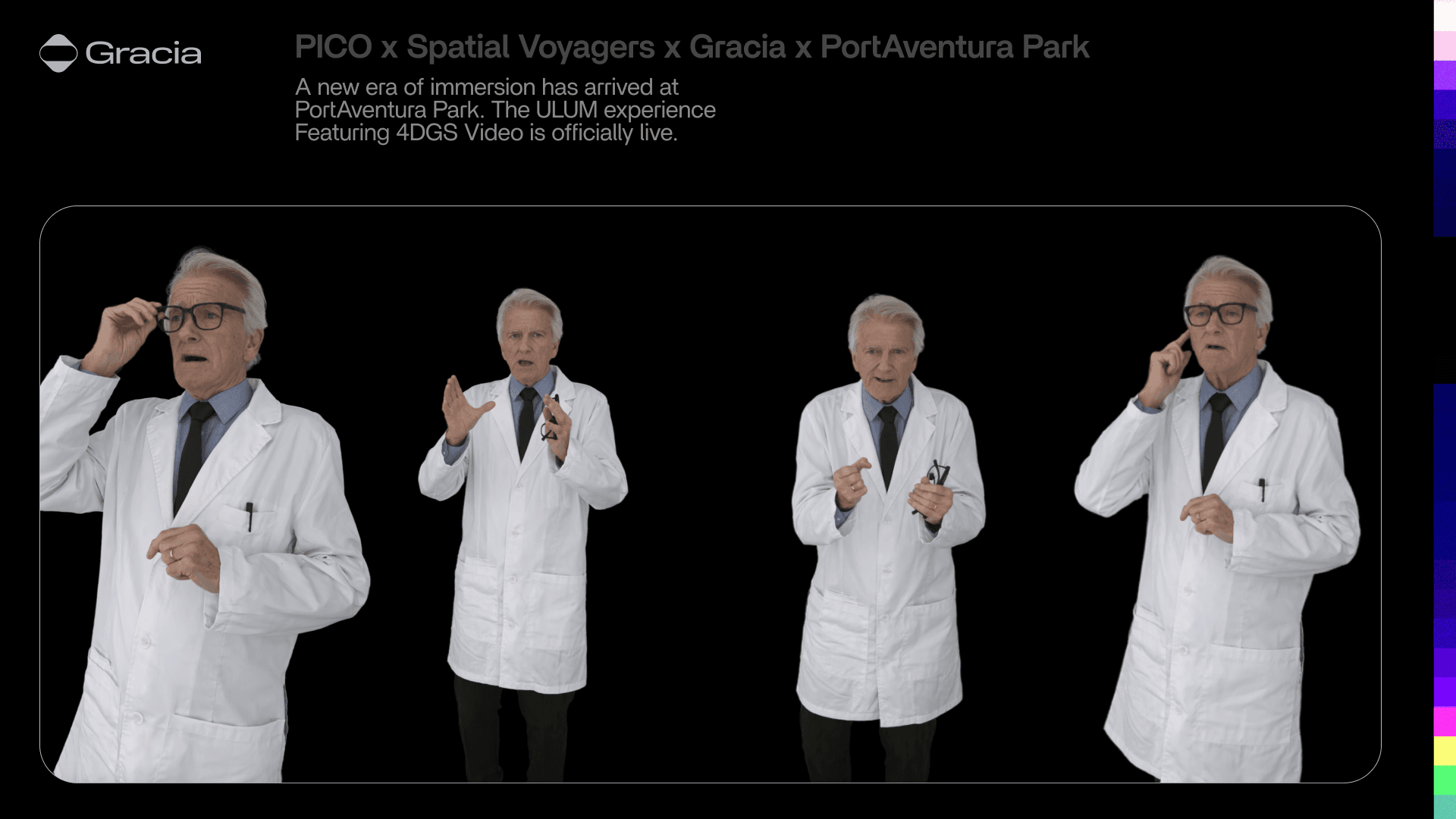
Gracia has deployed what appears to be the first real time 4D gaussian splatting digital human inside a live, public attraction. The installation, located at PortAventura Park, introduces a photorealistic volumetric character into a mixed reality experience running entirely on standalone headsets.
This is not a controlled lab environment or a pre-rendered sequence. It is a production deployment designed to run continuously throughout the day, onboarding groups of visitors and delivering consistent performance on mobile hardware.
The experience, titled Expedition ULUM: The Jurassic Awakening, begins with a volumetric “scientist” who greets visitors and introduces the narrative. Unlike traditional projections or animated characters, this figure is reconstructed from a real performance and exists as a fully three dimensional presence.
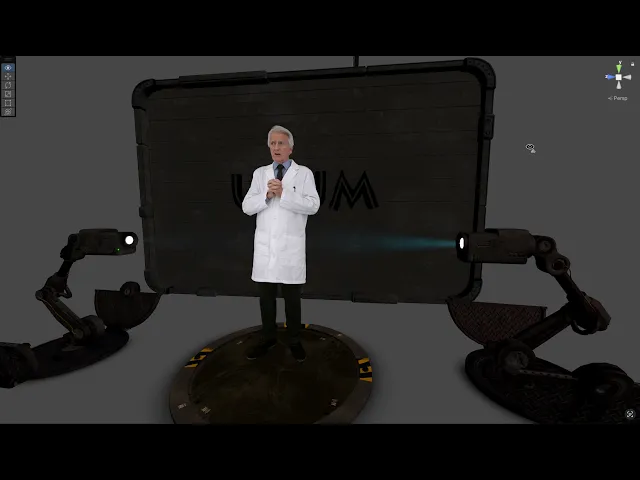
Visitors can move around the character, viewing him from any angle, with correct scale and spatial consistency. A child sees an adult-sized person towering above them. The character can even move within the shared space, reinforcing the illusion that a real human is present.
The performance itself comes from Paul Lavers, captured volumetrically and reconstructed using Gracia’s 4D Gaussian splatting pipeline. Theme parks introduce constraints that most technical demos avoid. Experiences must load quickly, operate reliably across repeated sessions, and accommodate users with no onboarding beyond a brief introduction. Any instability immediately becomes visible.
“The successful launch of this project is a great push for the development of further experience concepts. Gaussian Splatting is a strong fit for any immersive formats. Its photorealistic representation helps blur the line between real human performance and the fantasy world around it,” commented Georgii Vysotskii, CEO & Co-Founder of Gracia.
The production began with a 78 camera capture array, generating volumetric data at a scale that would traditionally be unusable for real time playback. Gracia then reconstructed the performance into a 4D gaussian splat representation and compressed it into a format suitable for deployment.
At runtime, the system decodes at roughly 850 MB per minute while maintaining near lossless quality. Without compression, volumetric video at this level can reach tens of gigabytes per minute, effectively ruling out standalone devices. Playback runs on PICO 4 Ultra Enterprise headsets, using a Vulkan-based rendering pipeline to deliver real time performance at 72 frames per second or higher.
While today the concept of having dynamic lifelike 3D reconstructions appears to many to be a fanciful science fiction dream, we are squarely in the capability today of extending video out of 2D for the remainder of our lives. The ceiling of lifelike 3D representations is truly only beginning to be understood and extended upwards.
To learn more about the experience and Gracia, please visit their website.


