
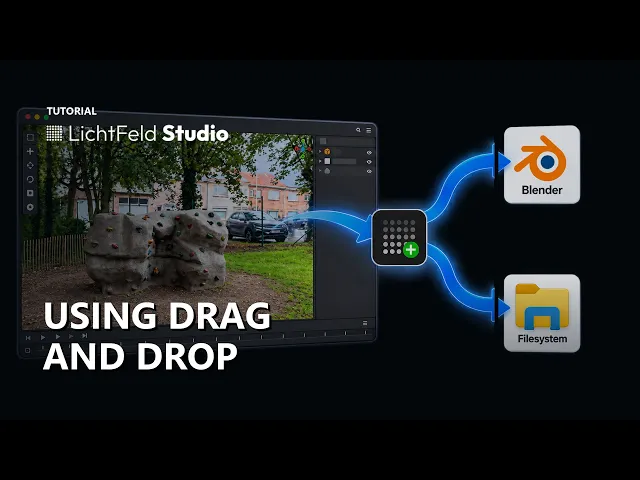
LichtFeld Studio has released v0.5.4.1, which lets splats be dragged from the Scene Graph into Blender or a folder as PLY or SPZ files.
The release arrives nine days after v0.5.4 introduced the .licht project format, and its changelog lists 391 merged pull requests across 406 commits.
Until now a gaussian splatting model in the Scene Graph could be reordered inside the application but not dragged out as a file. Dragging a group now delivers one file per splat, and a drop into Blender goes through the native splat importer in the Blender 5.3 beta, with no addon. PLY drags carry an up axis chosen in Preferences, and drops into Blender switch to its +Z up automatically on Windows and Linux X11. A model dragged out while training is paused gets its training step in the file name.
LichtFeld Studio v0.5.4.1 also trains inside a live crop box with far fewer floaters. Splats outside an active box previously learned at a damped rate, so the background could not fit its pixels and splats inside the box painted haze over it. The trainer now slows a splat only when its ray from the current camera misses the box, and moving or resizing the box takes effect on the next step. A setting labeled ROI growth inside fixes the share of new splats placed in the box, with Auto as the default, and the crop box and ellipsoid gain numeric position, rotation and scale fields.
Stored training sessions can now be resumed, including ones saved during sparsification. Training can also start from a mesh, with the init file accepting obj, fbx, gltf, glb, stl, dae, 3ds, or a ply with faces, which Mesh2Splat converts into splats when training begins. The mesh has to sit in the dataset's coordinates, as a photogrammetry mesh built from the same cameras does.
Video frame extraction adds batch processing, exact FPS that follows the source frame rate, naming presets, a configurable frame numbering base, full range color, and a software fallback for formats the GPU decoder cannot handle. A new compare command scores image sets, and masks now select the same pixels in training, evaluation and SSIM. Fixes cover RAD LOD files in 3DGUT, large group merges running out of VRAM, and SOG, SSOG and USDZ export on Linux.
Prebuilt Windows binaries come through the LichtFeld Portal, which requires registration and a donation, and the GPL-3.0 source builds on Windows and Linux. The v0.5.4.1 source and changelog are on GitHub.

