
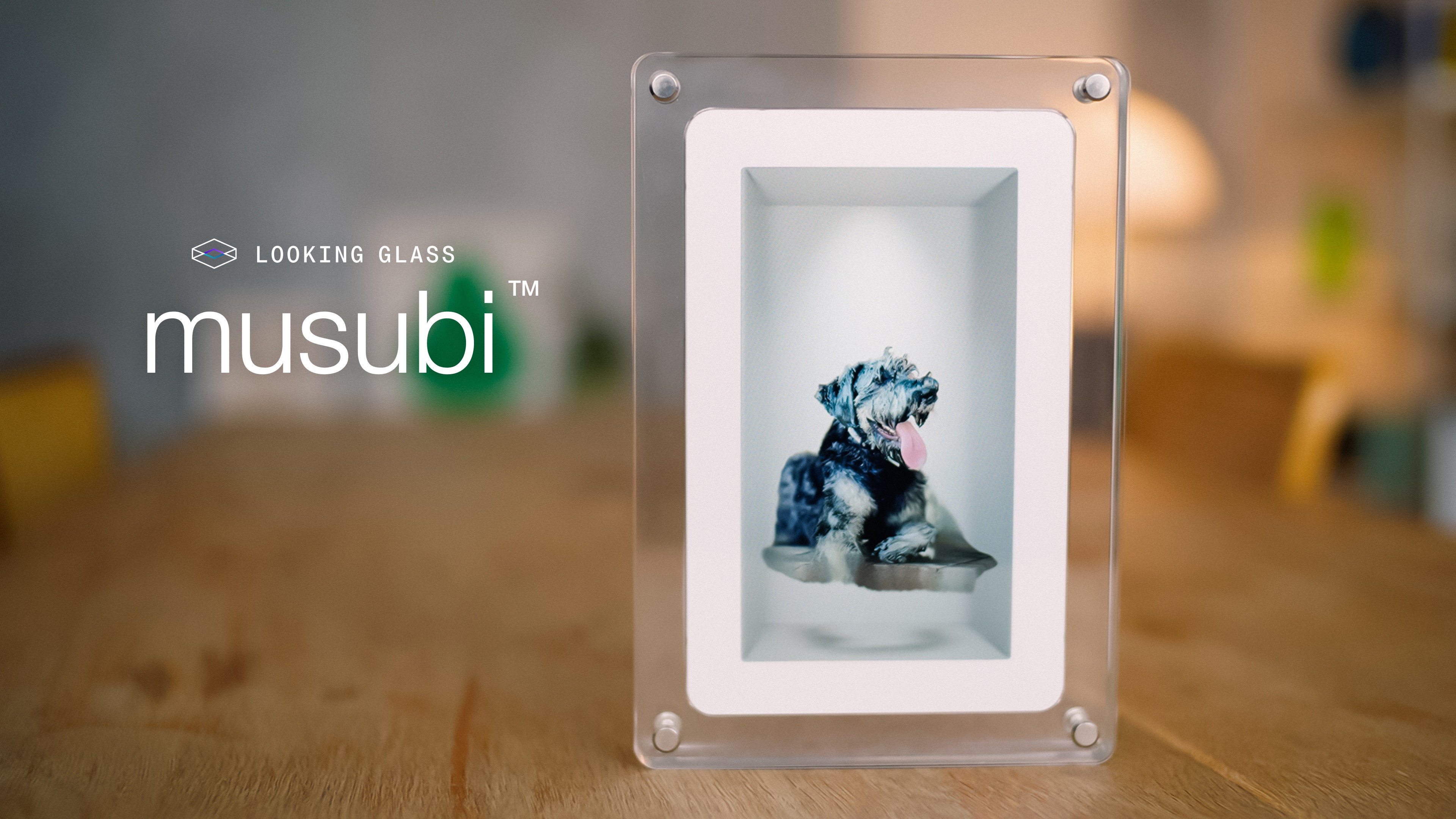
A company best known for pushing holographic displays into developer labs and enterprise installations is now extending their technology offerings in the home. Looking Glass has announced musubi, a consumer holographic photo and video frame designed to turn everyday media into spatial experiences.
Launching today on Kickstarter, the device converts standard photos and short video clips into holographic scenes that can be viewed directly on the frame’s Hololuminescent Display (HLD), with early backers able to purchase the device for $99 during the campaign’s first 24 hours.
While the headline pitch centers around converting holographic family photos, a deeper look at the platform reveals that musubi includes support for importing gaussian splats.
Most people have thousands of photos and videos stored on phones, drives, and cloud services that are rarely revisited. Looking Glass positions the device as a way to bring those moments back into the physical world, transforming them from flat images into holographic objects that appear to exist inside the frame.
Users connect the frame to a Mac or PC via USB-C, select photos or short video clips up to thirty seconds long, and run them through a desktop conversion tool provided by Looking Glass. The software uses machine learning to reconstruct a volumetric scene from the original media, producing a hologram that can then be transferred to the device. According to the company, the process takes only seconds and runs entirely locally on the user’s computer.
Once converted, the frame can store up to roughly 1,000 holograms in its internal 8GB of storage. Playback does not require Wi-Fi, cloud services, or subscriptions. The device can operate as a standalone frame powered by its internal battery or via USB-C.
The physical hardware centers around a 7-inch display capable of roughly two inches of holographic depth, allowing images to appear layered in front of and behind the display surface. A built-in speaker enables synchronized audio for holographic video clips.
The frame’s software pipeline supports importing gaussian splats, a radiance field representation that has rapidly become one of the most widely used formats for lifelike 3D capture. Looking Glass is positioning this as part of a broader creator ecosystem. musubi integrates with a set of tools that include:
Unity and Unreal plugins
A Blender add-on
Motion graphics templates for Adobe Premiere Pro and After Effects
These tools allow artists and developers to author holographic scenes that can be deployed not only on musubi, but also on Looking Glass’s larger Hololuminescent displays used for installations and enterprise digital signage.
For the radiance field community, the emergence of consumer hardware endpoints has been a persistent question. Radiance fields have made it dramatically easier to reconstruct scenes from photographs and video, but distribution channels for viewing those reconstructions have remained fragmented.
As part of the launch, Looking Glass partnered with OPEN HEART INC. owned Tavio, whom you might remember from our profile earlier this year. Tavio captured a baby's first birthday!
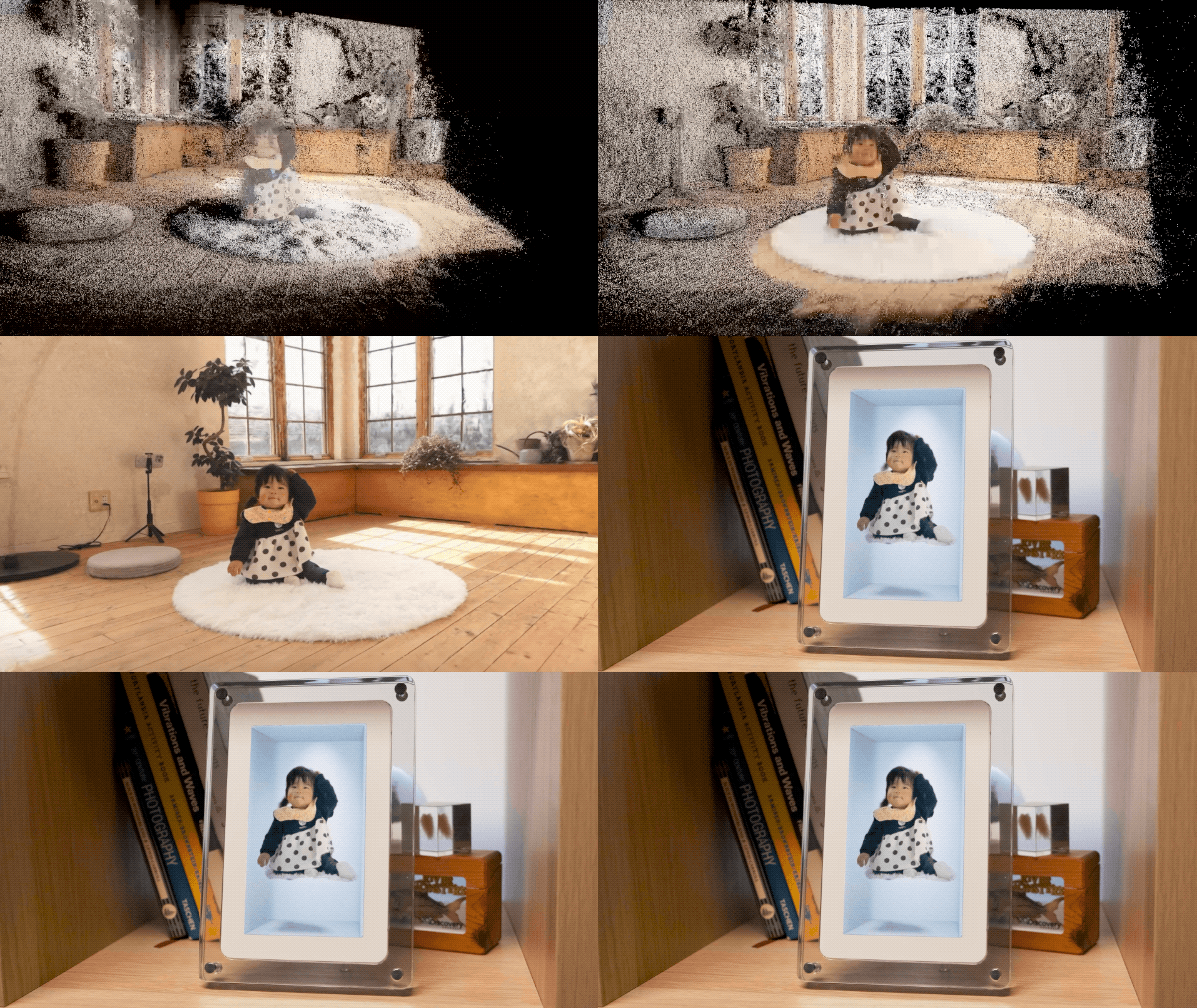
While musubi’s primary conversion workflow focuses on reconstructing depth from conventional photos and videos, the inclusion of splat support hints at a longer-term convergence between AI derived 3D scenes and native radiance field captures.
Looking Glass is not new to the holographic display space. Founded in 2014, the company has spent more than a decade developing light-field and holographic display technologies for developers, artists, and enterprise customers. musubi represents a shift toward mass-market accessibility, condensing the company’s holographic display stack into a device designed for everyday users.
The musubi Kickstarter campaign launches today, March 11 at 9 a.m. ET, with several reward tiers available for early backers. The headline offer provides a single frame for $99 during the first 24 hours, a 34% discount from the planned $149 retail price. Additional tiers include bundle packages and a limited “rush order” option designed to ship in time for Mother’s Day.
Looking Glass expects the campaign to run for 30 days, with production beginning immediately afterward. Early shipments are scheduled for late spring, with the main production run expected to ship to backers beginning in June 2026.
As spatial capture technologies continue to mature, the question is no longer just how to reconstruct reality in three dimensions, but where those reconstructions will ultimately live. Devices like musubi suggest one possible answer: right on the shelf next to your photo frames.


