

A new plugin is bringing native style Gaussian Splatting workflows directly into Unreal Engine 5. MLSLabsRenderer-Lite, developed by MaLanShan Audio & Video Laboratory, positions itself as a high performance renderer for both static 3D Gaussian Splatting scenes and dynamic volumetric video, often referred to as 4DGS.
Rather than routing splats through Unreal’s Niagara particle framework, the plugin introduces a custom low-level rendering pipeline designed specifically for large datasets. By bypassing Niagara’s general purpose particle architecture, MLSLabsRenderer-Lite targets consistent real time playback even when scenes scale into the millions of Gaussians.
In internal tests cited by the team, static .ply scenes containing more than seven million Gaussians run at over 50 frames per second on an NVIDIA RTX 4070 Ti. For dynamic sequences, the plugin reports real-time playback of 100,000+ Gaussians at 100 frames per second on similar hardware.
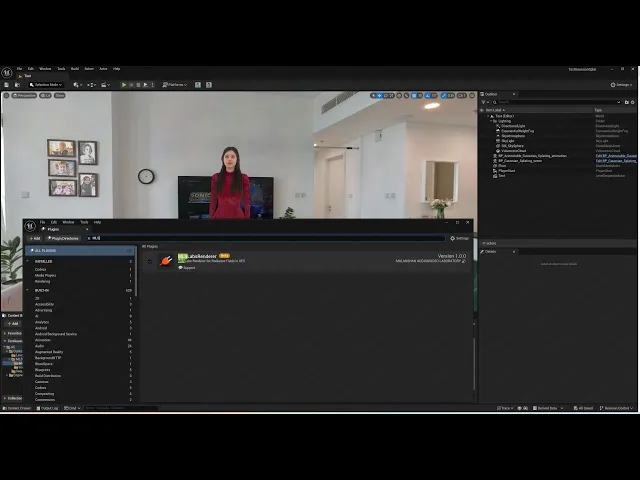
The plugin supports standard .ply imports for static captures as well as frame sequences for volumetric video playback. Once imported, splat actors behave like native Unreal assets. They can be positioned, transformed, and sequenced within the engine’s existing toolset. Integration with Unreal’s Sequencer allows creators to keyframe frame indices for volumetric playback, enabling editorial control directly within a Level Sequence. In practical terms, that means a 4D Gaussian performance can be treated as a timeline driven asset, not just a looping visualization.
DirectX 12 support and Shipping build compatibility are also already built in. Projects can be packaged for Windows, provided system requirements are met. The current release targets Unreal Engine 5.5.x on Windows 10 or 11, with NVIDIA GPUs supporting Shader Model 7.5 or higher. A minimum RTX 2060 is recommended, though higher end GPUs will be necessary to sustain the upper performance thresholds described.
Installation follows a conventional Unreal plugin workflow. The renderer can be dropped into either a project’s Plugins directory or the engine’s Marketplace plugins folder for packaging. On first launch, users are prompted to install dependencies, including LibTorch.
Early access functionality centers on core rendering and playback. Static Gaussian scenes can be imported individually, while animated sequences can be loaded by selecting multiple .ply frames within a directory. A quick focus shortcut frames splat actors in the viewport, and volumetric actors can be driven either manually or via Sequencer keyframes.
Looking ahead, the roadmap for a Professional version outlines ambitions that extend beyond the Lite release. Native VR and binocular rendering support, compressed 4DGS formats to reduce memory footprint, large scale environment handling through a .sog format, and advanced lighting with self shadowing are all in development. The team is also targeting higher frame rate thresholds for both static and dynamic scenes.
Unreal Engine has long been the backbone for virtual production, previs, and interactive experiences. With more platforms extending support to the platform, it remains to be seen how far users can leverage UE5 with gaussian splatting.
Learn more about MLSLabsRenderer-Lite, here.