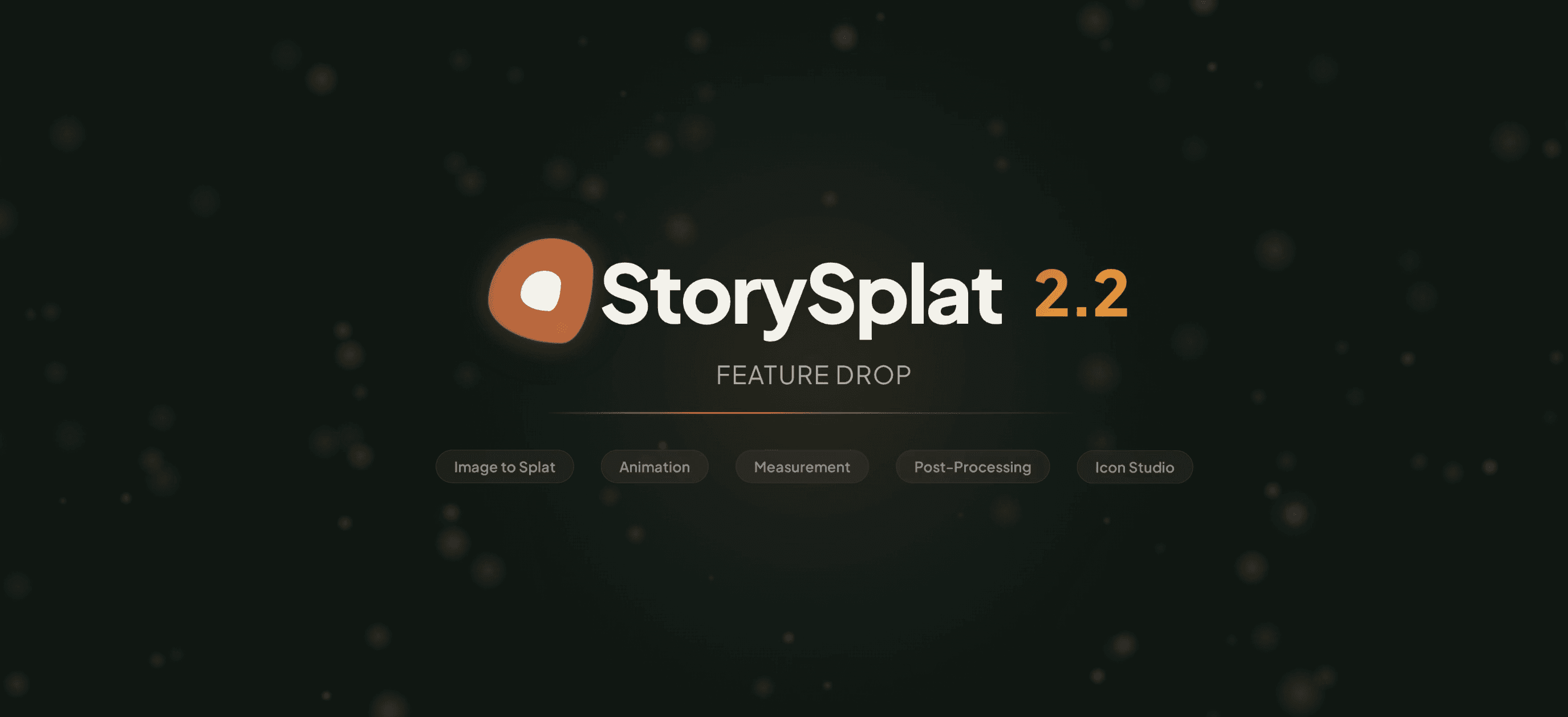
Not long after the platform’s major 2.0 rebuild, StorySplat has released version 2.2, continuing to expand the capabilities of its radiance field storytelling offering. The update introduces a collection of new creative and technical tools, ranging from image based splat generation to animation systems and spatial measurement utilities, while also delivering another round of performance improvements.
StorySplat has steadily positioned itself as a narrative layer for Gaussian splats. Creators upload a trained splat from capture tools, then transform it into a guided experience through camera viewpoints, interactive hotspots, audio, and scene navigation. The platform’s recent PlayCanvas-powered architecture has made it possible to support larger scenes and more dynamic interactions, and the new release continues building on that foundation.
The first addition to version 2.2 is single Image to Splat, which allows users to generate a gaussian splat directly from images inside the platform based upon Apple’s SHARP. StorySplat also introduces a new animation system that allows entities inside a scene to be animated over time. Objects can now scale, rotate, or move along defined paths, enabling creators to add motion driven storytelling elements to otherwise static environments. These animations can be used to highlight objects of interest, guide viewers through a scene, or create more cinematic narrative sequences within a splat.
Another addition focuses on practical spatial analysis. Tape Measure Mode allows creators and viewers to measure distances directly inside a Gaussian splat environment. By placing measurement points within the scene, users can determine real-world distances between objects, a capability that could be particularly useful for architectural documentation, education, or location-based storytelling. There is a misconception that splats cannot be measured, but they can. Later in the year we will see just how accurate splat measurements can be.
Version 2.2 also expands the visual presentation layer with the introduction of color grading. Standard options like Shadows, Highlights, and Vibrance plus more are available. Interactive design elements have also been refined. A new Icon Studio gives creators a way to design and customize the visual appearance of hotspots and portals, allowing these interactive elements to better match the aesthetic of a scene or brand identity. At the same time, custom menu links provide new navigation options within StorySplat experiences. Creators can now add external actions such as booking pages, maps, or other contextual links directly into the scene’s interface.
On the content pipeline side, the platform now supports direct import of LCC folders from XGRIDS captures with automatically generated level of detail structures. Finally, version 2.2 introduces an experimental cool feature called Mirror Planes, currently available in beta. Mirror planes allow creators to place reflective surfaces within a scene, creating reflections that interact with the surrounding environment.
StorySplat is free to use and can be accessed from their website.