
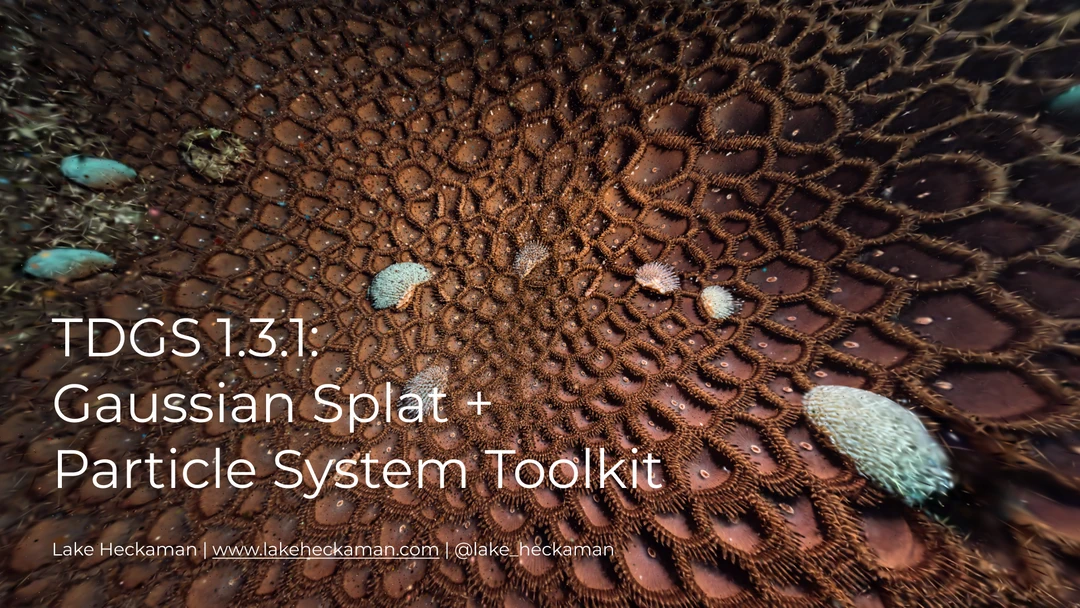
Lake Heckaman has released TDGS 1.3.1, the newest update to his Gaussian Splatting component for TouchDesigner. Built for TouchDesigner 2025.31760 and newer it addresses platform support, memory efficiency, and predictable performance at scale.
The updates in 1.3.1 begin with full macOS compatibility. TDGS now runs natively on Apple hardware, including Apple Silicon, with Heckaman noting that even the bundled sample .toe opens and runs on a 13-inch M1 MacBook Air. For TouchDesigner users who have long been limited by operating system workflows, this alone dramatically expands who can experiment with and deploy gaussian splats.
The update also brings proper SPZ support. Rather than aggressively optimizing at render time, TDGS opts for a cleaner approach that prioritizes visual correctness while still reducing disk footprint. Attribute handling has been reworked to conserve VRAM and cut down unnecessary GPU read and write operations. Expensive passes now only execute when they’re actually needed. For example, attribute blur operations tied to dissolving effects only cook when Zap Distance is greater than zero, avoiding hidden costs in scenes where that functionality isn’t in use.
TDGS 1.3.1 also gives artists more direct control over how splats behave spatially. New splat specific transform capabilities make it possible to manipulate splats without leaning on broader geometry level tricks, opening the door to more expressive motion design and cleaner procedural setups within TouchDesigner’s networked workflow.
Performance, especially in dynamic or large scale scenes, has clearly been a priority. The new “Blowout” mode is a good example of the kind of pragmatic thinking behind this release. By pushing splats away from the origin, it dramatically reduces screen space overlap and, in turn, sort cost. Rather than deleting or hiding data, TDGS simply makes it cheaper to draw.
Additional controls allow users to thin out splat sets or limit sorting and rendering to a defined bounding box when camera movement is predictable. These are explicit levers that let artists decide when fidelity matters more than frame time, and vice versa. In live performance and installation contexts, that kind of agency is often more valuable.
Taken together, TDGS 1.3.1 tightens the system, broadens access, and makes Gaussian Splatting inside TouchDesigner feel increasingly dependable. Heckaman has already hinted that further functionality updates are on the way, but even on its own, version 1.3.1 marks a step toward making gaussian splatting a practical, everyday tool for TouchDesigner artists. Learn more on Heckaman’s Patreon.


