
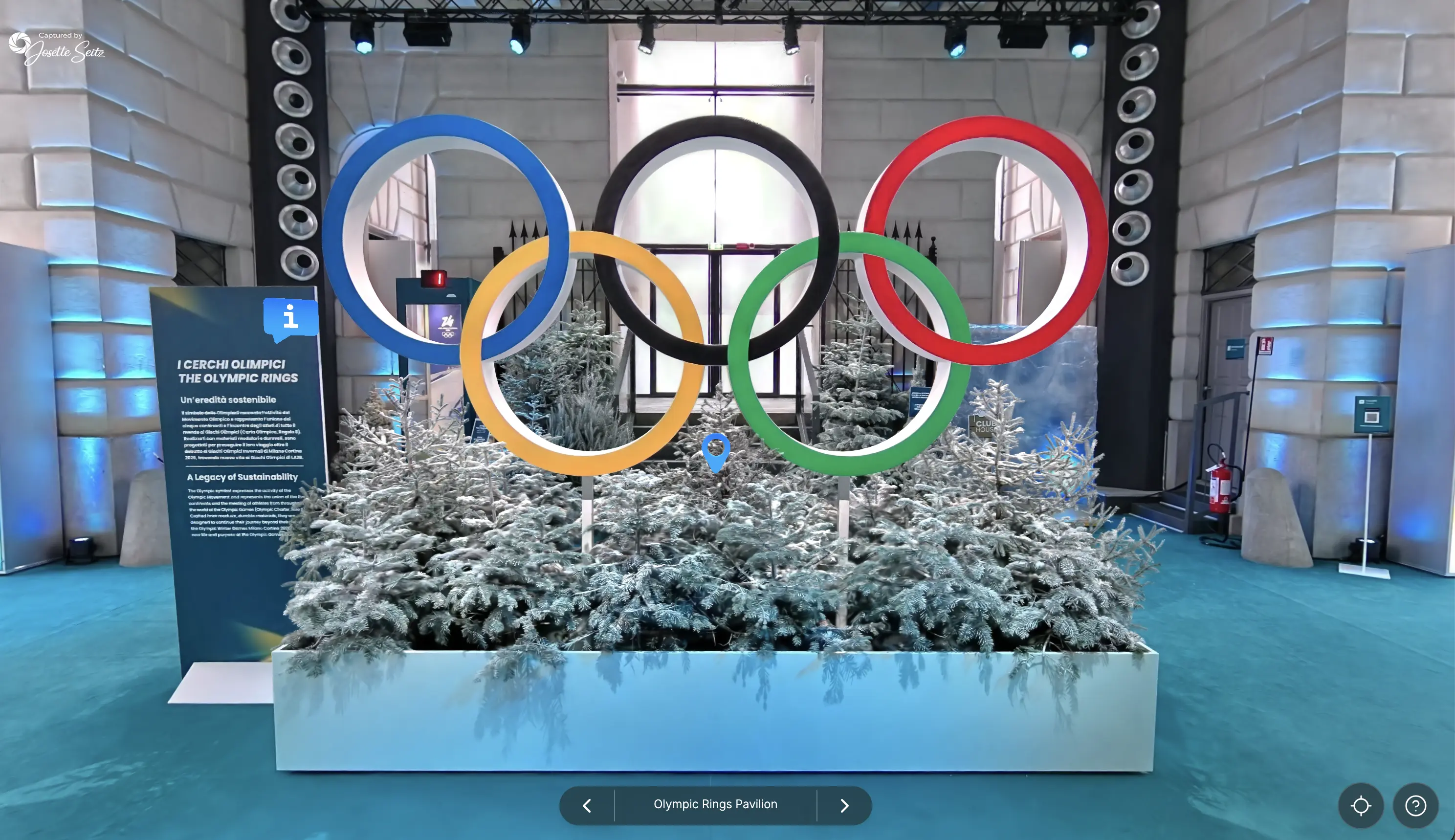
The Olympics have been one of the most documented sporting events in human history since photography made it feasible to freeze a moment in time. At the 1896 Athens Games, photographer Albert Meyer captured just 25 black and white images, staged, posed, and carefully composed due to the limits of early cameras. By 1912 in Stockholm, the first motion picture footage of the Games was recorded, launching an unbreakable tie between sport and moving images. At Milano Cortina 2026, the Olympic Broadcasting Services deployed FPV drones for mid-run camera angles during skiing events, AI-powered scene tagging for automated highlight curation, and even gaussian splatting for replays.
In 130 years, Olympic documentation has evolved from a single photographer with a glass plate negative to an infrastructure of thousands of lenses, sensors, and algorithms generating petabytes of data across every event, from every conceivable angle.
And yet, almost none of it captures what it actually feels like to be there.
There is a fundamental gap in the Olympic archive. Every photograph, every broadcast, every replay, no matter how high the resolution or how clever the camera angle, flattens the experience into a rectangle. You can see what happened, but you cannot walk through where it happened. The venues, the cultural exhibitions, the spaces in which the Games come to life for the people fortunate enough to be present, these exist for a few weeks, and then they are gone despite large scale budgets that go into creating the experiences.
This is especially true for the spaces that exist outside the competition arenas. The cultural programming, the exhibitions, the hospitality environments that blend Olympic heritage with the host nation’s identity, these are among the most richly curated and least documented aspects of any Games. At Milano Cortina 2026, one of those spaces was Clubhouse 26 Milano.
Clubhouse 26 Milano was housed inside the Dazi, a historic building at Piazza Sempione first constructed in 1806 and rebuilt in 1838 in honor of Napoleon. Sitting next to the Arco della Pace and the green expanse of Parco Sempione, the Dazi is one of Milan’s architectural landmarks, a place where Napoleonic era customs infrastructure has been reimagined over two centuries as civic and cultural space.
For the duration of the Winter Games, On Location, the IOC’s official and exclusive hospitality provider, transformed the Dazi into a premium hospitality venue operating in collaboration with the Olympic Museum in Lausanne. The building was designed by Giò Forma as two distinct yet complementary environments: an exhibition area showcasing Olympic medals, torches, and memorabilia from previous Winter Games, alongside a hospitality lounge where guests could dine, enjoy drinks, and follow the competitions.
This was the second iteration of the concept. At Paris 2024, the Clubhouse 24 at the Palais de Tokyo had been recognized with a Silver Bea World Award for its blending of cultural programming and Olympic hospitality. For Milan, the Olympic Museum loaned historical assets including a complete set of Olympic Games medals and torches, exclusive photographs, and artworks, bringing over a century of Olympic material culture to a single space.
But Clubhouse 26 was not a public museum. Hospitality packages started at €200 (excluding VAT). Access required purchasing through On Location’s official channels. The exhibition ran only for the duration of the Games, February 6 through 22, 2026. For the billions of people who follow the Olympics around the world, and even for the vast majority of visitors to Milan during those weeks, the contents of Clubhouse 26 were simply inaccessible.
But try searching for documentation online of what was actually inside. You will find press releases about the venue design, the hospitality packages, the celebrity chef overseeing the menu, and the architectural firm that designed the space. What you will find almost nothing of is the exhibition itself. No detailed catalog of the medals on display. No walkthrough of the poster history and sparse records of the mascot room. The cultural content, the Olympic artifacts that traveled from Lausanne to Milan for a two week appearance, is essentially undocumented on the public internet.
The most documented sporting event in human history produced one of its least documented cultural exhibitions. XR developer and artist Josette Seitz saw this gap and brought the tool to close it.
Josette Seitz, a XR developer and artist based in the San Francisco Bay Area, has built her creative practice at the intersection of immersive technology and artistic expression. Her work with gaussian splats and 3D environmental capture has spanned projects from virtual Burning Man reconstructions to holographic art installations with Android Jones using Looking Glass displays. She understands, intuitively, that some experiences lose their meaning when collapsed into two dimensions.
For her visit to the Winter Games, Seitz brought an XGRIDS PortalCam, the first spatial camera built specifically for 3D Gaussian Splatting. Walking through the Clubhouse 26 exhibition, Seitz captured the Olympic poster history, the collection of Olympic medals stretching back to 1924, and the mascot room, all of it rendered as a navigable, photorealistic 3D environment that anyone with a web browser can now explore through company, Nucleus4D.
Explore the Clubhouse 26 Olympic Museum Gaussian Splat
Use your mouse or touchscreen to move through the space. Orbit around the medal cases. Read the poster designs up close. Look up at the ceiling. This is not a photograph of the Clubhouse 26 exhibition. This is the Clubhouse 26 exhibition — or rather, it is the closest any of us will get to the experience of being there, now that the physical space has been disassembled and the artifacts have returned to Lausanne.
A photograph of an Olympic medal tells you what it looks like from one angle, under one lighting condition, at one moment. A gaussian splat lets you orbit the object and watch how light plays across the metalwork. The relationship between objects, between a 1924 medal and a 2026 medal, between historical posters and the architectural space that framed them, is preserved in a way that no sequence of flat images can replicate.
This has profound implications for education. Consider a student researching the evolution of Olympic visual identity. The poster designs at Clubhouse 26 told a story about how the Games have represented themselves graphically across a century, shifts in design language, national identity, artistic movements, and printing technology all visible in the progression from one poster to the next. That story is spatial. The posters were arranged in a deliberate sequence, at deliberate scales, with deliberate relationships to one another and to the room. A photograph captures the poster. A gaussian splat captures the exhibition.
The same is true for the medals. Olympic medal design is a discipline that reflects the host nation’s cultural values, artistic traditions, and relationship to the Olympic movement. Seeing medals in sequence, understanding how they changed in scale, material, iconography, is a fundamentally different experience than seeing any individual medal in isolation. Gaussian splatting preserves that sequence as a navigable environment rather than a curated slideshow.
For historians, for educators, for anyone who wants to understand what the Olympic experience is beyond the competition footage, spatial capture creates an archive that did not previously exist.
The arc of Olympic documentation follows the arc of imaging technology itself. In 1896, 25 staged photographs. In 1912, the first motion picture footage. In 1936, Leni Riefenstahl’s Olympia redefined what a camera could do at the Games. In 1948, the BBC paid £1,500 to broadcast the London Games to 60,000 television sets. In 1960, Rome brought color.
Each leap expanded what could be seen. None expanded what could be explored.
Gaussian splatting represents something different from the next resolution bump or the next camera angle. It is the shift from 2D into 3D. From recording what a space looked like to capturing what a space was. The technology is still young, but it is already at the point where I can’t help but wonder why we are still satisfied with 2D. When you can walk through the Clubhouse 26 exhibition from your browser, flipping through a photo gallery starts to feel like reading a description of a song instead of hearing it.
The Olympics will always be ephemeral. The flame is lit, the Games are played, the flame is extinguished. That is part of their power. But every Olympic host city invests enormous resources in creating cultural moments that, until now, vanished the moment the closing ceremony ended. Those moments can now be captured, shared, and explored by anyone, anywhere.
Experience the Clubhouse 26 Olympic Museum for yourself: Explore the Gaussian Splat on Nucleus4D.


