
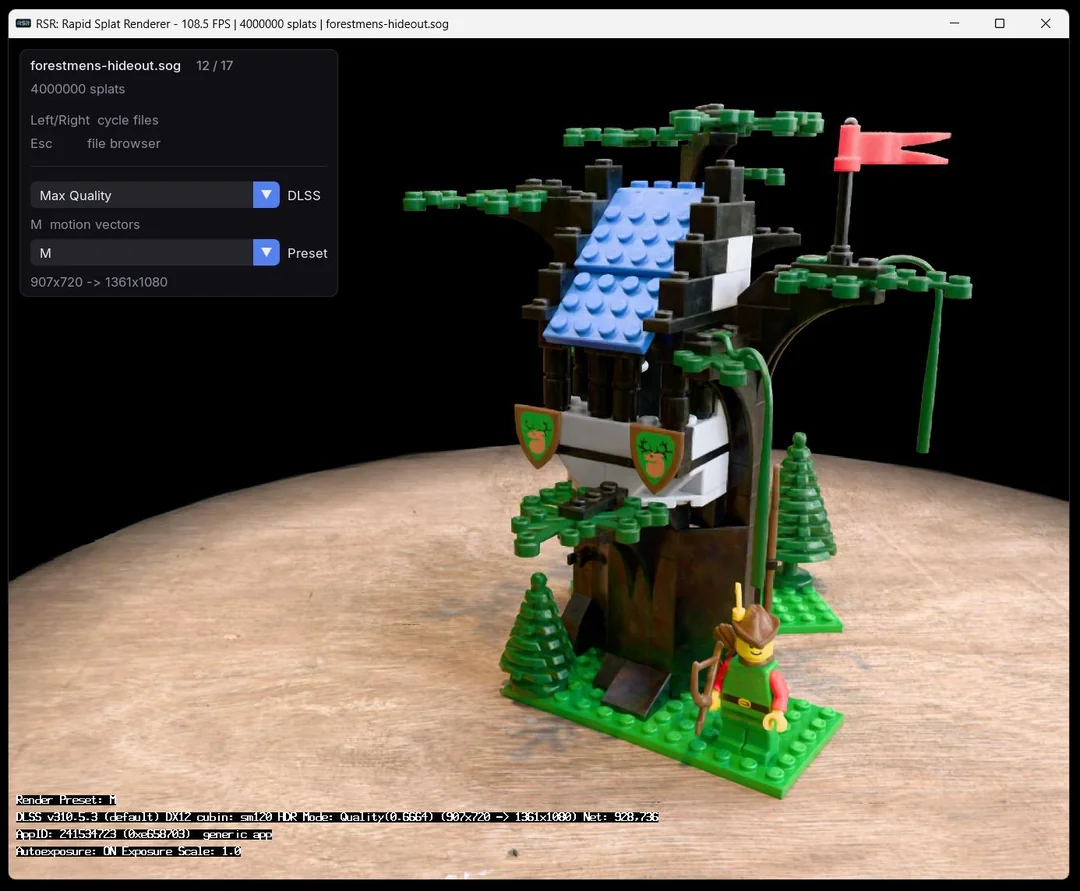
Most of the ways people view Gaussian Splatting scenes today involve some kind of intermediary. A web browser. A Unity or Unreal plugin. A Python script wrapping a research rasterizer. Each adds its own overhead, its own abstraction layer, its own set of compromises. RSR, a new viewer from Warpgate Labs skips all of it to write a native Windows app in C++ against Direct3D 12, talk to VR headsets through OpenXR directly, and keeps the entire rendering pipeline on the GPU.
RSR loads standard .ply files and PlayCanvas .sog compressed files (which run 15-20x smaller than raw PLY), renders with full spherical harmonics up to order 3, and sorts splats by depth using a GPU radix sort, without any CPU round trips for ordering. On NVIDIA RTX cards, it optionally layers on DLSS Super Resolution with multiple upsampling modes including DLAA, so you can push resolution without the proportional performance hit. Version 0.7.0, which followed a day after the initial public release, also added support for compressed PLY files, rounding out format coverage.
Additionally, any OpenXR compatible headset works. Toggle VR with a keypress and you’re in the scene with controller based movement and snap turning. There’s no engine bootstrapping, no project setup, or import step. Buffered background loading lets you traverse a folder of scenes without waiting for each one to fully load. You can flip through captures the way you’d scrub through a gallery. The app launches with either a file browser or direct path arguments, so it fits into both casual use and scripted pipelines. Initial camera framing in v0.7.0 was improved to handle scenes with outlier splats, so you don’t open a file and find yourself staring at a dot a kilometer away.
RSR is free for personal and non-commercial use, with commercial licensing available separately. It’s Windows only, requires a D3D12-capable GPU, and DLSS needs an RTX card. There’s no source code, this is a compiled binary release, but the v0.6 and v0.7 builds are up on GitHub now.


