
Bitbybit continues to expand its capabilities between web native engines, and emerging radiance field workflows. In its latest update, the platform has added support for PlayCanvas, joining Three.js and Babylon.js as a fully supported runtime for Bitbybit’s CAD and visualization stack.
With PlayCanvas now officially supported, Bitbybit users can draw OpenCascade, Manifold, and JSCAD geometry directly into PlayCanvas scenes, complete with faces, edges, and entity level representations of points, curves, lines, and polylines. An orbit camera implementation brings parity with the platform’s existing engine integrations, while maintaining PlayCanvas’ familiar workflow and performance characteristics. This brings a cleaner path for developers who prefer PlayCanvas’ editor centric approach, but still want access to Bitbybit’s parametric and procedural CAD capabilities.
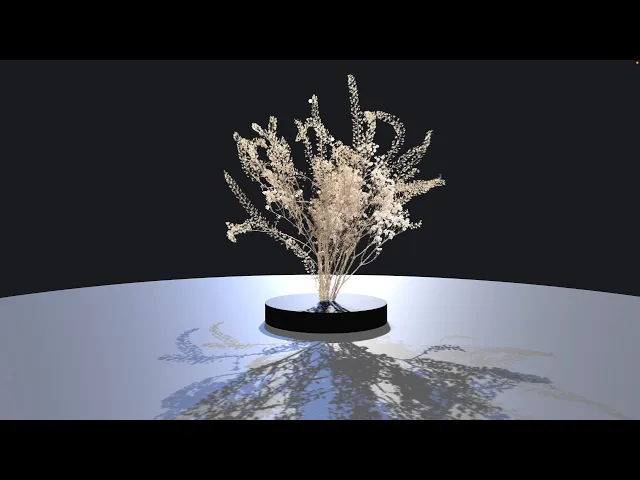
The headline addition in this update is shadow casting for 3D Gaussian Splatting, enabled through a new transparencyShadow property on directional and point lights. When activated, gaussian splat meshes can now contribute shadows to the scene, allowing them to ground themselves spatially. For anyone using splats alongside CAD geometry, parametric objects, or physically based materials, this change fundamentally alters how believable mixed scenes can become. Additionally, a new scaleInPlace method is now the recommended approach for scaling 3D Gaussian Splatting meshes, replacing an older method that introduced Y-axis flips and unintended side effects.
Alongside the engine integration, this release includes a set of rendering changes. Faces generated from OCCT, Manifold, and JSCAD are now rendered on their negative side by default, highlighted in blue. This subtle shift makes it easier to reason about face orientation. Directionality improvements extend to edges as well, with new arrow rendering options for polylines that help visualize wire and edge flow across all supported engines.
Multi-color rendering for points and polylines opens the door to richer semantic visualization, while a reworked point rendering pipeline based on thin instances significantly improves efficiency in dense scenes. Verb surface rendering issues have also been resolved across engines.
Materials and textures are another area where this update bridges gaps between ecosystems. Bitbybit has introduced a cross engine materials API that allows textures and PBR materials to be defined once and reused across Babylon.js, Three.js, and now PlayCanvas. Materials authored inside Babylon based visual programming editors can be exported to PlayCanvas with matching parameters and colors, acknowledging that while final shading may vary slightly due to engine specific pipelines, intent and appearance should remain consistent.
The Manifold kernel also receives a practical upgrade with the ability to generate cross sections from lists of points, expanding Bitbybit’s toolset for procedural analysis and geometric inspection. Rounding out the release is a refreshed documentation set, with dedicated runner guides now available for PlayCanvas, Three.js, and Babylon.js.
Bitbybit continues to be open source and MIT Licensed from their GitHub.


