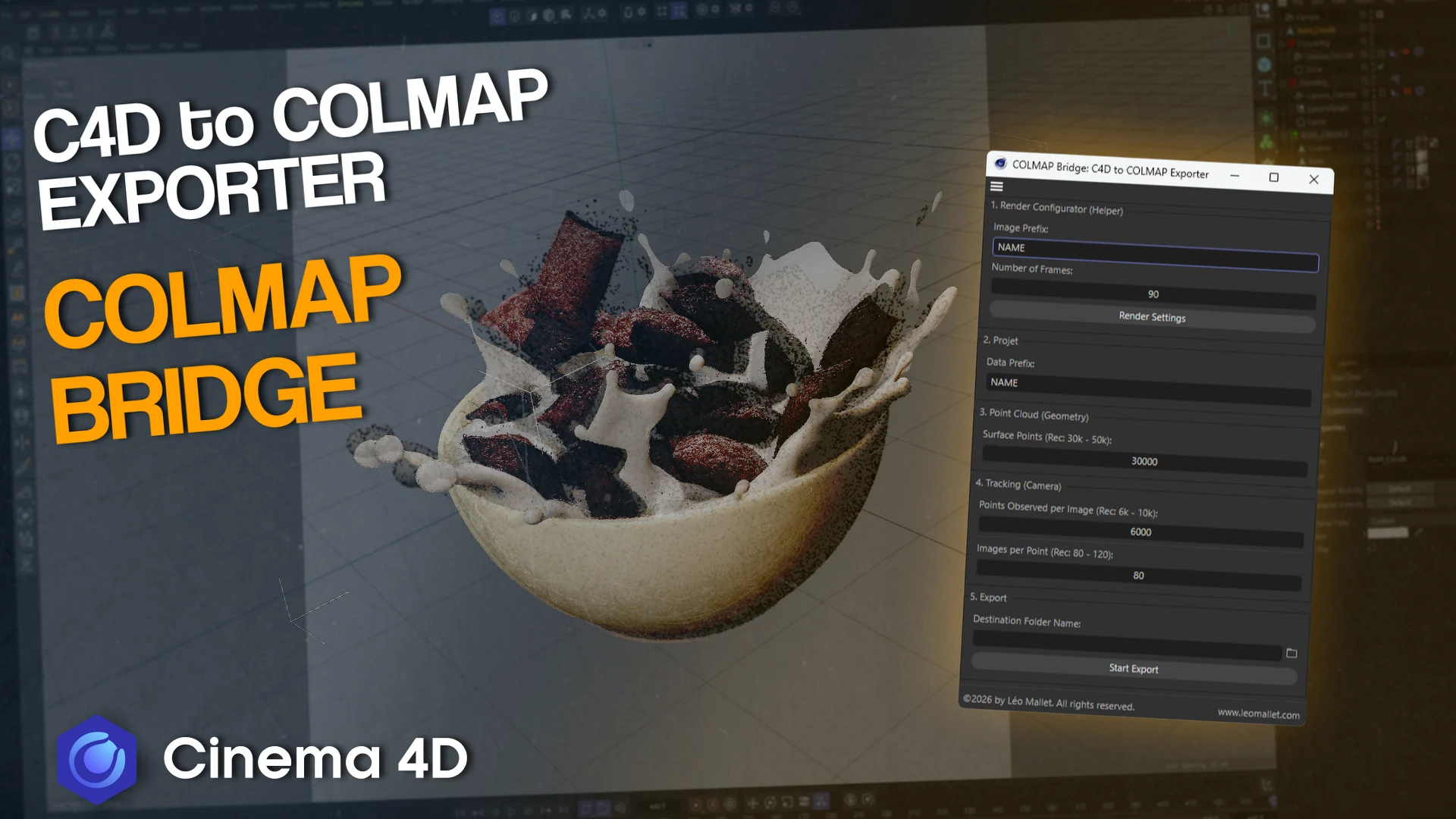
Léo Mallet has pushed a sizable update to COLMAP Bridge for Cinema 4D, the plugin we covered earlier this year for exporting C4D scenes directly into the COLMAP format. The new release targets three specific pain points in the synthetic to splat pipeline of camera distribution, edge aliasing in training imagery, and renderer compatibility for baked lighting.
The primary addition is a Fibonacci based camera placement mode, which Mallet is framing under a “Biomimicry” label. It appears to be a nod to the sunflower seed spiral that the Fibonacci lattice approximates. For those unfamiliar, Fibonacci sphere sampling produces near uniform point distributions across a sphere without the clustering artifacts you get from naive latitude/longitude grids. In a 3DGS training context, that translates to even angular coverage around a subject with no redundant views at the poles and no sparse bands around the equator.
Synthetic captures can fail in the same ways real captures do when camera placement is uneven through under or over covered regions. A Fibonacci distribution is about as close to an optimal prior as you can get for object centric captures without doing per-scene planning.
The second addition is sub-pixel jittering for anti-aliasing across the rendered image sequence. High frequency stair stepping in the source images can get interpreted as scene detail, and the optimizer spawns splats to try to reconstruct what is effectively a sampling artifact. Jittered AA softens those edges at the source, giving the trainer cleaner gradients to work with.
For synthetic pipelines, this closes a gap that real world captures don’t typically have, since sensor noise and lens blur already dither hard edges in the optical path. Ground truth renders, by contrast, can be too sharp for 3DGS to train on well.
The third update is renderer agnostic baking for Octane and Redshift users. Shading, GI, and any view dependent effects computed in those renderers can now be flattened into the exported image sequence in a way the COLMAP compatible training path expects, regardless of which renderer produced the pixels.
This was one of the more commonly requested additions after the initial release, since a large share of the C4D professional user base lives in either Octane or Redshift rather than Cinema 4D’s native Standard/Physical renderers.
This update does tighten the loop between a production C4D scene and a usable splat. Better coverage means fewer retraining iterations. Jittered AA means cleaner convergence. Renderer universal baking means artists don’t have to restructure their lighting setups to fit the plugin.
As more studios across entertainment and gaming look at 3DGS as a rendering and representation layer rather than a capture deliverable, the tooling around synthetic to splat conversion is going to matter even more. This update moves the needle in that direction.
COLMAP Bridge remains available for Cinema 4D R25 and newer under a commercial license. The updated build is live on Mallet’s Gumroad.