
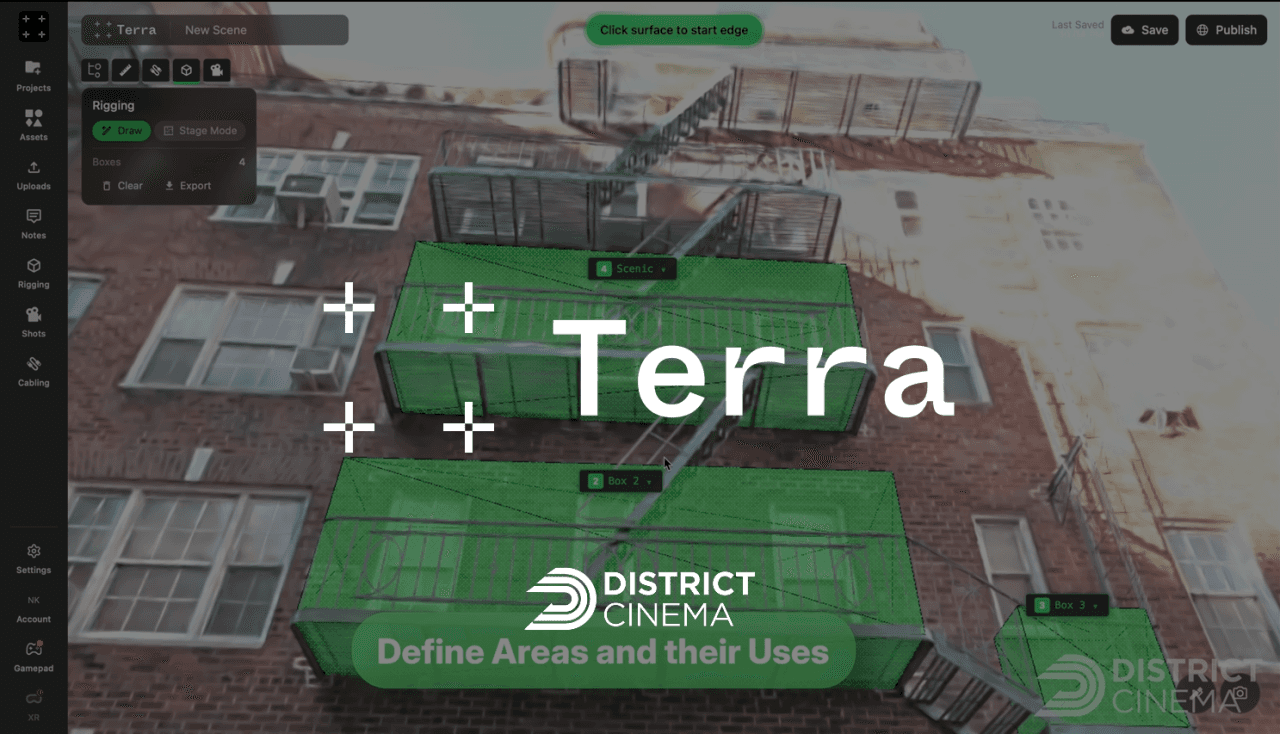
District Cinema Launches Terra, a Browser-Based 3D Viewer for Film Production

Michael Rubloff

Michael Rubloff

Email
Copy Link
Twitter
Linkedin
Reddit
Whatsapp
District Cinema

District Cinema, a creative technology studio specializing in virtual production and reality capture, has announced the launch of Terra, a web based 3D viewer built for film and TV production workflows, alongside a global Production Capture Network designed to supply productions with location scan data from vetted capture professionals around the world.

Terra is designed to let creative teams virtually scout, block shots, and take spatial measurements inside Gaussian Splat environments directly from a standard desktop browser, with no specialized hardware or large file downloads required. The platform targets the specific pain point in production of the cost, time, and carbon footprint associated with moving creative teams to physical locations for scouting and pre-production planning.
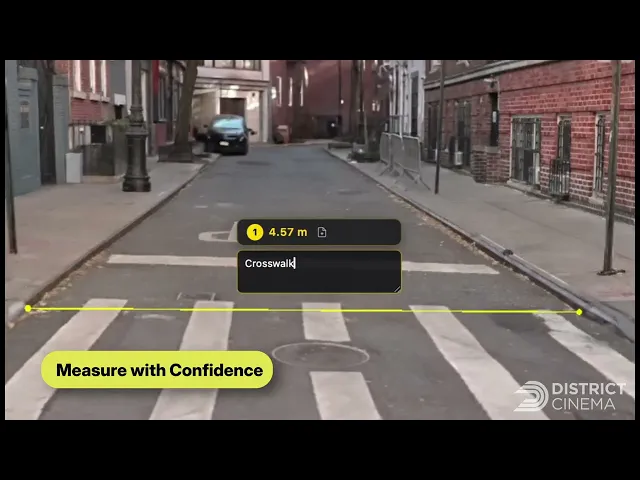
The platform includes virtual camera lensing, allowing directors and DPs to frame shots using accurate virtual lenses inside the 3D environment. Art departments and location teams can pull precise spatial measurements using built-in tools, with the ability to export those measurements as PDF reports. An upcoming feature will allow users to upload PDF scripts or shooting schedules to automatically structure scenes and organize scans chronologically within the platform.

On the capture side, District Cinema’s Production Capture Network provides a global roster of vetted scanning professionals who can be deployed to capture locations anywhere in the world. The network offers two tiers of output: “Previs Quality” scans optimized for scouting and planning inside Terra, and “Final Pixel Quality” cinema grade digital twins suitable for use as background assets on LED volumes or green screen stages. Scanning a location at the previs level takes 15 to 45 minutes on-site, with processing turnaround typically between half a day to one day per scan.

District Cinema has been building toward this launch for some time. The studio has been an early adopter of the Volinga and XGRIDS pipeline, using XGRIDS’ spatial cameras to produce centimeter accurate digital twins and Volinga’s Unreal Engine plugin for Gaussian Splat integration. District Cinema was specifically named as an early adopter in the Volinga and XGRIDS partnership announcement, where the two companies formalized the capture to Unreal pipeline that District Cinema had already been using for virtual pre production work.

With Terra, District Cinema is now layering a browser based access point on top of that pipeline, lowering the barrier for creatives who may not need (or want) to work inside Unreal Engine. The web based approach means that producers, directors, location managers, and HSA advisors can interact with scanned environments without requiring technical expertise in game engines or 3D software.

Terra is built specifically for the film industry’s confidentiality requirements, offering controlled access to proprietary scan data. District Cinema has also indicated that integrations with vCam tools for virtual camera rehearsal, 3D object placement, and AI relighting tools such as Beeble are being tested to address one of the known limitations of Gaussian Splats in production, baked in lighting conditions. VR headset support is also listed as being in active development.

“We are bridging the gap between physical production and the digital world,” said Barnabas Csutak, Producer and Lead of Reality Capture at District Cinema. “By leveraging novel techniques like Gaussian Splatting and our new Terra viewer, we are making advanced virtual production tools accessible to independent productions and major studios alike.”

Productions interested in the Terra beta can sign up on the District Cinema website. District Cinema can also consult on reality capture workflows for both prep and post pipelines.


Featured

Recents

Platforms

Volinga Adds 4D Gaussian Splatting to Unreal Engine

Volinga adds 4D Gaussian splatting to its Unreal Engine pipeline, converting per-frame PLY sequences into one optimized NVOL asset for Sequencer playback.

Michael Rubloff

Jul 24, 2026

Platforms

Volinga Adds 4D Gaussian Splatting to Unreal Engine

Volinga adds 4D Gaussian splatting to its Unreal Engine pipeline, converting per-frame PLY sequences into one optimized NVOL asset for Sequencer playback.

Michael Rubloff

Platforms

Autodesk Makes 3D Gaussian Splats an Editable Native Object Type in 3ds Max 2027.2

3ds Max 2027.2 makes 3D Gaussian splats an editable native point object, deformable in the modifier stack and rendered natively in Arnold for Max 5.9.3.

Michael Rubloff

Jul 24, 2026

Platforms

Autodesk Makes 3D Gaussian Splats an Editable Native Object Type in 3ds Max 2027.2

3ds Max 2027.2 makes 3D Gaussian splats an editable native point object, deformable in the modifier stack and rendered natively in Arnold for Max 5.9.3.

Michael Rubloff

4DV.ai, Dell Technologies, and Radiancefields.com Launch Complete 4DGS Video

Michael Rubloff

Jul 21, 2026

4DV.ai, Dell Technologies, and Radiancefields.com Launch Complete 4DGS Video

Michael Rubloff

Platforms

VRChat Gaussian Splatting v4 Adds LOD Pyramid

VRChat Gaussian Splatting v4 adds an import time LOD pyramid and per platform splat budget, scaling real-time 3DGS scenes to tens of millions of splats in Udon.

Michael Rubloff

Jul 20, 2026

Platforms

VRChat Gaussian Splatting v4 Adds LOD Pyramid

VRChat Gaussian Splatting v4 adds an import time LOD pyramid and per platform splat budget, scaling real-time 3DGS scenes to tens of millions of splats in Udon.

Michael Rubloff

Trending Articles
  1. TRENDING
    Loading...
  2. TRENDING
    Loading...
  3. TRENDING
    Loading...
Michael Rubloff

Written by Michael Rubloff

Michael is the Founder and Managing Editor of Radiancefields.com

Email
Copy Link
Twitter
Linkedin
Reddit
Whatsapp

More from Michael Rubloff

More from Michael Rubloff

Platforms

Volinga Adds 4D Gaussian Splatting to Unreal Engine

Volinga adds 4D Gaussian splatting to its Unreal Engine pipeline, converting per-frame PLY sequences into one optimized NVOL asset for Sequencer playback.

Michael Rubloff

Jul 24, 2026

Volinga 4D Gaussian Splatting

Platforms

Volinga Adds 4D Gaussian Splatting to Unreal Engine

Michael Rubloff

Jul 24, 2026

Volinga 4D Gaussian Splatting

Platforms

Volinga Adds 4D Gaussian Splatting to Unreal Engine

Volinga adds 4D Gaussian splatting to its Unreal Engine pipeline, converting per-frame PLY sequences into one optimized NVOL asset for Sequencer playback.

Michael Rubloff

Jul 24, 2026

Volinga 4D Gaussian Splatting

Platforms

Autodesk Makes 3D Gaussian Splats an Editable Native Object Type in 3ds Max 2027.2

3ds Max 2027.2 makes 3D Gaussian splats an editable native point object, deformable in the modifier stack and rendered natively in Arnold for Max 5.9.3.

Michael Rubloff

Jul 24, 2026

Autodesk 3DS Max Gaussian Splatting

Platforms

Autodesk Makes 3D Gaussian Splats an Editable Native Object Type in 3ds Max 2027.2

Michael Rubloff

Jul 24, 2026

Autodesk 3DS Max Gaussian Splatting

Platforms

Autodesk Makes 3D Gaussian Splats an Editable Native Object Type in 3ds Max 2027.2

3ds Max 2027.2 makes 3D Gaussian splats an editable native point object, deformable in the modifier stack and rendered natively in Arnold for Max 5.9.3.

Michael Rubloff

Jul 24, 2026

Autodesk 3DS Max Gaussian Splatting

4DV.ai, Dell Technologies, and Radiancefields.com Launch Complete 4DGS Video

Michael Rubloff

Jul 21, 2026

4DV.ai, Dell Technologies, and Radiancefields.com Launch Complete 4DGS Video

Michael Rubloff

Jul 21, 2026

4DV.ai, Dell Technologies, and Radiancefields.com Launch Complete 4DGS Video

Michael Rubloff

Jul 21, 2026