
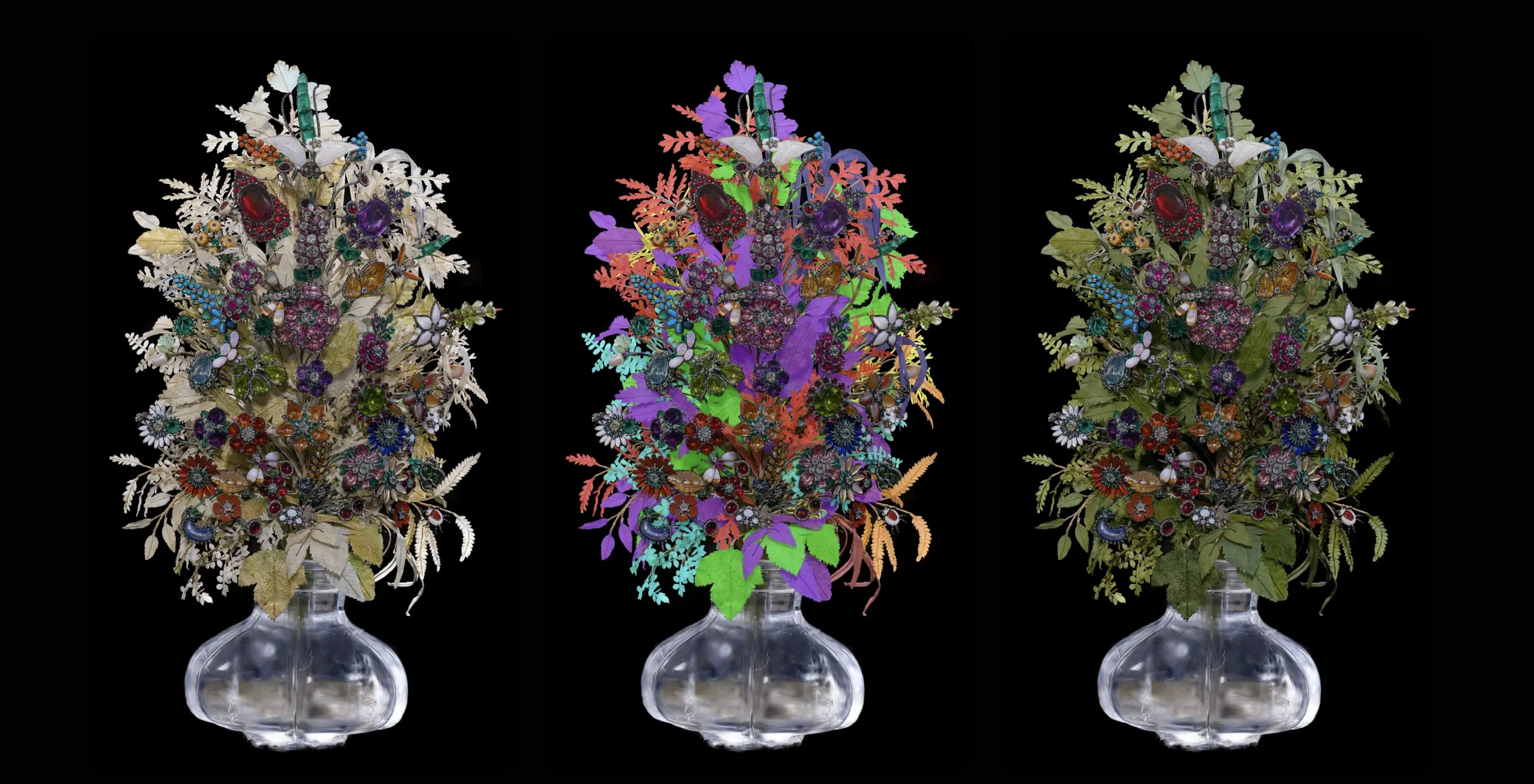
geofront, a Vienna based computational imaging company, has shipped a public 3D Gaussian Splatting reconstruction of Empress Maria Theresia’s gem bouquet in partnership with the Natural History Museum Vienna (NHM). The piece, an 18th-century arrangement of precious stones and flowers held in the NHM’s gem collection, is delivered through a guided viewer with bespoke presentation tooling and a splat-aware recoloring brush that the museum’s curator used to perform digital restoration of the faded textile leaves.
The capture set was more than 1,000 photographs documenting the bouquet from every relevant angle, to faithfully record cut gemstones, metallic surfaces, and the delicate botanical structure of the leaves. Alignment was handled in RealityScan; from that dataset, geofront trained the reconstruction in LichtFeld Studio, the open source 3D Gaussian Splatting platform by Janusch Patas and a contributor collective. The final model is approximately 700,000 splats.
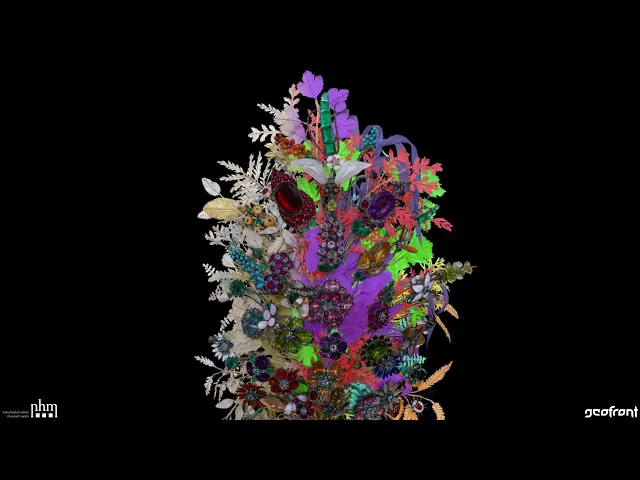
The choice of a splat representation over a traditional textured mesh was an easy one given the gem bejeweled bouquet is almost entirely view dependent specular response.
geofront built guided camera paths that reveal the bouquet through composed shots, interpretive overlays with labels for individual stones and structures, depth of field and vignetting that direct the eye to specific details, and a cinematic framing that matches how the museum already presents its material.
The recolouring work began because the bouquet’s leaves, made from cotton and silk over wire armatures, have faded substantially from sun exposure over the past two and a half centuries. The historical reference for what they originally looked like is a single watercolor painted in 1837, when the bouquet was last re-arranged. geofront’s first instinct was to recolor the 1,000 input photographs before training, but that would have been time-consuming. AI-based 2D recolouring of the inputs was also attempted and rejected, because it would be inconsistent between views. As the museum needed the ability to fade the recolor in and out, to show the bouquet’s current state and its inferred original state in the same viewer, a single model with toggleable color modification fitted the aim better than two separately trained models.
Working in splat space required a selection tool, so geofront implemented their own flood-fill brush, with a depth limit, a brush radius, and grouping. The flood fill walks neighbouring splats and selects them when the colour is similar and the distance is small. Grouping lets every instance of a given leaf type be tagged with an ID and recoloured as a unit. Constantin Tanase from geofront spent roughly two to three hours creating the leaf groupings for the full reconstruction.
The editing UI exposes LAB-space color sliders alongside exposure, contrast, saturation, black point, white point, and a mixing slider that linearly interpolates between the original and the new colour. Edits save out as JSON profiles.
Dr. Victoria Kohn, the NHM’s curator of the gem collection, used this tool directly to recolour the leaves toward their likely original state.
“The colouring of the faded leaves was achieved using a tool developed specifically for this purpose. The shades of green chosen are based on a watercolour painting from 1837. As it is highly likely that the colours of the watercolour have also changed over time, I decided to use the watercolour as a guide, but to colour the individual groups of leaves in such a way that the overall impression of the object appears suitable. I worked on it for at least 5 hours and created 3 versions to get to the impression that now imitates the former splendour of the historical object.”
Kohn described the resulting reconstruction to the Austria Presse Agentur as a “fantastic 3D model” that allows the object to be examined virtually from any angle.
LichtFeld Studio shipping its 0.5 release earlier this year added the embedded Python runtime, plugin marketplace, and MCP support that make this kind of bespoke editing tooling considerably more tractable for studios building on top of it. The geofront project is one of the first public facing institutional deployments to lean on that surface area. Their selection brush request also became a feature of the open-source tool itself.
The launch received substantial Austrian press coverage, including Der Standard, ORF, and the Austria Presse Agentur. The pop-up showcase in Hall IV, which presents the research findings alongside a video of the 3D model, is on display through early 2027, after which the bouquet remains permanently in its upgraded vault display case nearby.