How Gaussian Splats Helped Bring Madrid’s Calle Alcalá Onto an LED Volume for Netflix’s Berlin

Michael Rubloff

Michael Rubloff

Email
Copy Link
Twitter
Linkedin
Reddit
Whatsapp
Volinga Gaussian Splatting Lady with Ermine

Media and entertainment often has a long lead time before work can be shown. That said, we have begun to see a wave of shows using gaussian splatting. Netflix’s Berlin and the Lady with an Ermine includes a telling example of where Gaussian splatting is beginning to fit inside real production workflows as an on screen virtual production tool for a complex nighttime sequence.

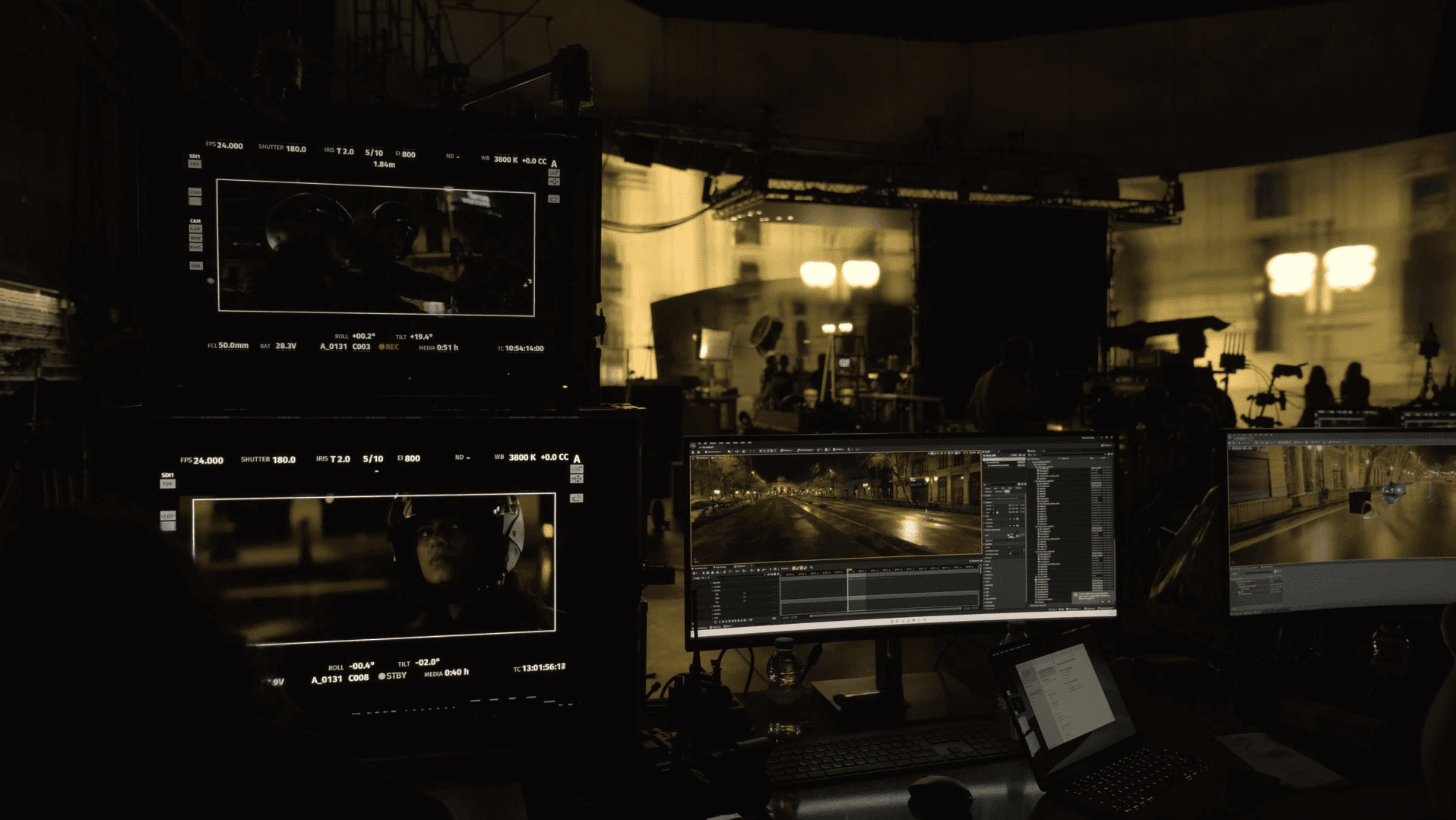
According to a new case study from Volinga, Vancouver Media, the production company behind Money Heist, used Gaussian Splatting for a motorcycle sidecar sequence set along Madrid’s Calle Alcalá. The scene combined wide stunt work shot on location with close up performance footage captured on a virtual production stage, using a reconstructed 3D environment displayed on an LED volume.

The creative team wanted the energy of a real Madrid street at night, but also needed the safety, repeatability, and intimacy of a controlled stage environment. Putting two actors in a moving sidecar created obvious physical risk, especially while trying to hold close, emotionally driven shots. Traditional 2D driving plates were not enough, because they lacked the depth and parallax needed for camera moves around two performers sitting at different heights.

Instead, the team captured Calle Alcalá with a multi camera rig mounted to a moving vehicle. OpenEXR sequences were created from the footage and processed into a 3D Gaussian Splat using Volinga Suite’s HDR ACES workflow. That gave the virtual production team a volumetric reconstruction of the real street rather than a flat background plate.

Gaussian splats are giving productions a way to capture the visual complexity of a real environment and then bring it into a controllable 3D space.

Volinga says the splat was brought into Unreal Engine and displayed on the LED volume through its Unreal Engine plugin, with MO&MO involved on the virtual production side. The final workflow combined traditional on location stunt footage with close ups splats, creating a hybrid sequence where the production could preserve the scale of the real location while keeping the actors and camera team in a controlled environment.
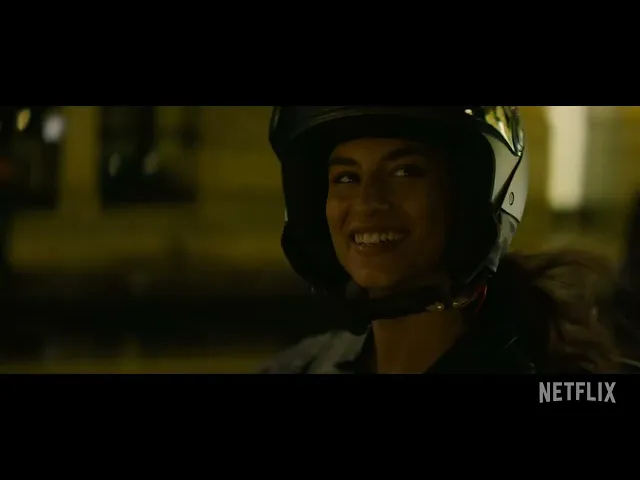
During the stunt shoot, Calle Alcalá’s city lights were illuminated. By the time the environment was captured later that night, some of those lights had been turned off. In a traditional workflow, that mismatch could push the fix downstream into postproduction. Volinga says its Unreal Engine relighting tools allowed the team to make adjustments directly within the environment, lifting shadows and balancing highlights while preserving the look of the captured street.

This is one of the reasons Gaussian splatting has become so interesting for virtual production. The original 3D Gaussian Splatting work demonstrated high quality real time radiance fields by representing scenes with 3D Gaussians.

The Berlin and the Lady with an Ermine use case follows a broader pattern emerging across film and television of splats moving into practical production infrastructure. Volinga has also previously published case studies around episodic virtual production, including a Fire Country Season 4 sequence where a real environment was reconstructed as a Gaussian splat for an LED wall stage, and CBS VFX proof of concept work around capturing and reusing television sets.

Gaussian splats offer a middle path between traditional driving plates and fully modeled CG environments, preserving the photographic richness of a real location while giving filmmakers the spatial flexibility of 3D.

Netflix lists Berlin and the Lady with an Ermine as a 2026 limited series centered on a new heist involving Leonardo da Vinci’s Lady with an Ermine, with the first episode titled “The Collection.” Netflix’s own announcement describes the series as a continuation of the Money Heist and Berlin universe, created by Álex Pina and Esther Martínez Lobato, with Vancouver Media behind the production.

Volinga says the splat assisted sequence can be seen in Episode 1 around the 32:20 mark. Can you tell they’re splats? The original case study can be found here.


Featured

Recents

KIRI Engine Releases a Free MIT Licensed Gaussian Splat Renderer for After Effects

KIRI Engine releases a free, MIT licensed Gaussian splat renderer for After Effects, rendering PLY captures through the AE 3D camera with no depth output.

Michael Rubloff

Jul 30, 2026

KIRI Engine Releases a Free MIT Licensed Gaussian Splat Renderer for After Effects

KIRI Engine releases a free, MIT licensed Gaussian splat renderer for After Effects, rendering PLY captures through the AE 3D camera with no depth output.

Michael Rubloff

Platforms

XGRIDS Brings 2D Photo Support and Drone RTK Optional in LCC Studio 2.2

XGRIDS LCC Studio V2.2.0 makes drone RTK optional for aerial and aerial-ground fusion reconstruction, and adds 3DGS models from a folder of local images.

Michael Rubloff

Jul 30, 2026

Platforms

XGRIDS Brings 2D Photo Support and Drone RTK Optional in LCC Studio 2.2

XGRIDS LCC Studio V2.2.0 makes drone RTK optional for aerial and aerial-ground fusion reconstruction, and adds 3DGS models from a folder of local images.

Michael Rubloff

ReconWorldLab Adds Relighting to Godot Gaussian Splats in GDGS 3.3.0

GDGS 3.3.0 adds relighting to Godot Gaussian splats, baking per-splat normals and ambient occlusion from a voxel proxy for +4.7% frame time with one light.

Michael Rubloff

Jul 30, 2026

ReconWorldLab Adds Relighting to Godot Gaussian Splats in GDGS 3.3.0

GDGS 3.3.0 adds relighting to Godot Gaussian splats, baking per-splat normals and ambient occlusion from a voxel proxy for +4.7% frame time with one light.

Michael Rubloff

Platforms

Chronosplat Plays 4D Gaussian Splat Sequences From Static Files in the Browser

Chronosplat is a GPLv3 browser player for 4D Gaussian splat sequences, converting any PLY sequence to per-frame SOG and running as static files with no server.

Michael Rubloff

Jul 30, 2026

Platforms

Chronosplat Plays 4D Gaussian Splat Sequences From Static Files in the Browser

Chronosplat is a GPLv3 browser player for 4D Gaussian splat sequences, converting any PLY sequence to per-frame SOG and running as static files with no server.

Michael Rubloff

Trending Articles
  1. TRENDING
    Loading...
  2. TRENDING
    Loading...
  3. TRENDING
    Loading...
Michael Rubloff

Written by Michael Rubloff

Michael is the Founder and Managing Editor of Radiancefields.com

Email
Copy Link
Twitter
Linkedin
Reddit
Whatsapp

More from Michael Rubloff

More from Michael Rubloff

KIRI Engine Releases a Free MIT Licensed Gaussian Splat Renderer for After Effects

KIRI Engine releases a free, MIT licensed Gaussian splat renderer for After Effects, rendering PLY captures through the AE 3D camera with no depth output.

Michael Rubloff

Jul 30, 2026

After Effects Gaussian Splatting

KIRI Engine Releases a Free MIT Licensed Gaussian Splat Renderer for After Effects

Michael Rubloff

Jul 30, 2026

After Effects Gaussian Splatting

KIRI Engine Releases a Free MIT Licensed Gaussian Splat Renderer for After Effects

KIRI Engine releases a free, MIT licensed Gaussian splat renderer for After Effects, rendering PLY captures through the AE 3D camera with no depth output.

Michael Rubloff

Jul 30, 2026

After Effects Gaussian Splatting

Platforms

XGRIDS Brings 2D Photo Support and Drone RTK Optional in LCC Studio 2.2

XGRIDS LCC Studio V2.2.0 makes drone RTK optional for aerial and aerial-ground fusion reconstruction, and adds 3DGS models from a folder of local images.

Michael Rubloff

Jul 30, 2026

LCC Studio V2.2 XGRIDS

Platforms

XGRIDS Brings 2D Photo Support and Drone RTK Optional in LCC Studio 2.2

Michael Rubloff

Jul 30, 2026

LCC Studio V2.2 XGRIDS

Platforms

XGRIDS Brings 2D Photo Support and Drone RTK Optional in LCC Studio 2.2

XGRIDS LCC Studio V2.2.0 makes drone RTK optional for aerial and aerial-ground fusion reconstruction, and adds 3DGS models from a folder of local images.

Michael Rubloff

Jul 30, 2026

LCC Studio V2.2 XGRIDS

ReconWorldLab Adds Relighting to Godot Gaussian Splats in GDGS 3.3.0

GDGS 3.3.0 adds relighting to Godot Gaussian splats, baking per-splat normals and ambient occlusion from a voxel proxy for +4.7% frame time with one light.

Michael Rubloff

Jul 30, 2026

Godot Gaussian splatting

ReconWorldLab Adds Relighting to Godot Gaussian Splats in GDGS 3.3.0

Michael Rubloff

Jul 30, 2026

Godot Gaussian splatting

ReconWorldLab Adds Relighting to Godot Gaussian Splats in GDGS 3.3.0

GDGS 3.3.0 adds relighting to Godot Gaussian splats, baking per-splat normals and ambient occlusion from a voxel proxy for +4.7% frame time with one light.

Michael Rubloff

Jul 30, 2026

Godot Gaussian splatting