
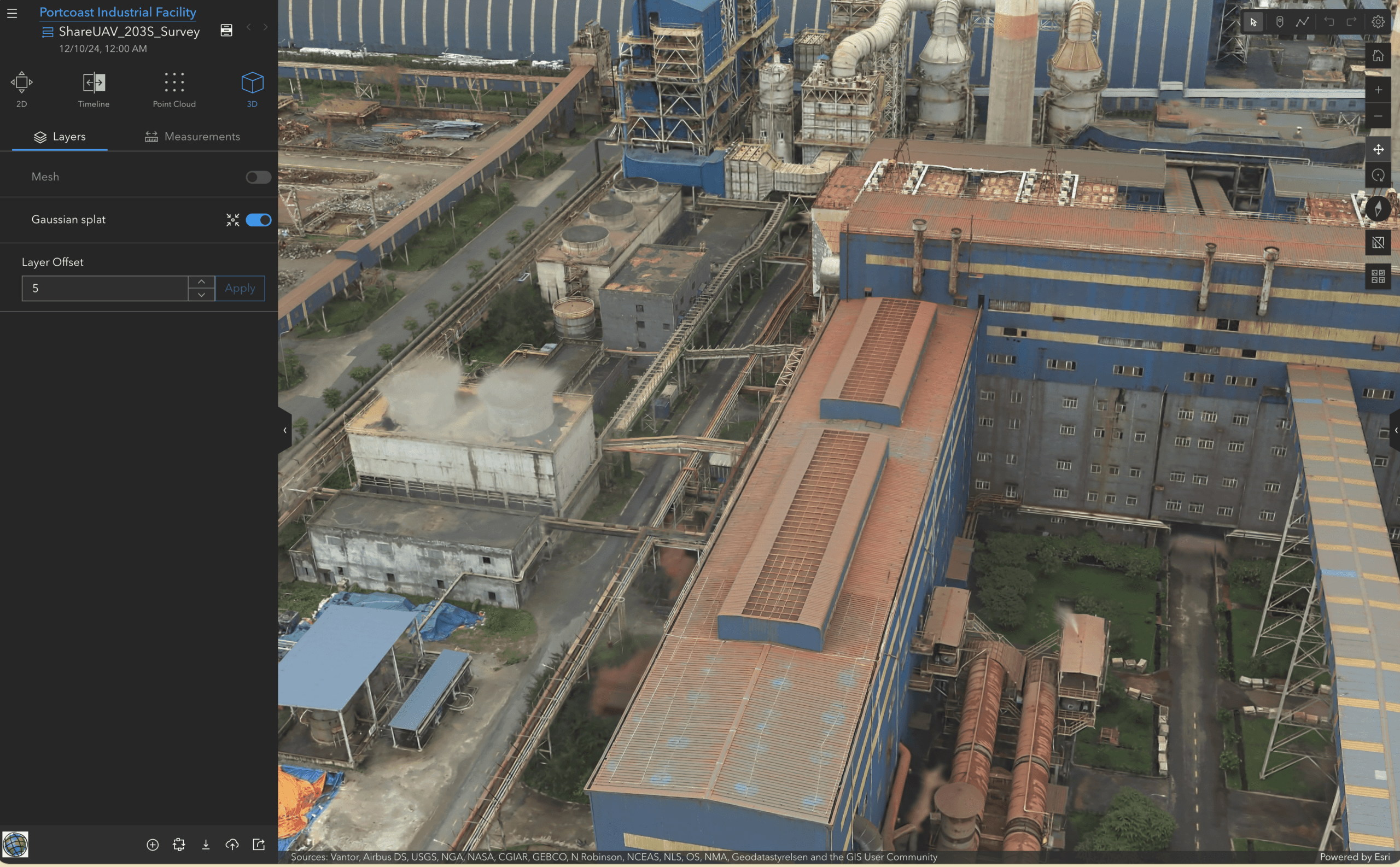
Esri has added cloud based Gaussian Splat generation to Site Scan for ArcGIS in its May 2026 release, letting drone teams produce splat layers directly from captured imagery without standing up GPU hardware of their own. The capability is gated to Custom Subscription accounts, Esri’s organization wide tier, and is currently unavailable to European customers who have explicitly requested EU hosting, which Esri attributes to AWS infrastructure limitations.
The splat work lands alongside a larger mission capacity that was rolled out in April and is the more significant operational change. Named user licenses can now process up to 5,000 images or 150 gigapixels per mission, whichever comes first. Custom Subscription accounts go to 10,000 images or 300 gigapixels. Esri’s framing is that dense, well connected image sets are what 3D Gaussian Splatting workflows actually need, splitting a corridor or a construction site across two or three smaller missions degrades the result, and the new limits let a single flight produce one cohesive output instead.
Site Scan generating splats in the cloud rounds out a pipeline that Esri has been assembling in public over the past year. The Geospatial Gaussian Splat layer shipped in ArcGIS 3.6 in late 2025, produced by the ArcGIS Reality Engine for survey grade outputs. The web side followed in February with the GaussianSplatLayer in ArcGIS Maps SDK 5.0, which streams those layers into SceneView applications. Capture to splat to web is now a continuous flow inside the Esri stack. Drone imagery in Site Scan, splat generation in the cloud, publishing as a 3D Tiles layer to ArcGIS Online, viewing in ArcGIS Pro or a browser.
The third update is 360° panorama publishing through oriented imagery. Site Scan can now push panos as oriented imagery layers into ArcGIS Online, which means an office based reviewer can step through a site in first person without leaving the GIS.
Esri has not published cloud splat generation pricing or per mission compute caps beyond the existing image limits. The full release notes and an associated explainer on splat generation are linked from the Site Scan May 2026 blog post.


