

Hesai has officially launched Kosmo, a capture system that combines lidar and high resolution imaging to reconstruct physical spaces as 3D Gaussian splats. Hesai is one of the largest lidar makers in the world, and Yole Group put its share of global passenger-car long-range lidar shipments at 43% in 2025. Kosmo is the company's first Gaussian splatting product, though Hesai sensors already sit inside SLAM scanners.
Hesai first previewed Kosmo in April as spatial intelligence hardware scheduled for release later in the year, then showed it at WAIC in July with an official launch set for the second half of 2026. According to its second quarter results, Hesai delivered initial Kosmo prototypes in July and secured orders from humanoid robotics companies including Galbot.
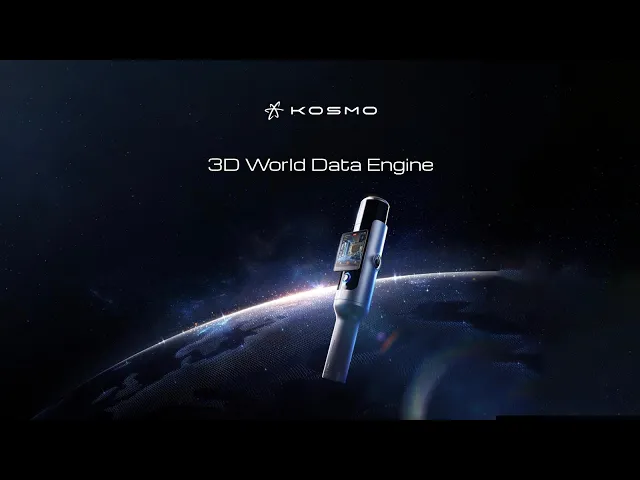
Kosmo launches as two products. Kosmo One is the handheld capture device, which Hesai calls the world's first 8K ultra HD AI spatial camera, and Kosmo World is the cloud platform that turns its captures into 3D data. Kosmo One pairs a Class 1, 1535 nm lidar with 569,000 points per second and 40 meters of range at 10 percent reflectivity with an 8K imaging system built on a one inch sensor and a high precision IMU, all synchronized to the microsecond. Hesai claims millimeter level geometric accuracy. Kosmo One captures at up to 8K, though exported files top out at 6K, and a typical 100 square meter room takes about 15 minutes to scan.
Reconstruction runs in Kosmo World rather than on the device. Hesai's Kosmo Spatial Core produces aligned 3DGS, mesh and depth outputs from a single reconstruction, uses generative AI to fill areas the scan missed, and segments the scene so individual objects can be identified and manipulated. Hesai puts model generation at up to about five times faster than comparable 3DGS products under similar conditions, but it has not published absolute processing times.
At the launch, Hesai showed Kosmo scans already in use. A Dairy Queen store that would have taken a professional team about 300 hours to model by hand was scanned and reconstructed in about 15 minutes and became the training environment for a Sharpa robot, which reached a 99 percent task success rate before being installed in the real store. Amap's Flying Street View already carries Kosmo reconstructions of the Gravity Art Museum and PIFO Gallery, and TRIC is using Kosmo for an immersive artwork based on Du Fu Thatched Cottage in Chengdu. Hesai also announced strategic partnerships with the embodied AI companies Galbot and Dexmal.
Additionally, the Hesai team built a lidar unit specifically tailored to Gaussian splatting that is available only through Kosmo. Kosmo features a fixed screen on the device and outputs HDR splats at launch. The design of the camera looks closer to a lightsaber than a camera, and it weighs about 1,200 grams with its battery handle, but there are several nice capabilities included. Hesai lists about 60 minutes of runtime from the standard battery and about 120 minutes from the extended battery, and you are able to continuously extend the battery life using a USB-C external battery that plugs directly into the device. However, the maximum time per capture is currently set to 45 minutes. Kosmo also comes with 512GB of on-device storage. Having used Kosmo for several months now, the output of the captures is fantastic.
Hesai positions the output primarily as training data for embodied AI and world models. Kosmo World assigns the splats to visual realism, the mesh to interactive objects and the depth data to spatial distance, and it can adapt rendered views to the camera of a target robot. Hesai also aims the same data at film, virtual production, game development and cultural heritage, and the April preview showed home design, where a scanned room becomes an interactive space with measurements, movable furniture and adjustable lighting.
Kosmo has already been used in high-end entertainment work. Pixar's Dylan Sisson scanned the plaza outside Pixar's Steve Jobs Building with an experimental Kosmo unit at the request of The Lab, an internal Pixar group, and rendered the resulting Gaussian splats in RenderMan. On October 5, Pixar published a RenderMan tutorial built on a Kosmo scan of the Pixar campus, tested with the RenderMan 28 beta ahead of native splat support in RenderMan 28, which Pixar has scheduled for this winter.
Kosmo exports splats as .ply and .sog files, meshes as .obj, and scenes as .usd and .usdz, along with raw images, point clouds and IMU data. Hesai lists NVIDIA Isaac Sim, Isaac Lab, Unreal Engine, RenderMan and Houdini as integrations. Hesai is a lidar maker listed on Nasdaq and the Hong Kong Stock Exchange, and it shipped 628,275 lidar units in the second quarter of 2026. It sells Kosmo both as integrated hardware and software and as a service that produces real world spatial data at scale for world model and physical AI developers.
Hesai is the latest and potentially largest company to offer a SLAM based camera whose primary output is Gaussian splatting. There continue to be strong signals that Gaussian splatting is a technology that is here to stay and be invested in.
Hesai has not published pricing or regional availability. Learn more here.