
Laskos Releases 360 Gaussian Pro With a Rebuilt COLMAP

360 Gaussian Pro is Laskos's paid version of 360 Gaussian, replacing SphereSfM alignment with a custom COLMAP build and folding SAM3 masking into the app.

360 Gaussian Pro is Laskos's paid version of 360 Gaussian, replacing SphereSfM alignment with a custom COLMAP build and folding SAM3 masking into the app.

Michael Rubloff

Michael Rubloff

Michael is the Founder and Managing Editor of Radiancefields.com

360 Gaussian Pro

Laskos has released 360 Gaussian Pro, a paid version of its free 360 Gaussian that replaces the alignment stack with a custom COLMAP build. The application trains 3D Gaussian splats from 360 video or image sequences locally, across a four stage pipeline of Extract, Masking, Alignment and Train.

360 Gaussian, which reached v1.4.5 in July, aligns through SphereSfM, which registers equirectangular material first and splits to cubemaps afterward, with optional Metashape and RealityScan routes and a slower pinhole workflow. 360 Gaussian Pro instead ships a custom source build of COLMAP carrying the GLOMAP global mapper, vocabulary tree loop detection, GPU bundle adjustment through Caspar and cuDSS, and CUDA accelerated Ceres.
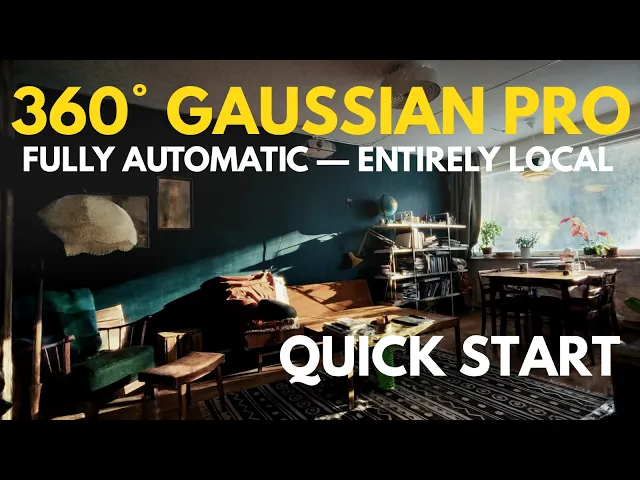
Masking moves into the application as well. 360 Gaussian Pro carries SAM3 keyword detection with a fisheye preset, custom masks and hand painting, and the Automasker listing that sold that capability separately now states that SAM 3 masking is built into the Pro app.

Extract accepts raw dual fisheye footage from Insta360 or DJI Osmo, stitched equirectangular material, or plain 2D video, with input support covering the Insta360 X4, X5 and X6, DJI Osmo 360, Antigravity A1 and DJI Avata 360. Enhancement photos from a smartphone, DSLR or drone can be added to the main 360 dataset. Train hands the result to LichtFeld Studio, Postshot or Brush, or any other trainer that reads a COLMAP dataset. The output is a sparse COLMAP model carrying camera poses and a sparse point cloud, alongside the extracted pinhole splits and their masks.

Every stage runs on its own or can be adjusted individually, and multiple processes can be queued overnight. Nothing is uploaded, and there is no cap on clip count or footage volume.

Requirements are a Windows PC with an NVIDIA RTX 20 series or newer GPU, 12 GB VRAM recommended, driver R580 or newer, and 16 GB or more of RAM. AMD and Intel graphics are not supported.

Pricing includes VAT and runs 20 euros for one week billed once with no auto renewal, 89 euros for one year, and 149 euros one time with free updates for all v1.x releases. A free trial needs no sign in. Keys arrive by email and are pasted into the app's License button, and payments run through Polar. It is available now for Windows through their website.

Thumbnail for Gaussian Splatting News episode 14

18:23

Watch · New every Monday

Open Source 4D Gaussian Splatting

Episode 14 · Nov 23, 2026

Open4DGS is out: an open-source pipeline for 4D Gaussian splatting from Arizona State University’s Narrative and Emerging Media program, with Contrast Media Labs writing the code.

Thumbnail for Gaussian Splatting News episode 14

18:23

Watch · New every Monday

Open Source 4D Gaussian Splatting

Episode 14 · Nov 23, 2026

Featured

Recents

Platforms

KIRI Engine 4.4 Brings 360 Video to 3DGS Scan

KIRI Engine 4.4 adds 360 video input to 3DGS Scan on the web and raises the scan limit to 500 photos or 5 minutes of video, alongside Manual Capture video.

Michael Rubloff

Nov 26, 2026

Platforms

KIRI Engine 4.4 Brings 360 Video to 3DGS Scan

KIRI Engine 4.4 adds 360 video input to 3DGS Scan on the web and raises the scan limit to 500 photos or 5 minutes of video, alongside Manual Capture video.

Michael Rubloff

Platforms

NVIDIA NCore 20.0.0 Adds Asynchronous Reads and zarr v3

NVIDIA NCore 20.0.0 adds zarr-python 3 support, zarr format v3 stores and asynchronous reading APIs, with faster reads of local and remote .itar archives.

Michael Rubloff

Nov 26, 2026

Platforms

NVIDIA NCore 20.0.0 Adds Asynchronous Reads and zarr v3

NVIDIA NCore 20.0.0 adds zarr-python 3 support, zarr format v3 stores and asynchronous reading APIs, with faster reads of local and remote .itar archives.

Michael Rubloff

Platforms

MicroPasts Releases a Splat Viewer for Cultural Heritage

MicroPasts splat-viewer 0.1.2 is a React viewer for 3D Gaussian splats built on Three.js and SparkJS, with a paradata record, a scale bar and splat telemetry.

Michael Rubloff

Nov 26, 2026

Platforms

MicroPasts Releases a Splat Viewer for Cultural Heritage

MicroPasts splat-viewer 0.1.2 is a React viewer for 3D Gaussian splats built on Three.js and SparkJS, with a paradata record, a scale bar and splat telemetry.

Michael Rubloff

Research

HiGS Splits the Splat Tile Three Ways to Render Faster

NVIDIA's HiGS renders Mip-NeRF 360 scenes 2.2x faster than SHARP-GS at 1080p and trains 2.3x to 3.0x faster than Faster-GS across three benchmark datasets.

Michael Rubloff

Nov 26, 2026

Research

HiGS Splits the Splat Tile Three Ways to Render Faster

NVIDIA's HiGS renders Mip-NeRF 360 scenes 2.2x faster than SHARP-GS at 1080p and trains 2.3x to 3.0x faster than Faster-GS across three benchmark datasets.

Michael Rubloff

Thumbnail for Gaussian Splatting News episode 14

18:23

Watch · New every Monday

Open Source 4D Gaussian Splatting

Episode 14 · Nov 23, 2026

Trending Articles
  1. TRENDING
    Loading...
  2. TRENDING
    Loading...
  3. TRENDING
    Loading...
Michael Rubloff

Written by Michael Rubloff

Michael is the Founder and Managing Editor of Radiancefields.com

More from Michael Rubloff

More from Michael Rubloff

Platforms

KIRI Engine 4.4 Brings 360 Video to 3DGS Scan

KIRI Engine 4.4 adds 360 video input to 3DGS Scan on the web and raises the scan limit to 500 photos or 5 minutes of video, alongside Manual Capture video.

Michael Rubloff

Nov 26, 2026

A phone in landscape showing a Gaussian splat street scene with palm trees generated from 360 video in KIRI Engine

Platforms

KIRI Engine 4.4 Brings 360 Video to 3DGS Scan

Michael Rubloff

Nov 26, 2026

A phone in landscape showing a Gaussian splat street scene with palm trees generated from 360 video in KIRI Engine

Platforms

KIRI Engine 4.4 Brings 360 Video to 3DGS Scan

KIRI Engine 4.4 adds 360 video input to 3DGS Scan on the web and raises the scan limit to 500 photos or 5 minutes of video, alongside Manual Capture video.

Michael Rubloff

Nov 26, 2026

A phone in landscape showing a Gaussian splat street scene with palm trees generated from 360 video in KIRI Engine

Platforms

NVIDIA NCore 20.0.0 Adds Asynchronous Reads and zarr v3

NVIDIA NCore 20.0.0 adds zarr-python 3 support, zarr format v3 stores and asynchronous reading APIs, with faster reads of local and remote .itar archives.

Michael Rubloff

Nov 26, 2026

NCore point-to-camera projection of lidar points onto a camera image from NVIDIA Hyperion data

Platforms

NVIDIA NCore 20.0.0 Adds Asynchronous Reads and zarr v3

Michael Rubloff

Nov 26, 2026

NCore point-to-camera projection of lidar points onto a camera image from NVIDIA Hyperion data

Platforms

NVIDIA NCore 20.0.0 Adds Asynchronous Reads and zarr v3

NVIDIA NCore 20.0.0 adds zarr-python 3 support, zarr format v3 stores and asynchronous reading APIs, with faster reads of local and remote .itar archives.

Michael Rubloff

Nov 26, 2026

NCore point-to-camera projection of lidar points onto a camera image from NVIDIA Hyperion data

Platforms

MicroPasts Releases a Splat Viewer for Cultural Heritage

MicroPasts splat-viewer 0.1.2 is a React viewer for 3D Gaussian splats built on Three.js and SparkJS, with a paradata record, a scale bar and splat telemetry.

Michael Rubloff

Nov 26, 2026

MicroPasts

Platforms

MicroPasts Releases a Splat Viewer for Cultural Heritage

Michael Rubloff

Nov 26, 2026

MicroPasts

Platforms

MicroPasts Releases a Splat Viewer for Cultural Heritage

MicroPasts splat-viewer 0.1.2 is a React viewer for 3D Gaussian splats built on Three.js and SparkJS, with a paradata record, a scale bar and splat telemetry.

Michael Rubloff

Nov 26, 2026

MicroPasts

New to Gaussian Splatting? Start here

Radiance fields, explained from the ground up: what a Gaussian splat is, how to capture one, and which tools and gear to start with.

Newsletter

Keep up with the field.

New research, tools and captures from the Radiance Fields newsroom, in your inbox. Free, no spam.

Gaussian Splatting News on YouTube

The week in radiance fields, every Monday.

Gaussian Splatting News on YouTube

The week in radiance fields, every Monday.

Gaussian Splatting News on YouTube

The week in radiance fields, every Monday.

Gaussian Splatting News on YouTube

The week in radiance fields, every Monday.