
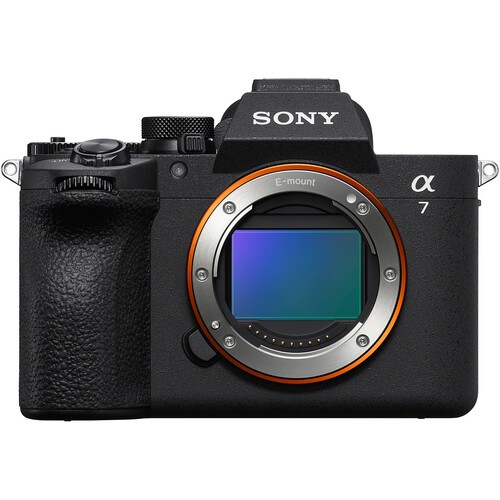
Sony has announced the α7V, its first update to the mid-range Alpha line in four years and arguably the most consequential upgrade yet for creators working in Gaussian Splatting and radiance-field reconstruction. The camera introduces a new 33-megapixel partially-stacked Exmor RS CMOS sensor and the BIONZ XR2 processor, a redesigned architecture that dramatically increases readout speed and brings Sony’s integrated AI compute from the flagship α1 II into a more accessible price tier.
For volumetric capture, the implications are meaningful. Faster readout directly reduces rolling-shutter distortion, one of the most persistent challenges when generating clean radiance field reconstructions from handheld or multi-camera sequences though papers like the Unscented Transform help tackle this. The α7V’s ability to shoot blackout free bursts at up to 30 fps with full AF/AE tracking means capture pipelines dependent on high frame rate redundancy and strong frame to frame alignment now have a far stronger foundation.
The partially stacked sensor also brings improved dynamic range, now rated at 16 stops, and a native ISO 100–51200 window. For creators who frequently operate in mixed or minimal lighting, the α7V represents a meaningful upgrade over the α7 IV.
Video performance sees a parallel boost: the camera now records 4K60p oversampled from 7K, 4K120p using a Super35 crop, and 1080p at 240 fps, offering several viable pathways for video based splatting and neural scene reconstruction. A redesigned graphite Sigma heatsink supports extended recording at high frame rates.
Autofocus also receives a significant generational jump. The new processing engine unifies the AI unit and image processor into one compute block, supporting real-time tracking across 759 phase-detect points, expanded subject recognition, and new Pre Capture buffering that rolls up to a second of footage before the shutter is triggered. However, you’re going to want to be shoot on manual focus or at least with a deep depth of field for gaussian splatting.
Sony has refined the body and interface too, borrowing the α7R V’s 4 axis vari-angle touchscreen, adding dual USB C ports, and improving battery efficiency by more than 20%. Wireless performance also steps forward with Wi-Fi 6 across 5 GHz and 6 GHz bands. Having the dual USB C is a very nice upgrade.
For many creators in the radiance field ecosystem, this may become the new default workhorse, representing a balance of speed, fidelity, and accessibility that aligns with rapidly evolving 3D capture practices.