

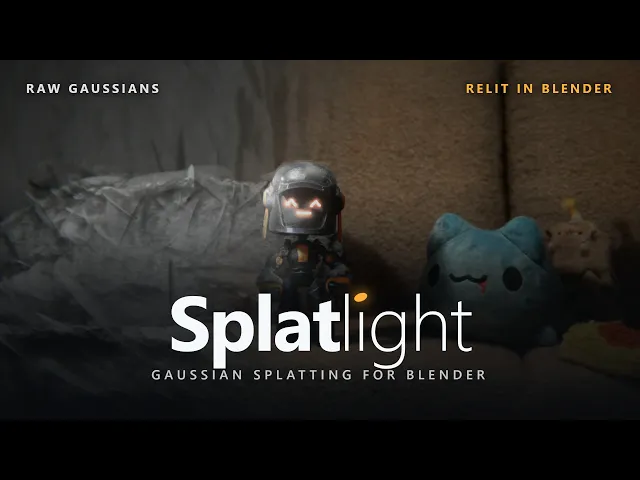
Javier Herrera has released Splatlight, a Blender add-on that makes gaussian splats respond to scene lights and cast self shadows.
A splat imported into Blender has carried the lighting baked into its capture and ignored every lamp around it. Splatlight derives shadowing from each gaussian's own opacity, so shadows stay soft where the capture is wispy and solid where it is dense, and one slider crossfades the capture between its original appearance and a fully lit object.
Splatlight supports Blender 4.2 through 5.2, ships under the GPL, and renders in EEVEE and Cycles. Herrera does not recommend Cycles, because the transparency light paths the method depends on tank performance.
The free LITE tier is the whole viewer and relighter, covering import, shading, relighting, self-shadowing, and export back out to standard .ply.
Splatlight Pro is listed at $35 and adds proxy mesh binding, where one click builds a watertight proxy and every gaussian then rides its surface through armatures, lattices, shape keys, cloth and softbody. Weight painted masks transfer PBR values onto the splats. Pro also carries crop, floater shaving, merge and decimate, 4D timeline playback, camera import from a COLMAP or nerfstudio solve, and a lighting bake that Herrera says survives export back to .ply and still reads correctly in SuperSplat.
Two of the generators run locally. Splatlight trains a 3DGS scene from any video where the camera moves and returns the solved camera parented and aligned for match moving, and a second builds a splat from a single image. A third path sends a prompt to World Labs Marble and imports the returned world as a Blender object. Marble is a separate service, not included with Splatlight, billed on the user's own API key at roughly $1.20 a world with a $5 minimum top up.
Herrera credits Houdini's self-shadowing as the prompt for building the add-on. Neither the listing nor the announcement states a splat count ceiling or a GPU floor for the local training path. Splatlight is available now on Gumroad and Superhive.


