
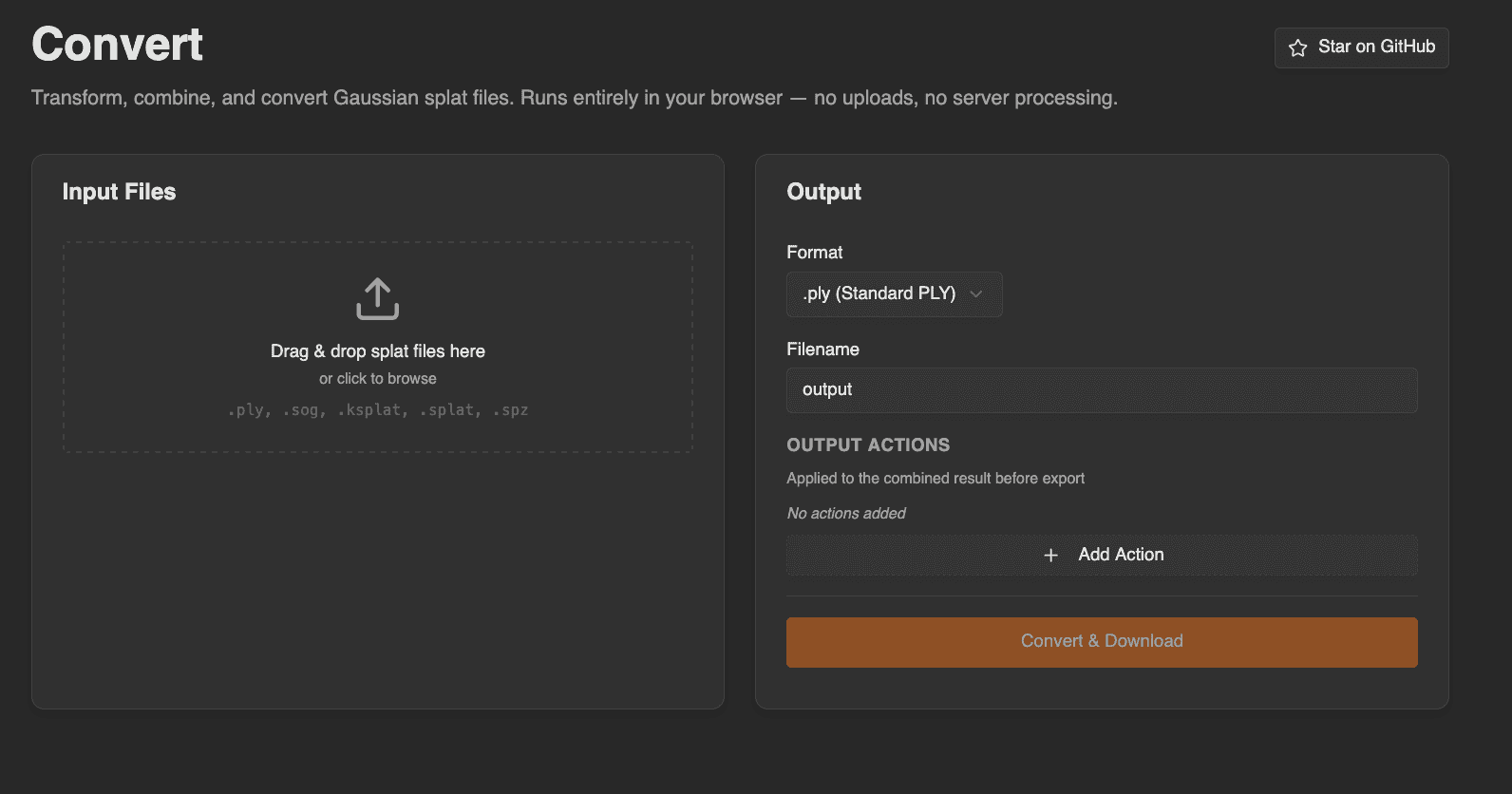
When SplatTransform first appeared, it solved a very specific, and very real, problem of how to reliably move gaussian splats between formats, coordinate systems, and runtimes without breaking a pipeline. It ran directly from the command line tool.
With today’s release of SplatTransform v1.0.0, that framing no longer holds. This release marks an exciting shift from CLI tool to a library, designed to sit inside modern JavaScript and TypeScript applications, either on the server, in the browser, and everywhere splats now live.
SplatTransform has been refactored into a library + CLI model, exposing a programmatic API that mirrors that expands what was previously possible only through flags and arguments.
For teams building custom viewers, ingestion pipelines, compression services, or automated QA around splat data, this is the unlock. You can now import SplatTransform directly. Crucially, this API works both in Node.js and in the browser.
SplatTransform now abstracts file systems entirely. Inputs can come from URLs, memory buffers, or ZIP archives. Outputs can be written back to memory or packaged for distribution, without assuming a local disk or Node specific primitives.
The new statistical summary action allows developers to compute per column metrics directly on splat data. In practice, this turns SplatTransform into a lightweight diagnostic tool. With larger scenes becoming more prevalent, this is a super nice tool to have and helps measure splat quality, detect anomalies, and validate datasets programmatically.
There are also a couple of additional items baked into the release. K-means initialization for SOG compression has been improved, contributing to more stable clustering. GPU device handling has also been simplified through dependency injection. A comprehensive test suite has been added.
PlayCanvas is continuing to position gaussian splats as a manipulable, analyzable data format that can flow through modern web architectures. By elevating SplatTransform into a reusable library, with browser support, streaming I/O, and statistical tooling, they are laying groundwork for splats to become something closer to an imaging medium.
This a trend that I fully expect to see throughout the industry, as more companies realize they can reconstruct their work into lifelike 3D. SplatTransform continues to be both open source and MIT Licensed.


