
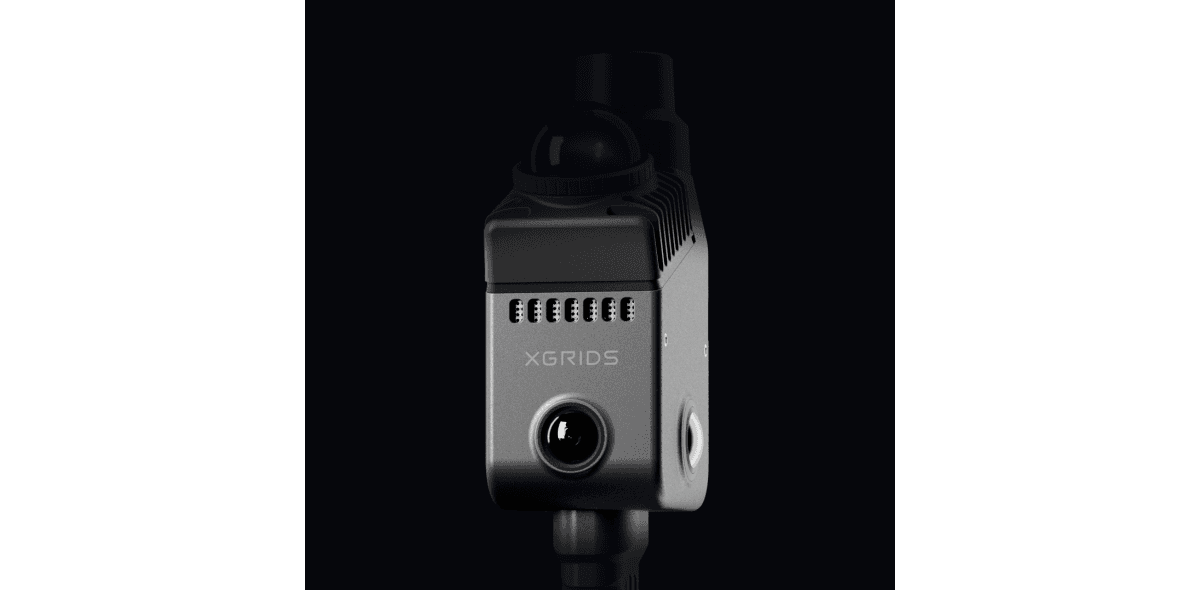
Today XGRIDS is announcing the Lixel K2 at the 3DISE conference by Mindy Li. The camera is the successor to the K1 handheld scanner that the company launched as its entry point into the 3DGS capable LiDAR market. The K2 carries the same core architecture, mobile LiDAR with integrated cameras, processed through LCC Studio to produce their splats.
The most significant addition is built in RTK. The K1 had no onboard GNSS positioning, which meant absolute accuracy depended on post processing with ground control points or external GNSS hardware. The K2 folds RTK directly into the device, and the accuracy numbers are competitive with dedicated survey instruments. 3 cm RMSE absolute accuracy in both elevation and horizontal, available in real time without post-processing. Relative accuracy is 1 cm RMSE. Post-processed point cloud thickness comes in at ≤ 1 cm. Repeatability is 2 cm.
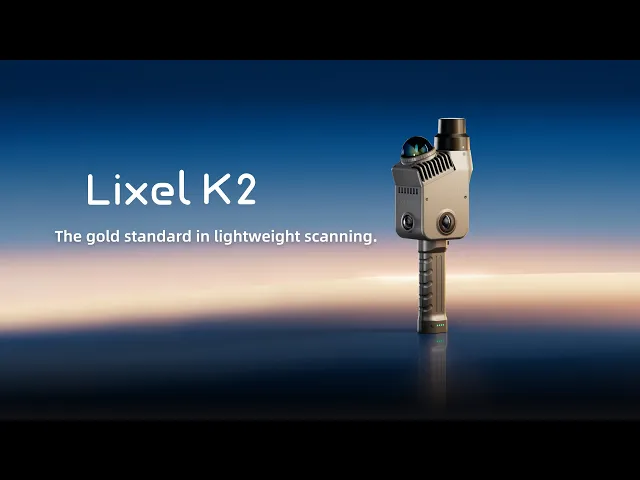
The camera system is also changed. Where the K1 used dual 48-megapixel panoramic cameras, the K2 moves to three sensors. Two fisheye cameras covering a 200° × 200° panoramic field of view, plus a dedicated forward facing camera with a 100° × 85° field of view. Each sensor resolves at 4000 × 3000 on a 1/2” CMOS. The forward camera feeds into visual aided positioning, which uses visual odometry alongside LiDAR SLAM to maintain tracking in featureless or repetitive environments where LiDAR alone can drift.
The LiDAR module specs are largely carried over from the K1: 200,000 pts/s, 360° × -7° to +52° field of view, 40m range at 10% reflectivity with a 100m maximum, Class 1 at 905 nm. Point cloud enhancement is listed as supported, which in the LCC pipeline refers to the densification step where 3DGS-derived geometry fills gaps in the raw scan data.
Many people might wonder how the device sits between the Portalcam and the L2Pro, but the device actually makes a lot of sense. Output formats are .las for point cloud and .jpg for imagery; the LCC file format, which XGRIDS open-sourced last year, handles the 3DGS scene container on the software side.
On the hardware side, the K2 is built around an aviation grade aluminum body with IP54 ingress protection, a USB 3.1 Gen2 data interface, 512GB internal eMMC storage, and dual band WiFi (802.11 a/b/g/n/ac, 2.4 and 5 GHz). The device runs on 14.4V at under 20W. Weight is approximately 1,200 grams including the clip on 1,900 mAh battery, which provides 1.5 hours of operation. Operating temperature range is -20°C to 50°C. I tried the K2 yesterday and it is very light to use.
Included accessories are a phone mount and a control point base. An extension pole and adapter kit is available optionally.
More information about the K2 can be found here.