
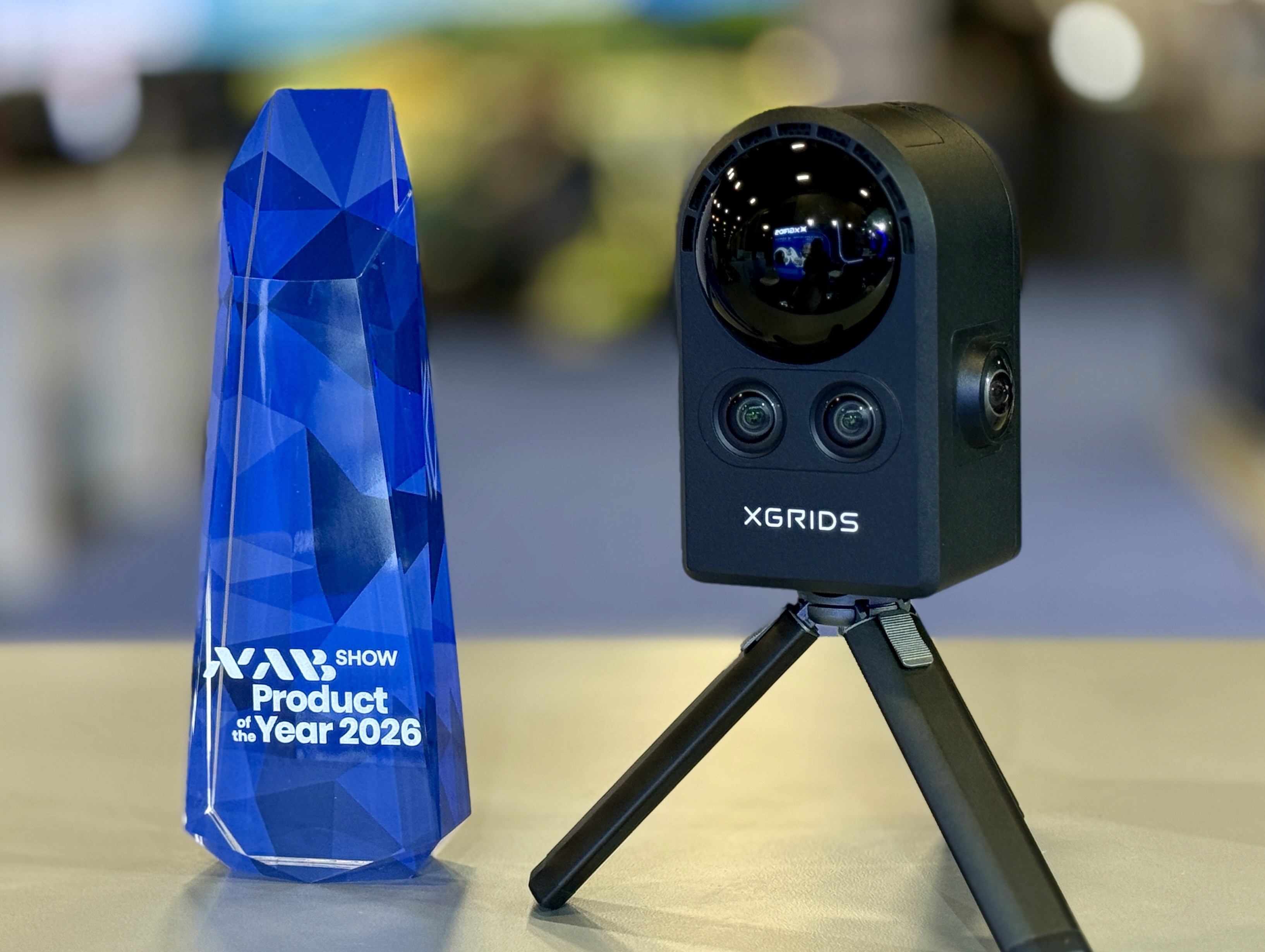
The incredible year for spatial camera company XGRIDS continues. Launched in early September, XGRIDS’ newest device, the PortalCam, rapidly connected with professionals and prosumers alike, making high quality Gaussian Splatting capture broadly accessible. Today those efforts were recognized, taking home Best Product in the Intelligent Technology category at this year’s NAB Show in Las Vegas, one of the media and entertainment industry’s most competitive awards programs.
Editor’s Update: After publication, XGRIDS won an additional three awards at NAB including 1) Graphics editing, VFX & Switches, 2) Best Camera, and 3) Remote Production.
I just returned from the show and can confirm there was significant interest in both Gaussian Splatting and XGRIDS in particular.

The PortalCam carries a four-camera array: two fisheye lenses with a 200° field of view and two front-facing cameras at 100° × 85°, all shooting at 4000 × 3000 pixels off 1/2-inch CMOS sensors. The LiDAR unit captures 856,000 points per second at up to 60 meters, with a 180° × 180° field of view that makes it effectively omnidirectional for most indoor and outdoor scenarios.
Paired with the LCC Scan mobile app and XGRIDS’ LCC Studio software, a captured scene moves rapidly from raw sensor data to a navigable Gaussian Splat. The LCC (Lixel CyberColor) file format, which recently reached V2.0, gives that output a portable, interoperable container that travels into game engines, web viewers, VR platforms, and increasingly, broadcast and virtual production pipelines.
That last use case is what brought the PortalCam to NAB in the first place, where I was fortunate enough to be on a panel with the XGRIDS team. Virtual production teams have always needed fast, credible ways to capture real world environments for LED volume backgrounds and pre-vis. The PortalCam, at $4,999 for the Standard Kit, sits at a price point where a mid-size production company can own one outright and deploy it on location without a dedicated survey crew.
The NAB recognition is a signal that the M&E industry is paying serious attention to where Gaussian Splatting is headed. XGRIDS has spent several years building out its spatial computing stack piece by piece, scanners, file formats, SDKs, and the PortalCam is where that infrastructure comes together in a form factor a camera operator can actually use on set.
Congratulations to the XGRIDS team, the first, I suspect, of many awards to come.
If you’re interested in purchasing a PortalCam, you can do so here. Using the code RADIANCEFIELDS at checkout supports RadianceFields.com.


