
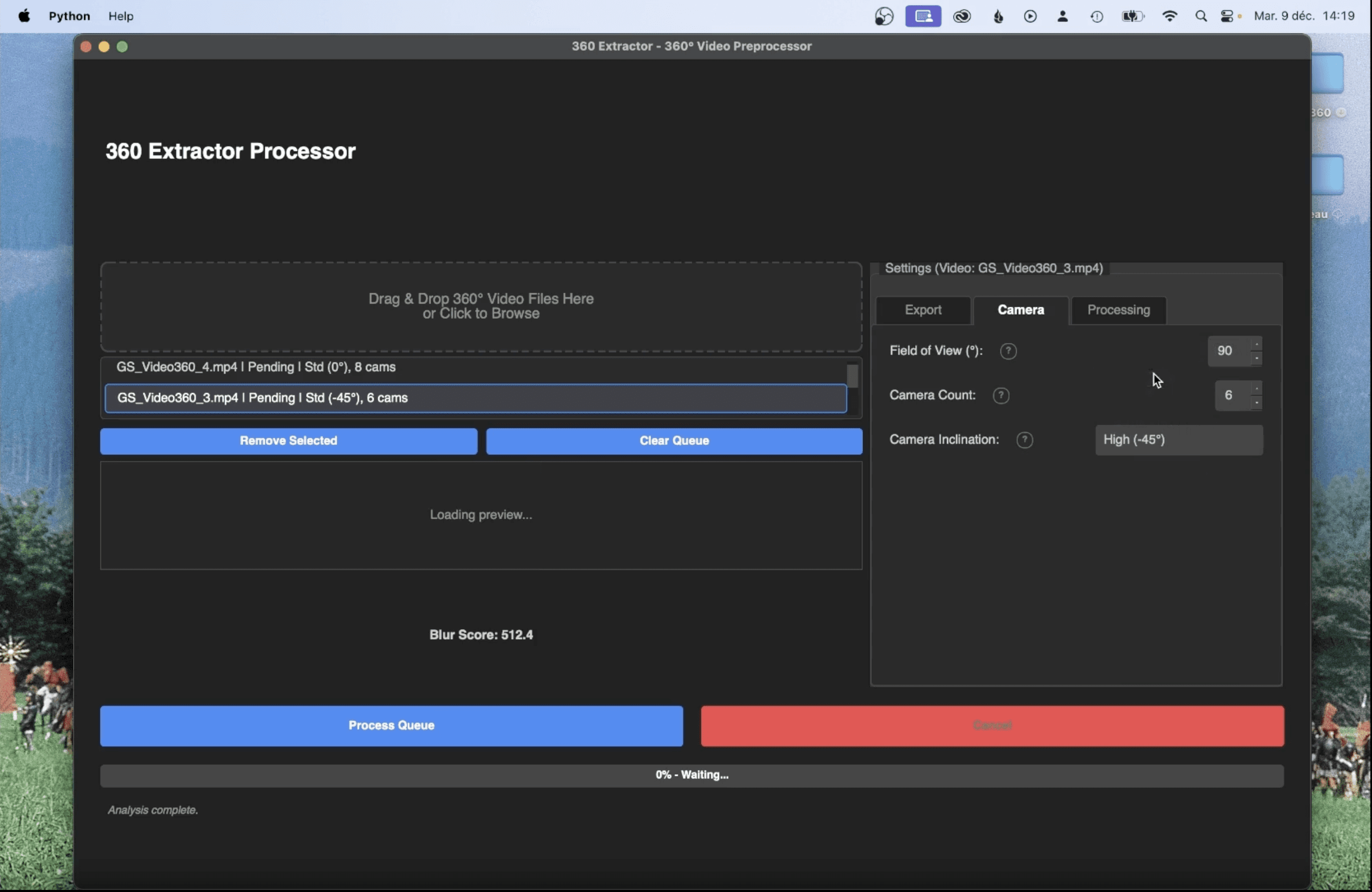
The surge of interest in radiance field workflows keeps revealing that the cleaner your data, the better your splats. Yesterday developer Nicolas Diolez published a preprocessing tool, 360 Extractor. It’s a cross platform desktop application that turns equirectangular footage into rectilinear pinhole datasets built for Gaussian Splatting, COLMAP, and RealityScan.
360 Extractor parses 4K–8K footage into a grid of virtual cameras whose behavior can be tuned for the specific capture environment. Two camera passes, six camera cube setups, or full 36 camera distributions based on Fibonacci tiling and allows you to adjust pitch and inclination. For radiance field creators who have been manually orchestrating these projections with scripts and one off tools, this makes it a handy tool.
One of the more compelling touches is the automated blur filter, which uses a Variance of Laplacian pass to flag frames too soft to meaningfully contribute to a reconstruction. A built in analyzer even computes an optimal sharpness threshold by sampling frames from the selected video.
But the headline feature is operator removal. Using YOLOv8, 360 Extractor can detect humans in a scene and either drop those frames entirely or generate perfectly named masks for RealityScan. For creators using 360 cameras where the operator is almost impossible to hide, this alone may justify the tool.
Videos can be dragged into a batch queue, each file can be given its own extraction interval or camera configuration, and the shared settings panel updates dynamically as different items are selected. Processing is multithreaded and responsive, pushing through heavy footage on both macOS (with Apple Silicon optimizations) and Windows. Under the hood, 360 Extractor sticks to widely used libraries like Python, PySide6, OpenCV, but the interface is polished enough that the underlying scripts fade away.
RealityScan compatible .mask.png conventions are generated automatically. Because the project integrates Ultralytics’ YOLOv8, it ships under AGPL-3.0, a choice that foregrounds openness but requires derivative tools to remain equally transparent.
For anyone working with 360 rigs and hoping to sidestep the usual conversion headaches, 360 Extractor is free and available through GitHub.


