
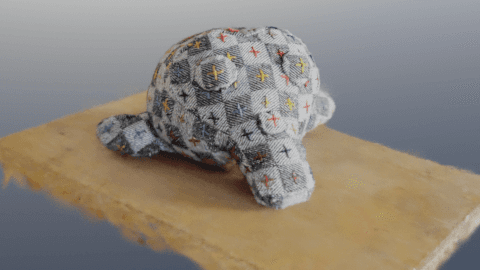
Blender 5.3 will add native 3D Gaussian Splat import and rendering, with PLY and SPZ v4 file support across Workbench, EEVEE, and Cycles.
Gaussian splat work in Blender previously required an add-on such as BlendSplat. The Blender Foundation opened a design task for native import in June 2026, and the implementation arrived via PR#163102.
Splats are stored as point clouds using a new "3D Gaussian Splats" type on the PointCloud data-block, alongside the existing "Points" type. Each splat carries position, scale as a Vector, rotation as a Quaternion, and opacity and base radiance together in a 4D Vector attribute called radiance:base. Spherical harmonics coefficients for view-dependent color are stored as radiance:sh_{index} Vectors, ordered L=1 M=-1, L=1 M=0, L=1 M=1, L=2 M=-2, and continuing from there.
PLY files containing splats typically use Z-forward, -Y-up coordinates, and the importer auto-detects whether a file contains a splat from its geometry and attributes. SPZ through v4 is also supported, with automatic coordinate conversion to Blender's convention, though files saved outside the expected convention may need manual adjustment. Neither format has export support in 5.3.
Three geometry nodes changes ship in 5.3. A Set Point Cloud Type node switches a PointCloud data-block between the Points and 3D Gaussian Splats types. An Import SPZ node handles SPZ loading procedurally. The Import PLY node now detects splat files and routes them to a PointCloud output, with the output socket renamed to Geometry.
The release notes list three known limitations. Performance is not ideal. The pipeline assumes sRGB color space, and the combination of low opacity with high radiance can render incorrectly under Cycles and EEVEE's linear pipeline. Apply Transform does not correctly handle scale, rotation, or spherical harmonics attributes.
All three engines use an emissive shader by default, driven by the radiance attribute and applied automatically without manual node setup. Replacing the Emission node with a Diffuse BSDF enables rudimentary relighting. Experimental builds are available here.


