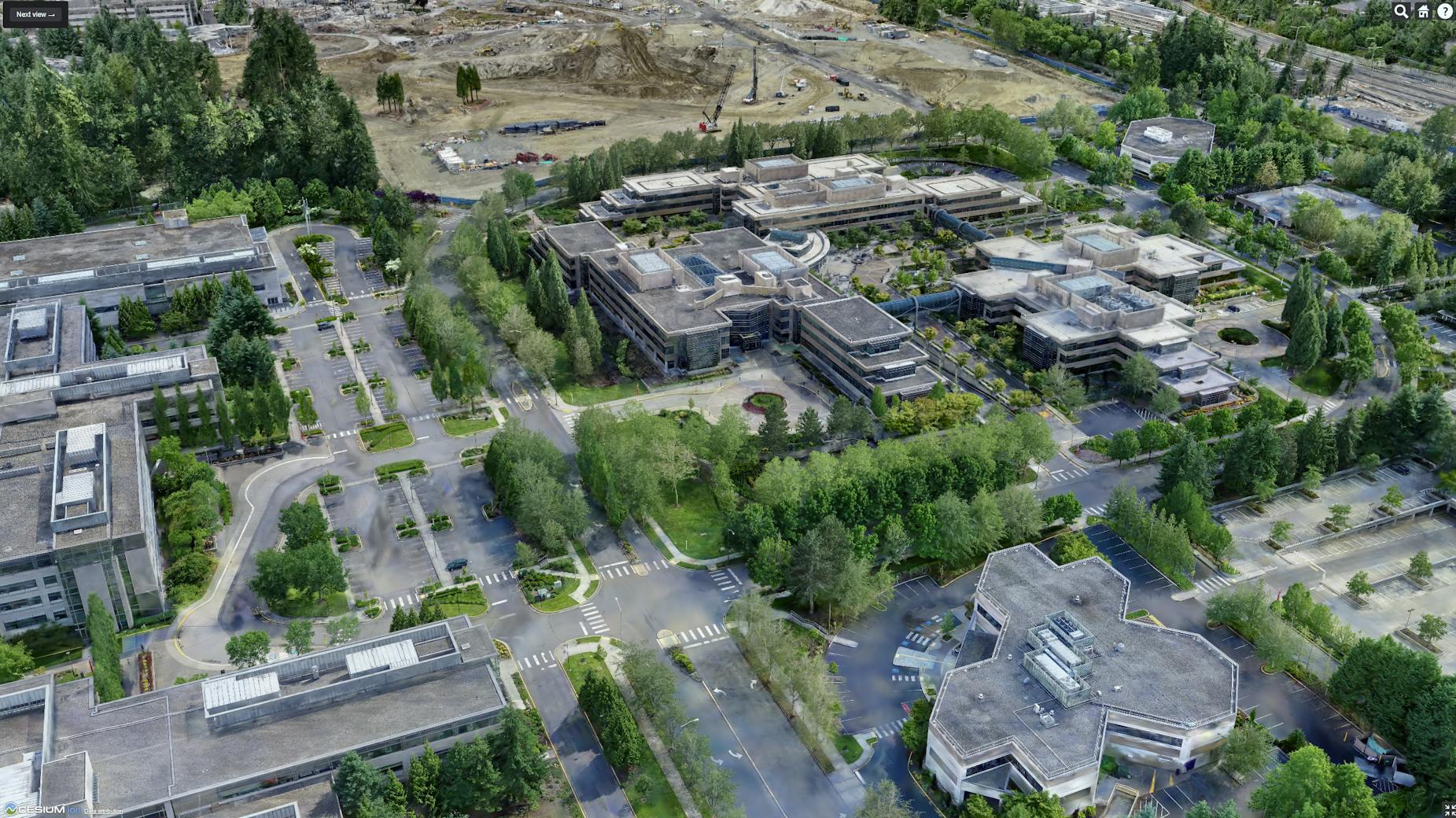
Cesium has rolled out 3D Gaussian splat support with hierarchical level of detail (LOD) across its core stack, including CesiumJS, Cesium for Unreal, and Cesium ion. The release uses 3D Tiles as the spatial index and glTF as the payload, allowing splat datasets to stream from city scale down to sub centimeter detail without loading the full reconstruction at once.
The announcement consolidates roughly a year of work that began with experimental 3DGS support in CesiumJS in mid 2025 and progressed through the standardization of KHR_gaussian_splatting and KHR_gaussian_splatting_compression_spz_2 at Khronos earlier this year, followed by Cesium’s first shipping implementation of the extension in CesiumJS 1.139 and Cesium for Unreal v2.23.0 in March. With LOD now in place, the pipeline reaches the throughput levels typically required for production geospatial workloads.
The base glTF extension stores splats as point primitives, which means renderers without 3DGS support fall back to a sparse point cloud rather than failing outright. Compression is handled by the SPZ extension, the open source format contributed by Niantic Spatial. SPZ achieves up to 90% size reduction relative to PLY using quantization plus gzip, and version 2.0.0 added improved rotational accuracy by encoding rotations as normalized quaternions, a change driven specifically by artifacts observed on long, linear features like antennas, power lines, and rails during geospatial evaluations.
3D Gaussian splats are slated to be part of the proposed 3D Tiles 2.0 OGC community standard. Khronos published the KHR_gaussian_splatting release candidate in February 2026, with full ratification targeted for Q2 2026.
With iTwin Capture technology integrated into Cesium ion (a result of Bentley’s 2024 acquisition of Cesium), users can upload source photos and have the platform reconstruct a 3D Tileset as a mesh, point cloud, or 3D Gaussian splats. The workflows are accessible through the ion web interface and via REST APIs, supporting both manual uploads and automated production pipelines. Output tilesets are georeferenced and can be combined with Cesium World Terrain or Google Photorealistic 3D Tiles.
CesiumJS implements 3DGS rendering through specialized shaders for volumetric rendering, with sorting accelerated via WebAssembly. Cesium for Unreal now streams 3DGS tilesets directly from Cesium ion, and Cesium says support for Cesium for Unity and other runtimes is on the roadmap based on community feedback.
I’m quoted in the announcement on the significance of the LOD step:
The barriers to working with Gaussian splatting continue to fall. With a glTF extension and LOD support now part of 3D Tiles, developers can increasingly work with splats within familiar tools and workflows. Gaussian splats are quickly becoming a professional, scalable medium for delivering lifelike 3D on the web.
The integration is being positioned by Cesium and its collaborators, Khronos, OGC, Esri, and Niantic Spatial, as the geospatial community’s contribution to bringing splats into mainstream graphics pipelines. Khronos president Neil Trevett framed the move as elevating SPZ “from an open-source project into a royalty-free open standard,” providing the IP certainty enterprises need to deploy at scale. OGC’s Scott Simmons added that the same approach used for 3D Tiles will ensure splats sit “in the right place” for geospatial analysis, alongside meshes, terrain, and imagery.
Target use cases highlighted in the post include infrastructure monitoring, telecom tower maintenance, electrical utility and substation inspection, real estate, media and entertainment capture, and long term asset monitoring.
Cesium ion offers free community accounts for uploading photos and producing reality models. Live examples are available in the Cesium Sandcastle.
The original announcement is available here.