
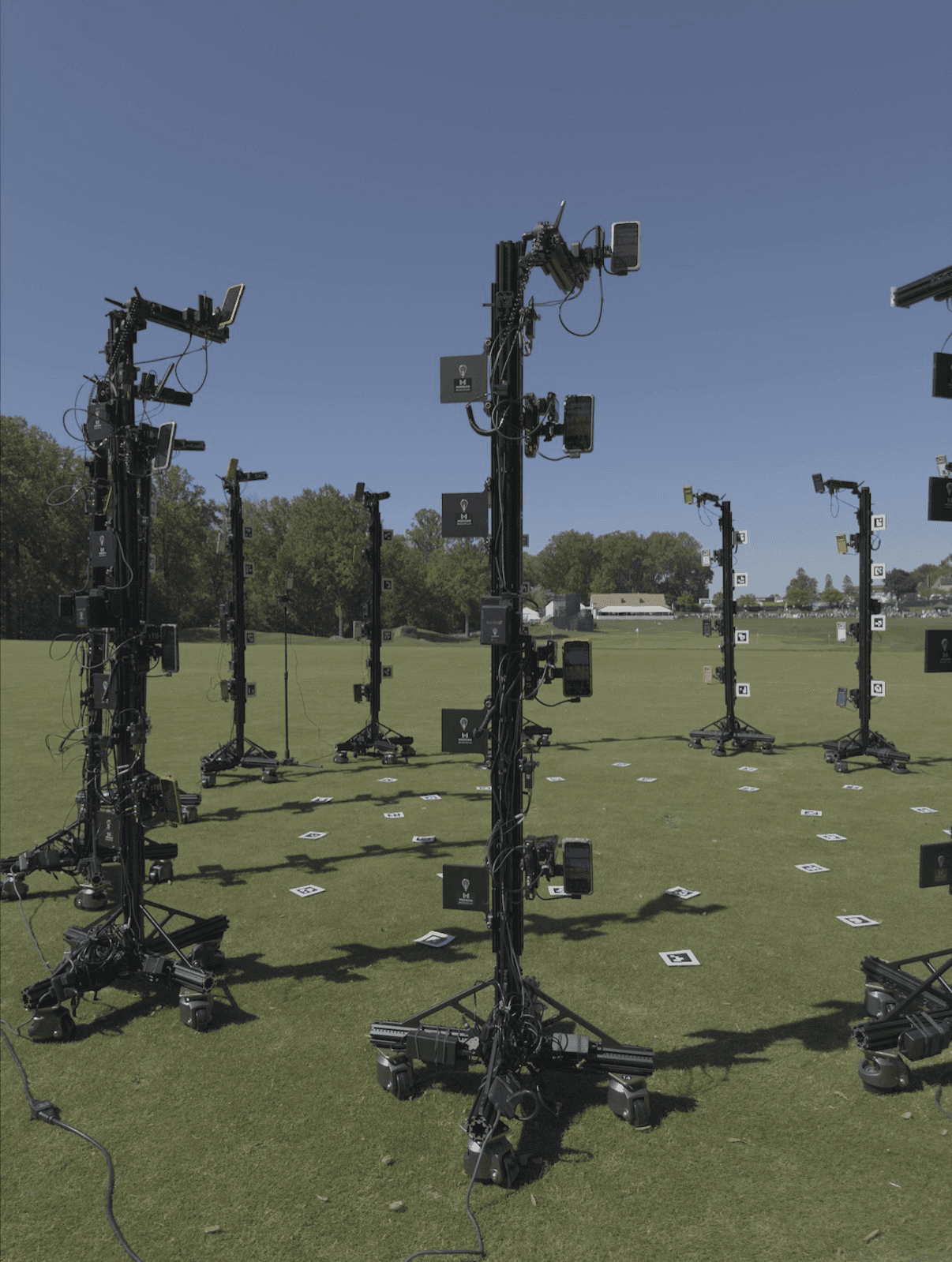
The director’s skepticism immediately dispelled as they realized what they had. He was suddenly looking at a collection of lifelike 3D videos of some of the most famous golfers on the planet, who just a day earlier had been beginning their tournament. Faced with a question of how this could be possible, the only answer was of course gaussian splatting.
When Radiant Images rolled into the 2026 PGA Championship at Aronimink Golf Club for T-Mobile earlier this week, the brief was the kind that a couple of years ago would have represented an extreme challenge. It was a live, nationally watched broadcast, with hundreds of thousands of fans on-site, four pro golfers on the clock, and a fast turnaround. However, the promise of gaussian splatting is too high to ignore. Lifelike 3D video, rendering in real time on mobile devices.
When you think of 4DGS, the default is to imagine multi million dollar camera rigs. That’s why when the morning of the team arrived at 5:30 AM with 56 iPhone 17 Pros, you would be forgiven for being skeptical. However, Radiant settled on the 17 specifically because of the genlock support and vapor chamber cooling, which has made thermal throttling during sustained ProRes RAW capture a non issue in indoor conditions and manageable outdoors. All of the devices were networked over a private 5G connection rather than the usual cable bundle that a conventional multi camera array demands. Moving the rig means breaking all of that down and rebuilding it. With the wireless approach, repositioning takes about ten minutes.
The first golfer hit the rig at 8 AM sharp, but the Radiant team was already well set up and tested for the rapid iteration of golfers who were here to work. Among the golfers captured were some of the best in the world, including Max Homa, Min Woo Lee, Kyle Berkshire, and Wyndham Clark. The last of four scans wrapped at 11:30 AM, with each individual capture session taking roughly five minutes per athlete. The capture format was ProRes RAW, 4K Open Gate, 60 fps. The raw footage across the four golfers totaled roughly 20 terabytes.
Though the filming process itself is done in real time, the conventional pipeline for a shoot of this size, download, sync, trim, reorient, color grade, transcode, upload, and then process, would have taken hours before any 4DGS work could even start. Elnar Mukhamediarov walked through the numbers with me. At minimum two hours per ten second clip in the traditional flow, multiplied across four golfers, before factoring in the offload time for 20TB of ProRes RAW. With taking the captures at face value, this would be nearly a day of just offloading and preparing the data.
Radiant’s workaround is to push the per clip work onto the phones themselves. A proprietary app running on each device handles file access over the 5G network, and crucially, each phone individually trims, rotates, color grades, and transcodes its own selected clip after a single in/out command from the operator. A low-bitrate witness camera streams playback in real time so the team can pick selects on set. In testing at the shop over WiFi, that step took about ten minutes. In the field over 5G, it ran closer to five. The four golfers were delivered into Gracia’s cloud for 4DGS processing in roughly 20 minutes total. Gracia’s turnaround on the 4DGS reconstructions themselves was about 24 hours from receipt of footage.
While Gracia was processing the 4DGS assets, the team needed something tangible for the director to design camera moves against and ultimately for broadcast approval. So immediately after each take, they pulled a single frame from the rig and ran a normal 3DGS reconstruction right there on set. That doubled as a validation pass for the rig itself, confirming that the genlock was holding, no cameras had been lost, and the SfM was registering cleanly. The 3DGS asset then served as the stand-in for camera move design. When the 4DGS came back from Gracia, the approved moves dropped in. Nine iterations of camera work were locked through this loop.
Fortunately, that same morning, Postshot 1.1 had formally shipped PPISP (the photometric compensation). Mukhamediarov tested it immediately and reported a meaningful reduction in floaters, particularly in the grass.
Because the splats coming out of Gracia are not regenerated per frame as independent assets, but rather are the same splats moving through space with velocity and direction, it allowed the team to ramp speeds freely. The original capture was 60 fps, and some elements in the final broadcast piece are slowed to 240 fps, with others at 120 fps, with freeze moments in between.
However, Radiant’s work on the course didn’t end at the tee box. PGA gave Radiant less than ten minutes to capture the surrounding environment, with other crews working the same space and live balls in the air. Drones were off the table. A 360 drone wasn’t on the FAA cleared list for the event, and only a brief standard drone window was offered, which wouldn’t have served for reconstruction.
Radiant used the XGRIDS PortalCam for the background scan, which Mansouri described as the only realistic way to capture that volume of space in the time available. The capture happened around 6:30–7:00 PM on the evening of the shoot, on the side of the course where the golfers wouldn’t be scanned until 8 AM. Because the player captures and environment captures were geographically and temporally separated, Mukhamediarov composited the final environment from slices of multiple scans, rotating the scans and the player positions in Postshot to get the shadows to align.
The pitch Radiant brought to PGA and T-Mobile deliberately led with human performance rather than entertainment spectacle. The argument was that the most defensible immediate value of capturing a swing in 4DGS is for the athlete, the coach, and the broadcaster doing performance analysis, with full control over time. The fan facing interactive view is the layer that comes after.
In golf you play the ball where it lies. Now we can walk around it.


