
Gaussian splatting has rapidly moved from research into production pipelines, impacting some of the world’s largest industries. In parallel, a fundamental question emerged around how these datasets should be stored, exchanged, and integrated within the broader 3D ecosystem.
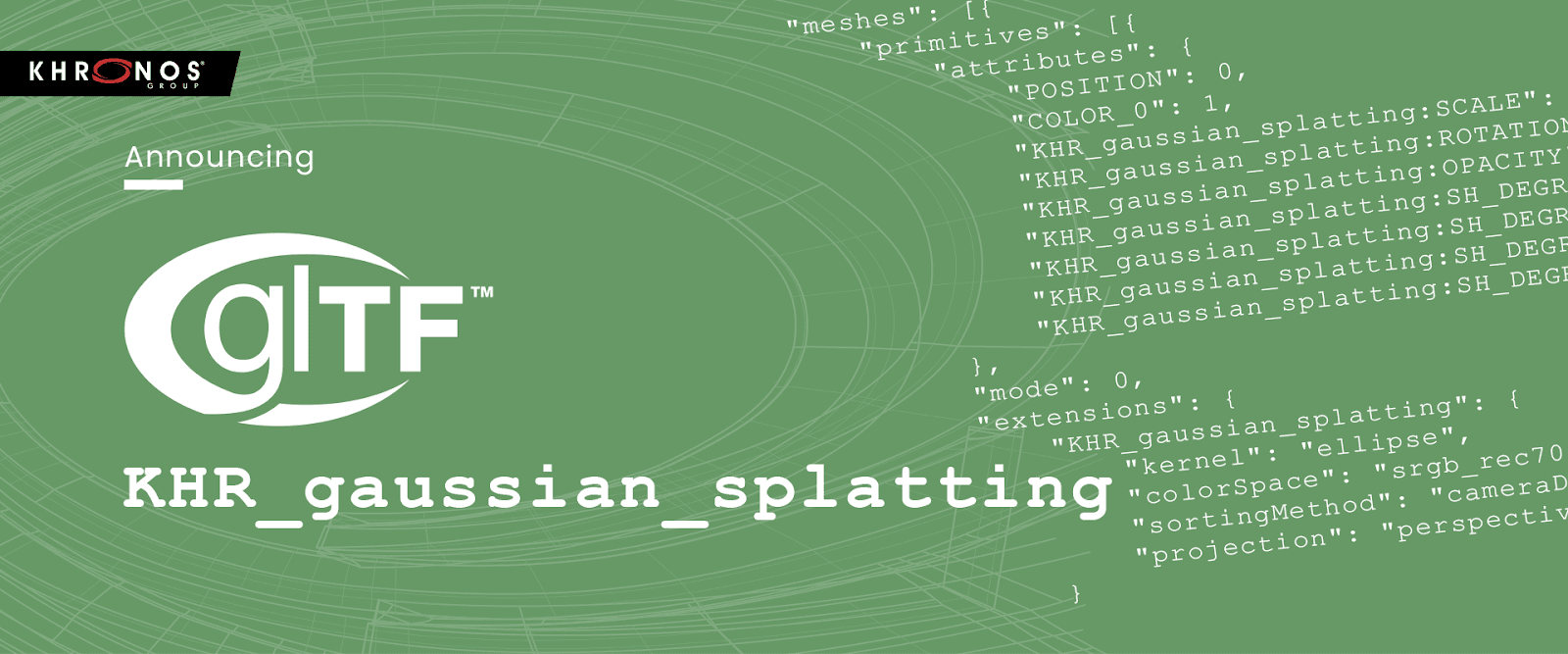
Today, the Khronos Group is offering a concrete answer, announcing a release candidate for KHR_gaussian_splatting, a new glTF extension that defines a cross platform baseline for representing 3D Gaussian splats within glTF 2.0. As a release candidate, the specification is now open for broad community feedback ahead of formal ratification, currently targeted for the second quarter of 2026.
The extension focuses on interoperability, enabling Gaussian splats to live inside existing glTF pipelines, coexist with meshes and terrain, and participate in the same spatially contextual workflows already used across real time graphics, digital twins, and geospatial visualization.
At a technical level, the extension treats Gaussian splats as a specialized interpretation of glTF mesh primitives. Each splat is defined by position, orientation, scale, color, and opacity, with clear interpretation rules that instruct a renderer to treat the data as ellipsoidal kernels rather than triangles. If a viewer does not yet support splatting, it can still interpret the asset as a sparse point cloud.
Given the rapid pace of research and the continued evolution of Gaussian splatting approaches, Khronos has intentionally avoided baking in assumptions that could age poorly. The current release candidate defines an uncompressed, GPU ready base representation, while leaving room for future extensions that introduce new kernel types, color spaces, projection methods, and sorting strategies as the field matures. These updates are overwhelmingly likely to happen, and it is a critical decision to build the foundation with this reality in mind.
In early 2025, the Metaverse Standards Forum began hosting public town halls to assess whether Gaussian splatting was ready for a formal standard. You might even recall that I gave the initial presentation.
Across those discussions, one concern came up consistently. Without a shared storage and interchange model, splat based pipelines risked fragmenting as adoption accelerates. Integrating splats cleanly into glTF, where they could live alongside meshes, imagery, and sensor derived data in Earth referenced coordinate systems, emerged as a clear priority.
Khronos’ 3D Formats Working Group took that feedback and moved quickly.
Several compression extensions are being developed in parallel, including proposals based on Niantic Spatial’s SPZ format and Qualcomm’s L-GSC work. Because glTF is explicitly designed to support vendor extensions, Khronos expects a period of experimentation before any compression approach is elevated to cross vendor standard status.
Industry response reflects how far Gaussian splatting has already traveled. Production deployments today span infrastructure visualization, mapping, media, and mobile capture, with shipping applications that include CesiumJS, Esri ArcGIS, Scaniverse, and the broader XGRIDS ecosystem.
Patrick Cozzi, Chief Platform Officer at Bentley Systems and founder of Cesium, framed the extension as foundational, noting that standardized Gaussian splats in glTF will play a role in upcoming efforts like OGC 3D Tiles 2.0. For geospatial users, it is becoming widely expected that lifelike 3D through Gaussian splatting will be a necessity that interoperates with terrain, imagery, and time varying information.
“Gaussian splatting represents the first real bridge between radiance fields and large-scale industry adoption,” said Michael Rubloff, managing editor of RadianceFields.com. “By providing a shared foundation through KHR_gaussian_splatting, glTF enables this momentum to scale without fragmentation as more industries begin shipping Gaussian splat-based content and products.”
I was honored to be included in the list of industry quotes. I believe the above statement wholeheartedly and am already aware of testing across several additional industries where setting a strong foundation for this new imaging medium is critical.
Khronos is now explicitly inviting the community to test the release candidate, review sample assets, develop implementations, and provide feedback through its public GitHub repositories. The working group has also signaled that Gaussian Splat Town Halls will continue.
By defining a lowest common denominator representation inside glTF, Khronos is making it easier for innovation to happen without breaking interoperability. Gaussian splatting continues to be adopted across real world industries, and it is becoming increasingly difficult to argue against its long term future.
Ratification is expected later this year. Between now and then, the community has an opportunity to help shape the future of KHR_gaussian_splatting.


