
Cintoo Introduces 360 Edition with Gaussian Splat Support

Michael Rubloff

Michael Rubloff

Tags

Email
Copy Link
Twitter
Linkedin
Reddit
Whatsapp
Cintoo 360

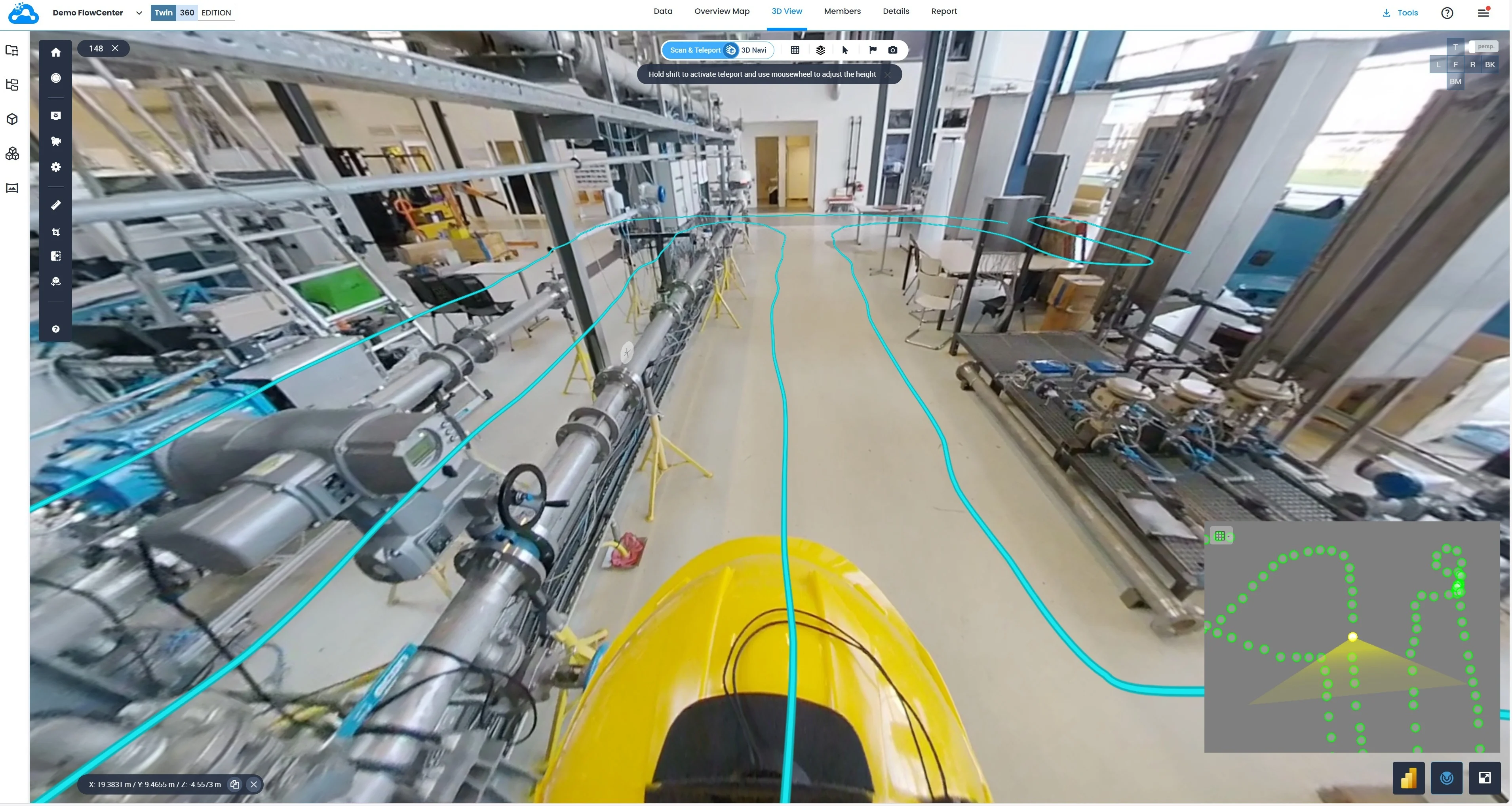
Cintoo has announced 360 Edition, a new solution that converts 360 degree video walkthroughs into navigable 3D data, extending how panoramic capture can be used inside professional reality capture workflows.

The release enables Ricoh 360 imagery to be processed, aligned, and visualized alongside terrestrial laser scans and BIM or CAD models within a single synchronized 3D environment. Because of the partnership this is exclusive to Ricoh cameras and will not work with DJI’s Osmo 360 or Insta360’s X5.

For the radiance fields community, the most notable addition is support for Gaussian Splats visualization. Panoramic imagery and 3D datasets can now be rendered together using an in house developed splat pipeline, allowing dense visual information from lightweight 360 captures to integrate more naturally with scan derived geometry.

Cintoo’s 360 Edition includes automatic camera path processing, manual 3D alignment tools, and access to existing features such as annotations, crops, and measurements. The workflow is designed around an automated field to cloud pipeline intended to reduce manual processing and accelerate time to visualization.

The beginning of 2026 has quickly seen a growing number of platforms and excitement surrounding the world of 360 capture. I am reporting here from Geo Week where gaussian splatting has been dominating conversations.

Learn more about Cintoo’s 360 Edition here.

Featured

Recents

Platforms

three.js Ships Its Native Gaussian Splat Renderer and Splat Raycasting in r186

three.js r186 ships GaussianSplat, its first native Gaussian splat renderer, adding raycasting, per-mesh frustum culling and view-dependent spherical harmonics.

Michael Rubloff

Sep 9, 2026

Platforms

three.js Ships Its Native Gaussian Splat Renderer and Splat Raycasting in r186

three.js r186 ships GaussianSplat, its first native Gaussian splat renderer, adding raycasting, per-mesh frustum culling and view-dependent spherical harmonics.

Michael Rubloff

Platforms

PlayCanvas Releases SuperSplat 3.0

SuperSplat 3.0 rewrites PlayCanvas's Gaussian splat editor on WebGPU only, removing the WebGL2 path, cutting peak memory, and adding sort-free Stochastic Alpha.

Michael Rubloff

Sep 8, 2026

Platforms

PlayCanvas Releases SuperSplat 3.0

SuperSplat 3.0 rewrites PlayCanvas's Gaussian splat editor on WebGPU only, removing the WebGL2 path, cutting peak memory, and adding sort-free Stochastic Alpha.

Michael Rubloff

XGRIDS Adds WebXR Support to the LCC Web SDK in v0.6.3

XGRIDS LCC Web SDK v0.6.3 adds WebXR support to its Three.js and Cesium renderer, bringing browser-based headset viewing to LCC and LCC2 Gaussian splat scenes.

Michael Rubloff

Sep 8, 2026

XGRIDS Adds WebXR Support to the LCC Web SDK in v0.6.3

XGRIDS LCC Web SDK v0.6.3 adds WebXR support to its Three.js and Cesium renderer, bringing browser-based headset viewing to LCC and LCC2 Gaussian splat scenes.

Michael Rubloff

Splat Box Editor for Unity Now Ships Full Source Code

Simulacrum's $199 Splat Box Editor for Unity now includes full source code, with PLY and SPZ import and export, real-time relighting, shadow mapping and SSAO.

Michael Rubloff

Sep 4, 2026

Splat Box Editor for Unity Now Ships Full Source Code

Simulacrum's $199 Splat Box Editor for Unity now includes full source code, with PLY and SPZ import and export, real-time relighting, shadow mapping and SSAO.

Michael Rubloff

Michael Rubloff

Written by Michael Rubloff

Michael is the Founder and Managing Editor of Radiancefields.com

Email
Copy Link
Twitter
Linkedin
Reddit
Whatsapp

More from Michael Rubloff

More from Michael Rubloff

Platforms

three.js Ships Its Native Gaussian Splat Renderer and Splat Raycasting in r186

three.js r186 ships GaussianSplat, its first native Gaussian splat renderer, adding raycasting, per-mesh frustum culling and view-dependent spherical harmonics.

Michael Rubloff

Sep 9, 2026

three.js Gaussian Splatting

Platforms

three.js Ships Its Native Gaussian Splat Renderer and Splat Raycasting in r186

Michael Rubloff

Sep 9, 2026

three.js Gaussian Splatting

Platforms

three.js Ships Its Native Gaussian Splat Renderer and Splat Raycasting in r186

three.js r186 ships GaussianSplat, its first native Gaussian splat renderer, adding raycasting, per-mesh frustum culling and view-dependent spherical harmonics.

Michael Rubloff

Sep 9, 2026

three.js Gaussian Splatting

Platforms

PlayCanvas Releases SuperSplat 3.0

SuperSplat 3.0 rewrites PlayCanvas's Gaussian splat editor on WebGPU only, removing the WebGL2 path, cutting peak memory, and adding sort-free Stochastic Alpha.

Michael Rubloff

Sep 8, 2026

Supersplat 3.0

Platforms

PlayCanvas Releases SuperSplat 3.0

Michael Rubloff

Sep 8, 2026

Supersplat 3.0

Platforms

PlayCanvas Releases SuperSplat 3.0

SuperSplat 3.0 rewrites PlayCanvas's Gaussian splat editor on WebGPU only, removing the WebGL2 path, cutting peak memory, and adding sort-free Stochastic Alpha.

Michael Rubloff

Sep 8, 2026

Supersplat 3.0

XGRIDS Adds WebXR Support to the LCC Web SDK in v0.6.3

XGRIDS LCC Web SDK v0.6.3 adds WebXR support to its Three.js and Cesium renderer, bringing browser-based headset viewing to LCC and LCC2 Gaussian splat scenes.

Michael Rubloff

Sep 8, 2026

XGRIDS

XGRIDS Adds WebXR Support to the LCC Web SDK in v0.6.3

Michael Rubloff

Sep 8, 2026

XGRIDS

XGRIDS Adds WebXR Support to the LCC Web SDK in v0.6.3

XGRIDS LCC Web SDK v0.6.3 adds WebXR support to its Three.js and Cesium renderer, bringing browser-based headset viewing to LCC and LCC2 Gaussian splat scenes.

Michael Rubloff

Sep 8, 2026

XGRIDS