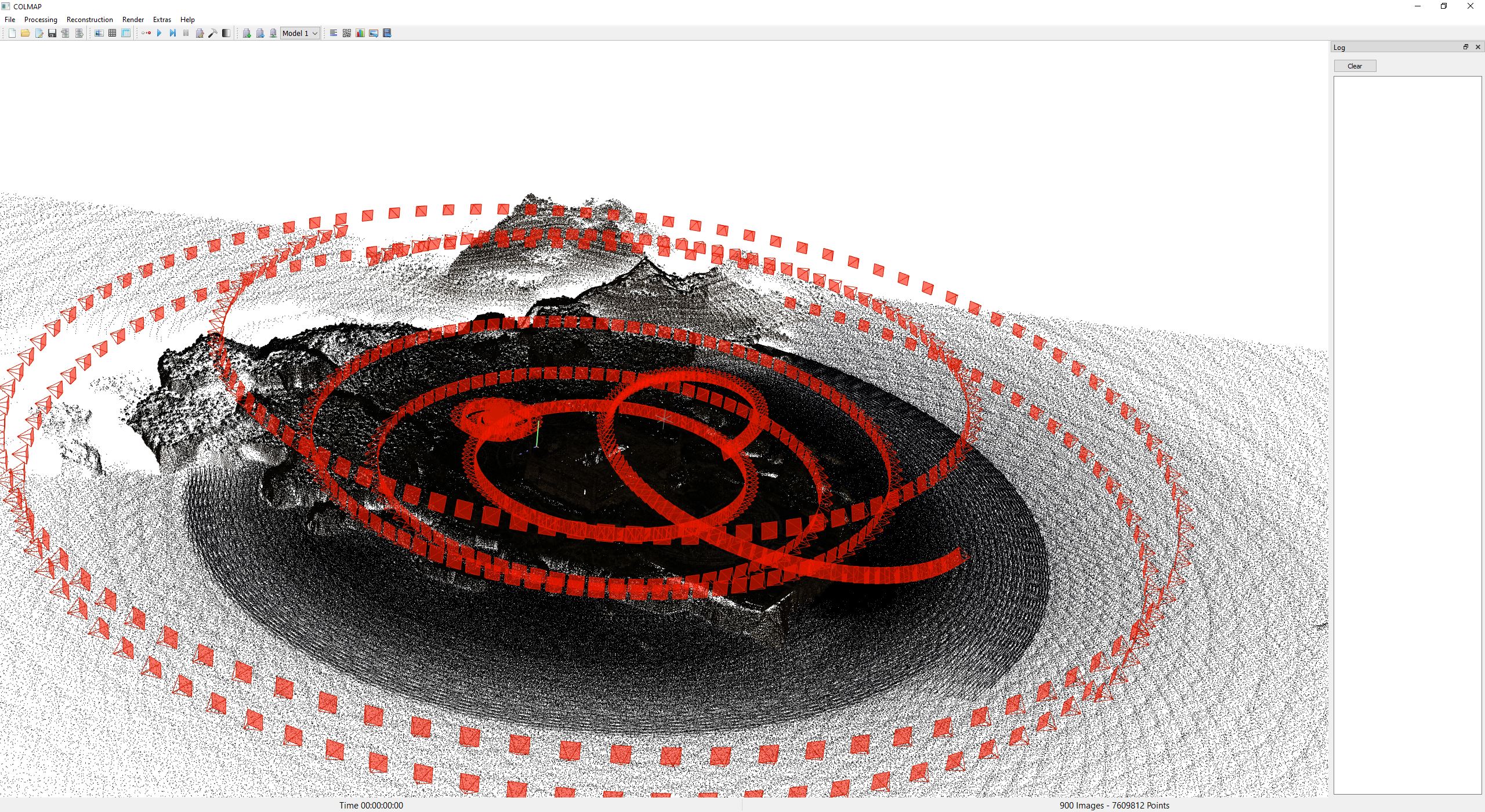
Johannes Schönberger has released COLMAP 4.2.0, which reconstructs every disconnected component of a view graph as its own model. The global mapper arrived in 4.0 through the GLOMAP integration, and until this release it kept the largest connected component and discarded the rest.
GlobalMapper.multiple_models now controls that behavior and is on by default, while GlobalMapper.min_model_size sets the registered frame count below which a model is dropped. Both are reachable from pycolmap, and components that only appear once outlier relative rotations have been filtered come back as separate models. A capture that breaks into two unconnected groups of images now yields two reconstructions from a single global mapper run, each usable on its own as gaussian splatting initialization.
COLMAP 4.2.0 adds LoMa learned feature extraction and matching through ONNX, with LOMA_B and LOMA_B128 descriptors, brute force matching, several dedicated matcher variants, and optional BF16 inference. LoMa runs from the CLI, the GUI and pycolmap. CoreML joins the ONNX execution providers on macOS, with automatic CPU fallback for unsupported models.
Dense stereo now runs on AMD hardware. The patch_match_stereo step gains ROCm/HIP acceleration behind a HIP_ENABLED build option, and CUDA and HIP builds are mutually exclusive. A browser based viewer for sparse binary reconstructions ships with the release, running locally with no upload and covering camera and point inspection, source images and reprojections.
The GUI gains incremental, global and hierarchical mapper selection with mapper specific configuration and progress rendering, and pycolmap gains complete hierarchical mapping bindings in hierarchical_mapping and HierarchicalPipeline. Calibrated two view geometry, relative pose refinement, guided matching and generalized pose estimation move from Sampson error on camera bearings to a pixel consistent tangent Sampson error, which the project singles out as improving wide field of view and spherical cameras. For people using 360 cameras for splat reconstruction (like myself), this is a great addition. COLMAP added native spherical and equirectangular camera models in 4.1.0.
Analytical reprojection Jacobians for every camera model and for fixed pose bundle adjustment produce what the project benchmarks as approximately 1.2 to 1.55x faster incremental mapping on common pinhole and OpenCV camera configurations, and image warping is reported 4 to 7x faster on modest downscales in common undistortion cases. Two view geometry also picks up six point shared focal and one sided focal relative pose solvers for unknown or partly known intrinsics, and optional DEGENSAC fundamental matrix estimation for plane dominated scenes through TwoViewGeometry.use_degensac, off by default.
Prebuilt binaries cover arm64 macOS and Windows in both CUDA and non CUDA builds, and COLMAP stays under the new BSD license. Their team has also added a browser based viewer for COLMAP.