ComfyUI-InfiniSplat Brings the InfiniSplat Single-Image Gaussian Splatting Model to ComfyUI

ComfyUI-InfiniSplat 0.1.3 brings the InfiniSplat single-image Gaussian splatting model to ComfyUI, with native Preview Splat output and Gaussian PLY export.

ComfyUI-InfiniSplat 0.1.3 brings the InfiniSplat single-image Gaussian splatting model to ComfyUI, with native Preview Splat output and Gaussian PLY export.

Michael Rubloff

Michael Rubloff

Michael is the Founder and Managing Editor of Radiancefields.com

ComfyUI

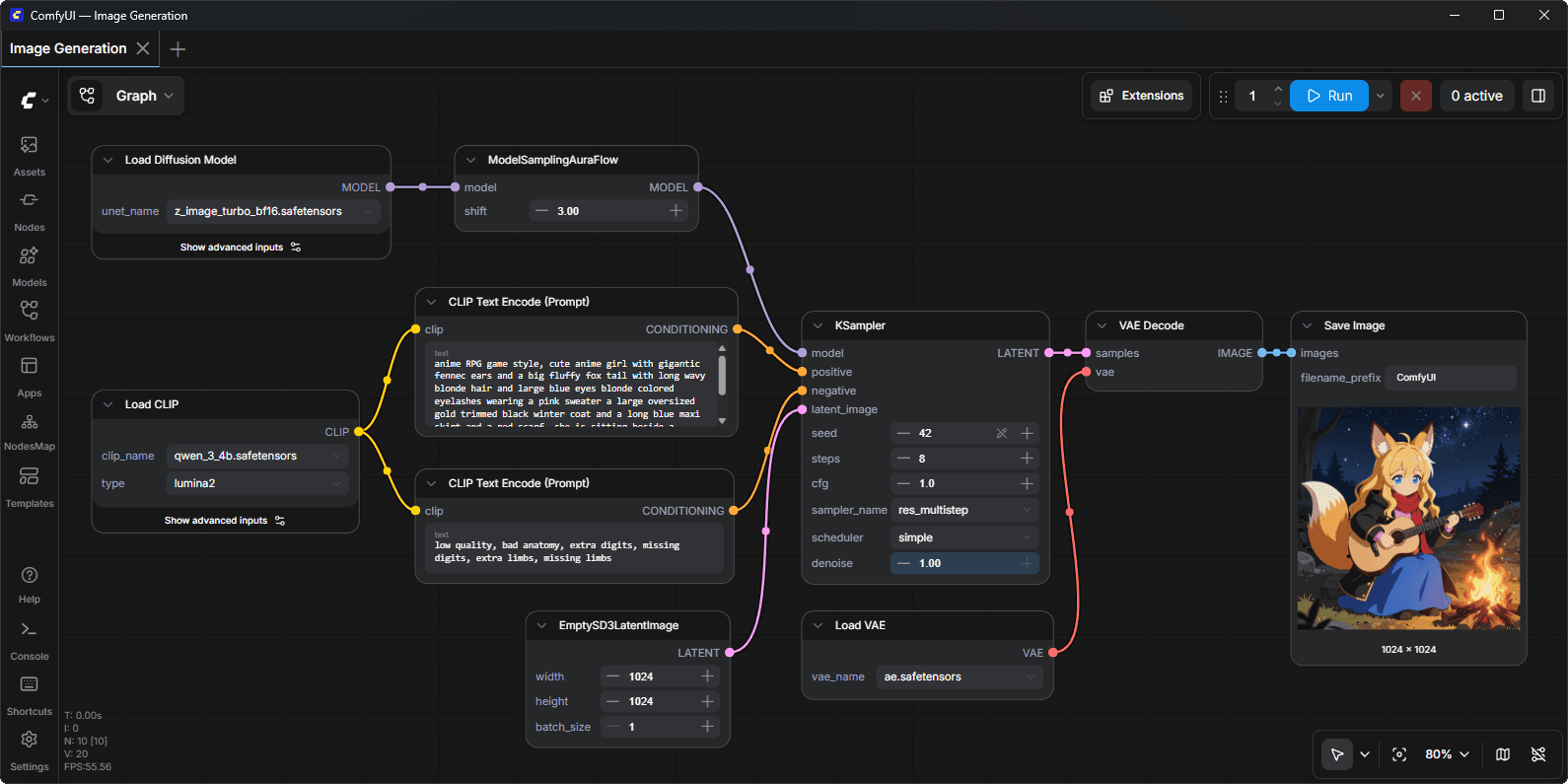
Juhana Kaarlehto has released ComfyUI-InfiniSplat 0.1.3, a custom node that runs the InfiniSplat single image gaussian splatting model inside ComfyUI.

ComfyUI's built-in route from one image to a splat has been TripoSplat, which arrived as a native workflow template in v0.23.0. The same release made splats a native data type, and InfiniSplat now feeds into the Preview Splat node that followed in v0.25.0. ComfyUI-InfiniSplat is a third party package, published to the Comfy Registry as infinisplat on October 9, and is not part of ComfyUI core.

InfiniSplat comes from the ZJU3DV group at Zhejiang University and was accepted to SIGGRAPH Asia 2026 (Journal Track), according to its arXiv listing. Most feed forward single image methods predict Gaussians from fixed pixel grid locations, which holds up near the input view but scatters primitives under large viewpoint shifts. InfiniSplat instead places sample points along the depth derived surface structure of the scene, then decodes each Gaussian from image features queried at those points. The authors call the result a surface aligned representation.

The node, InfiniSplat (Image to PLY), takes one RGB image or a batch and returns a model_3d output for the built-in Preview Splat node, with optional .ply saving. ComfyUI-InfiniSplat samples 1,500,000 Gaussians by default before a final floater filter, and assumes a 30 mm focal length (35 mm equivalent) unless GeoCalib estimation or intrinsics from a MoGe2 node replace it. A query_chunk_size default of 20,000, against upstream's 80,000, lowers peak decoder memory without reducing the sample count.

The node requires NVIDIA CUDA and ComfyUI 0.39.2 or newer. Its installer builds a separate Python 3.11, PyTorch 2.9 and CUDA 12.8 environment outside ComfyUI's own and pins a specific upstream commit. Testing covered Windows on an RTX 5090 Laptop GPU with 24 GB of VRAM, and Linux is untested. The depth guided InfiniSplat checkpoint is not exposed, because upstream's xFormers kernels fail on that GPU's SM120 architecture and the non-xFormers fallback fails as well.

The wrapper code is MIT licensed. InfiniSplat's code falls under the ZJU3DV Project Registration License, which is free for personal, research, educational and evaluation use and requires a free registration before any project use by a company, organization or other entity.

ComfyUI-InfiniSplat is available now on GitHub.

Featured

Recents

Platforms

CHCNAV Releases CoViewer, a Free Desktop Viewer for Gaussian Splats

CHCNAV CoViewer is a free Windows desktop 3DGS viewer that opens PLY, 3D Tiles, and HSC models, with elevation clipping and offline access to CoCloud projects.

Michael Rubloff

Oct 10, 2026

Platforms

CHCNAV Releases CoViewer, a Free Desktop Viewer for Gaussian Splats

CHCNAV CoViewer is a free Windows desktop 3DGS viewer that opens PLY, 3D Tiles, and HSC models, with elevation clipping and offline access to CoCloud projects.

Michael Rubloff

Platforms

Artec 3D Launches Artec Twins, Its First Software to Generate and Render Gaussian Splats

Artec Twins is the first Artec 3D software to generate and render Gaussian splats, built from Artec Jet LiDAR or photos alongside point clouds and meshes.

Michael Rubloff

Oct 10, 2026

Platforms

Artec 3D Launches Artec Twins, Its First Software to Generate and Render Gaussian Splats

Artec Twins is the first Artec 3D software to generate and render Gaussian splats, built from Artec Jet LiDAR or photos alongside point clouds and meshes.

Michael Rubloff

Platforms

TACTYC Gaussian Splat v2.0 Renders and Relights Gaussian Splats in Cinema 4D With Redshift

TACTYC Gaussian Splat v2.0 renders and relights Gaussian splats in Cinema 4D with Redshift, building one textured card per splat with SH view-dependent color.

Michael Rubloff

Oct 10, 2026

Platforms

TACTYC Gaussian Splat v2.0 Renders and Relights Gaussian Splats in Cinema 4D With Redshift

TACTYC Gaussian Splat v2.0 renders and relights Gaussian splats in Cinema 4D with Redshift, building one textured card per splat with SH view-dependent color.

Michael Rubloff

Platforms

WebODM 3.3.0 Brings Gaussian Splatting to Open-Source Drone Mapping

WebODM 3.3.0 adds Gaussian splatting support, exporting COLMAP training sets for OpenSplat or Brush and tiling uploaded splats into Spark's RAD format.

Michael Rubloff

Oct 9, 2026

Platforms

WebODM 3.3.0 Brings Gaussian Splatting to Open-Source Drone Mapping

WebODM 3.3.0 adds Gaussian splatting support, exporting COLMAP training sets for OpenSplat or Brush and tiling uploaded splats into Spark's RAD format.

Michael Rubloff

Trending Articles
  1. TRENDING
    Loading...
  2. TRENDING
    Loading...
  3. TRENDING
    Loading...
Michael Rubloff

Written by Michael Rubloff

Michael is the Founder and Managing Editor of Radiancefields.com

More from Michael Rubloff

More from Michael Rubloff

Platforms

ComfyUI-InfiniSplat Brings the InfiniSplat Single-Image Gaussian Splatting Model to ComfyUI

ComfyUI-InfiniSplat 0.1.3 brings the InfiniSplat single-image Gaussian splatting model to ComfyUI, with native Preview Splat output and Gaussian PLY export.

Michael Rubloff

Oct 12, 2026

ComfyUI

Platforms

ComfyUI-InfiniSplat Brings the InfiniSplat Single-Image Gaussian Splatting Model to ComfyUI

Michael Rubloff

Oct 12, 2026

ComfyUI

Platforms

ComfyUI-InfiniSplat Brings the InfiniSplat Single-Image Gaussian Splatting Model to ComfyUI

ComfyUI-InfiniSplat 0.1.3 brings the InfiniSplat single-image Gaussian splatting model to ComfyUI, with native Preview Splat output and Gaussian PLY export.

Michael Rubloff

Oct 12, 2026

ComfyUI

Platforms

CHCNAV Releases CoViewer, a Free Desktop Viewer for Gaussian Splats

CHCNAV CoViewer is a free Windows desktop 3DGS viewer that opens PLY, 3D Tiles, and HSC models, with elevation clipping and offline access to CoCloud projects.

Michael Rubloff

Oct 10, 2026

CoViewer

Platforms

CHCNAV Releases CoViewer, a Free Desktop Viewer for Gaussian Splats

Michael Rubloff

Oct 10, 2026

CoViewer

Platforms

CHCNAV Releases CoViewer, a Free Desktop Viewer for Gaussian Splats

CHCNAV CoViewer is a free Windows desktop 3DGS viewer that opens PLY, 3D Tiles, and HSC models, with elevation clipping and offline access to CoCloud projects.

Michael Rubloff

Oct 10, 2026

CoViewer

Platforms

Artec 3D Launches Artec Twins, Its First Software to Generate and Render Gaussian Splats

Artec Twins is the first Artec 3D software to generate and render Gaussian splats, built from Artec Jet LiDAR or photos alongside point clouds and meshes.

Michael Rubloff

Oct 10, 2026

Artec

Platforms

Artec 3D Launches Artec Twins, Its First Software to Generate and Render Gaussian Splats

Michael Rubloff

Oct 10, 2026

Artec

Platforms

Artec 3D Launches Artec Twins, Its First Software to Generate and Render Gaussian Splats

Artec Twins is the first Artec 3D software to generate and render Gaussian splats, built from Artec Jet LiDAR or photos alongside point clouds and meshes.

Michael Rubloff

Oct 10, 2026

Artec

New to Gaussian Splatting? Start here

Radiance fields, explained from the ground up: what a Gaussian splat is, how to capture one, and which tools and gear to start with.

Newsletter

Keep up with the field.

New research, tools and captures from the Radiance Fields newsroom, in your inbox. Free, no spam.