

Splatara Cloud Renderer, a competition entry from Killian Cartelier, Eugene Yew and MakerFred, renders gaussian splats on a PC and streams them to Meta Quest headsets.
The team entered it in the Meta VR Start Developer Competition 2026, and its Devpost page went up on November 18. Splatara captures splats on a Quest and trains them in a Windows companion app, which Cartelier rebuilt around a new desktop pipeline in September. SplataraScan added a peer to peer multiplayer viewer when it reached SideQuest in April, and the submission describes the scenes people capture as far too heavy for a standalone headset to render.
A Windows PC with an NVIDIA RTX GPU now renders the scene for each eye with a CUDA rasterizer, encodes it as HEVC with NVENC, and streams it over Wi-Fi on Kyber, a low latency video streaming stack. The headset reprojects every frame to the latest head pose. Captures of several gigabytes are split into level of detail scene files, and one PC serves two headsets by default and up to four, each with its own encoder session, stream and viewpoint.
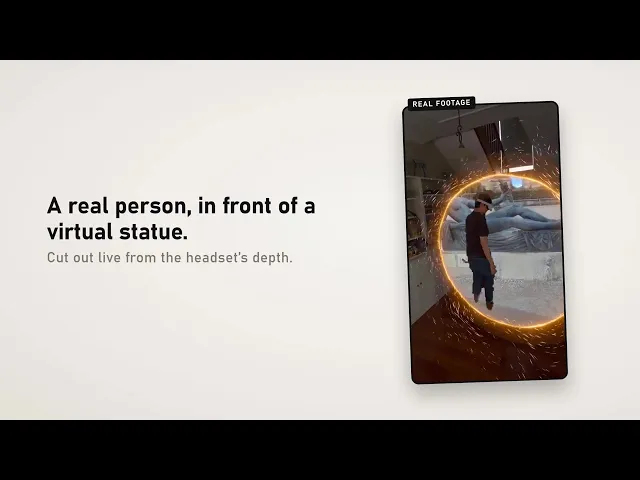
A session starts in passthrough, where a ring opens in the room and the captured place shows through it until the player walks in. Environment depth and the Space Setup room scan put anything real that is closer than the walls, a hand, another player, a dog, in front of the splat scene, and walls and furniture glow through it within 40 cm. Headsets in one room share a spatial anchor, so every player sees the scene in the same place.
Every function works by hand, with pinch selection, a pinch and hold teleport arc, Meta's palm menu and thumb microgestures. The client runs Unity 6 with URP and Vulkan on OpenXR and Meta XR Core SDK v207, and headsets pair with the PC through an X25519 key exchange and a short confirmation code. A scenario editor on the PC lays out splat scenes, portals, models, sounds and timed or conditional rules against the host headset's room scan.
As team HypeD+Escape, the three placed second in the IWSDK category at the XRCC 2026 hackathon and won its Best use of Gaussian Splat award with SplataraScan, according to the submission. Download links are on the Devpost submission page.


