
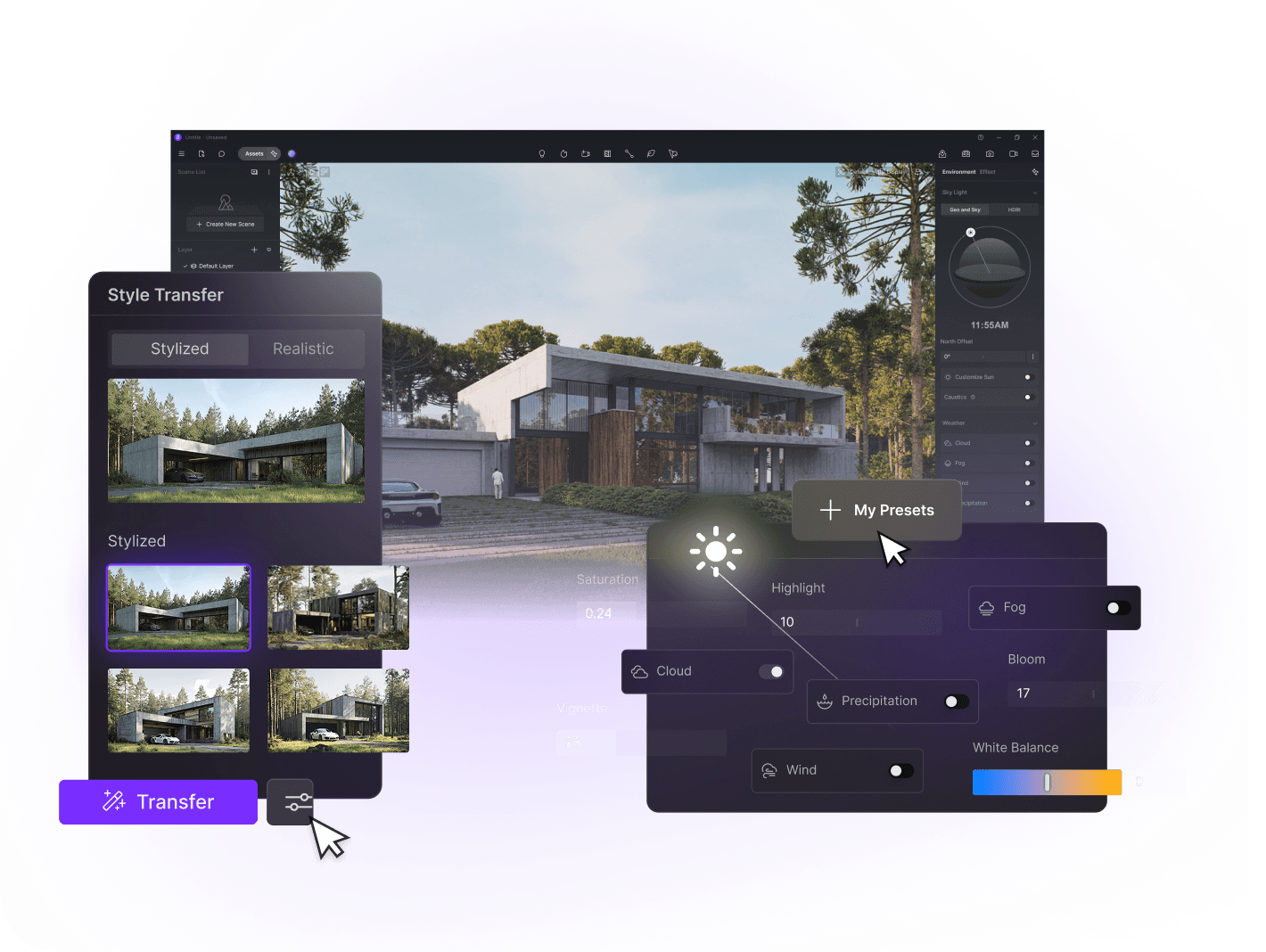
D5 Render has released version 3.0, and for the first time the platform explicitly brings gaussian splatting into the core product narrative rather than keeping it confined to cloud only workflows. While D5 has supported reconstructing with Gaussian Splatting for some time, particularly through XR Tour and its GS 3D pipeline, this release expands their gaussian splatting capabilities.
D5 Render 3.0 brings alpha support for importing Gaussian splatting models directly into a scene. D5 can now ingest common 3DGS formats such as PLY, allowing users to place reconstructions alongside traditional geometry, lighting, and cameras. This is an early implementation and is clearly labeled as experimental, but it represents an exciting expansion from the engine.
Prior to 3.0, D5’s use of Gaussian splatting was primarily surfaced through XR Tour. In that workflow, users upload rendered images or videos and receive an interactive, browser based 3D scene reconstructed using 3DGS. That pipeline remains intact in 3.0, and continues to be the most mature and production ready way D5 users interact with splats today. The difference now is that those representations are no longer isolated from the main authoring environment.
Imported Gaussian splats do not behave like editable mesh assets, and there is no expectation that they replace conventional geometry workflows. Animation, physics, and deep material interaction remain outside the scope of the current implementation. Instead, splats function as viewable spatial assets, well suited for visualization, reference, and presentation use cases.
The number of ecosystems that gaussian splatting has expanded to only continues to increase. Learn more about D5 Render directly from their website.


