

The first time you orbit a good 3DGS capture your brain starts treating it like something you stepped into. This is called the "Wow" effect.
That is why I keep paying attention to splats. The captures keep getting better, but what happens after the wow moment, when you have this incredible file and still need to turn it into something people can actually experience?
One of my favorite examples is Dany Bittel's macro insect work.
Dany is a digital artist and developer from Switzerland with a background in visual effects, animation, rendering, shading, and interactive installations. His macro splats are exactly the kind of thing that makes Gaussian Splatting feel different from normal 3D scanning. Insects are tiny, hairy, reflective, fragile, and full of details that are annoying in the best possible way.
They are also a nightmare to capture.
On his macro splats page, Dany describes the process clearly: because macro photography has an extremely shallow depth of field, a normal capture from many angles is not enough. Each camera angle needs focus stacking, where multiple photos with slightly different focus distances are combined into one sharp image. For one capture, he describes using 111 perspectives and 16 images per stack, resulting in 1776 photos from a single session.
Then the images still need work. The camera positions are reconstructed in COLMAP. The images are color corrected and masked. The final Gaussian Splat is trained in Postshot. Only after all that do you get something that can be viewed freely from different angles.
That is a serious amount of work for something that, at the end of the pipeline, many people would still experience as a file in a viewer.
And that is where I think things get interesting, though I will come back to that at the end.
Capture is only half the story
This is the piece I think gets missed in a lot of Gaussian Splatting conversations.
The capture tools are improving fast. The compression formats are improving. Web viewers are improving. More artists, researchers, museums, real estate teams, tourism teams, educators, and brands are beginning to understand what splats can do.
But a splat by itself is still an asset.
A museum does not just need a scan of an object. It needs interpretation, navigation, captions, language support, and a way to publish the experience for visitors. A real estate team does not just need a beautiful room capture. It needs calls to action, scene flow, mobile delivery, and analytics. A product team does not just need a 3D reconstruction. It needs a story around the object, maybe other media, maybe commerce, maybe a way to embed it in a campaign.
That gap between "the splat exists" and "people can use this" is where Cyango fits.
Cyango is a no-code visual editor for building apps and interactive 3D/XR experiences. You can upload Gaussian Splats, 3D models, 360 media, video, audio, and combine them with popups, scene transitions, camera animations, quizzes, buttons, multilingual content, and publish the result as a link.
No app download for viewers. The same experience can work across desktop, mobile, AR, VR, Android, iOS and as a PWA.
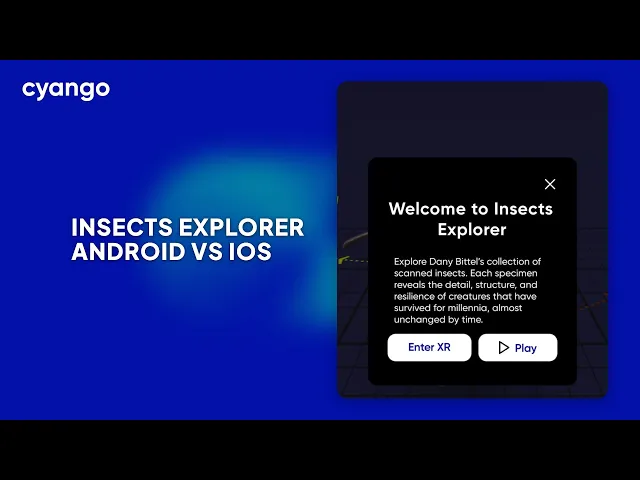
You can share it by link, embed it inside an iframe on your own site, open it from a QR code, or protect it with a password. After the first load, it can also work offline, which matters for exhibitions, field use, and places where connectivity is unreliable.
That distribution side is important to me for another reason too: full data ownership. You can keep running the experience on Cyango, export it, or self-host it on your own infrastructure if that fits your project better. Your splats, scenes, media, and published experiences stay yours to control.
If the project needs to go further than showing content, Cyango also has its own ecommerce layer ready to plug in when needed. You can connect a Shopify store and sync products into an XR Store experience, or use Cyango's Spotside Pay payments gateway for checkout inside the experience itself. Not every splat project needs that, but it matters when the goal is not just to impress people with a capture, but to let them explore something and buy from it in the same flow.
That sounds like a product list, but the point is simpler: creators should not have to become engine developers just to turn a good splat into something useful. And Cyango is not another vibe-coded Gaussian Splat platform either. There are plenty of those now: upload a file, orbit it, ship a landing page, call it a product. Cyango is a visual editor for full interactive experiences, with splats as one part of a much larger authoring infrastructure and publishing workflow.
Why splats and visual authoring belong together
Gaussian Splatting is already a very visual medium. It has this strange mix of technical complexity and immediate emotional effect. The pipeline underneath can be heavy, but the result is instantly understandable.
That makes it a good match for visual authoring.
If you are building around a splat, you usually want to make creative decisions in context. Where should the first camera angle be? What should the viewer notice first? Should a popup appear when they click a part of the subject? Should there be a guided animation before free exploration? Should this be a single-scene study, a multi-scene tour, or part of a larger XR app?
Those decisions are painful if every small change requires a custom development loop. Even with AI from scratch, you end up prompting a lot to get a reasonable result.
Inside Cyango, the goal is to make that layer editable. Upload the splat. Place it in a scene. Add interactions. Move, rotate, scale, animate, add interface, test in the browser, then publish. If the experience needs other media around it, that lives in the same workflow: 3D models, 360 panoramas, video, spatial audio, text, UI, and actions. Cyango also supports AI agents through MCP, so compatible assistants can work inside the editor instead of trying to regenerate the whole experience from scratch every time you want a change.
For other creators, the same idea applies to heritage interiors, scanned products, architecture, retail spaces, tourism locations, art installations, and training environments.
The next frontier is not another viewer
I do not think every Gaussian Splat needs to become a full app. Sometimes a simple viewer is perfect. If the goal is to share a capture quickly, there are already good tools for that.
But a lot of the commercial and cultural value of splats will come from what surrounds them: the story, the interface, the context, the way a visitor moves from one subject to another, the way a museum makes a fragile object inspectable, the way an educator turns a difficult subject into something people can explore instead of just read about.
That is the layer Cyango allows. Not a replacement for capture tools. Not a replacement for dedicated splat research. It's not the right tool for every possible 3D project. It is for the moment after the splat is made, when someone says: "Okay, this looks incredible. Now how do we turn it into something useful?"
What Dany built with Cyango
Which brings me back to Dany's Gaussian insects experience in Cyango, because that project is the clearest example of what I mean.
On their own, Dany's insect splats are already extraordinary. You can orbit a ladybug, a honeybee, a butterfly, or one of his other macro subjects and feel how well Gaussian Splatting handles hair, translucency, specular highlights, and all the tiny surface chaos that makes insects feel otherworldly. Dany has said himself that he thinks of splats as a kind of 3D photograph, shaped by the specimen, the pose, the lighting, and the same creative decisions you would make in photography. I agree with that. The capture is already an artwork.
But a standalone viewer only gets you so far.
What changes in Cyango is that those splats stop being isolated files and start becoming part of an experience with structure. You can frame how someone first meets the subject. You can move between insects without asking the viewer to hunt for separate links. You can add context around the splat with text, audio, video, UI, camera moves, scene transitions, and interaction instead of leaving all the interpretation to whoever happens to find the file online.
For macro insects, that structure matters more than it might look at first glance. These are subjects people rarely inspect properly in real life. Most of us glance at a fly on a window and move on. A good macro splat already changes that, but an experience can go further. It can slow you down. It can guide your attention to the wing membrane, the compound eye, the fuzz along the body, the way light catches a cuticle. It can turn a technical marvel into something closer to a small digital exhibition about scale, nature, and photography meeting computer graphics.
That is what I find exciting about Dany's insects project inside Cyango. It respects the amount of work that went into the capture. Four hours of shooting for one subject. Focus stacking. Masking. COLMAP. Postshot. All of that effort deserves more than a fifteen-second wow moment in a browser tab.
It deserves an experience.
And once you see that with insects, it becomes easier to imagine the same pattern everywhere else in the Gaussian Splatting ecosystem. Heritage spaces. Product launches. Museum collections. Architecture walkthroughs. Training modules. Tourism content. Scientific reference material. All of these can start with a splat, but they only become useful when someone builds the layer around them.
Gaussian Splatting gave us a new way to bring reality into 3D. Projects like Dany's insects experience show what can happen when that capture is treated as the beginning of the story, not the end of it.
References
· Dany Bittel's Gaussian insects experience in Cyango: https://www.cyango.com/explore/story/690b2b6c0b6362dfb5dd5ea8
· Support Dany Bittel on Patreon: https://www.patreon.com/cw/DanyBittel
· Cyango: https://www.cyango.com