
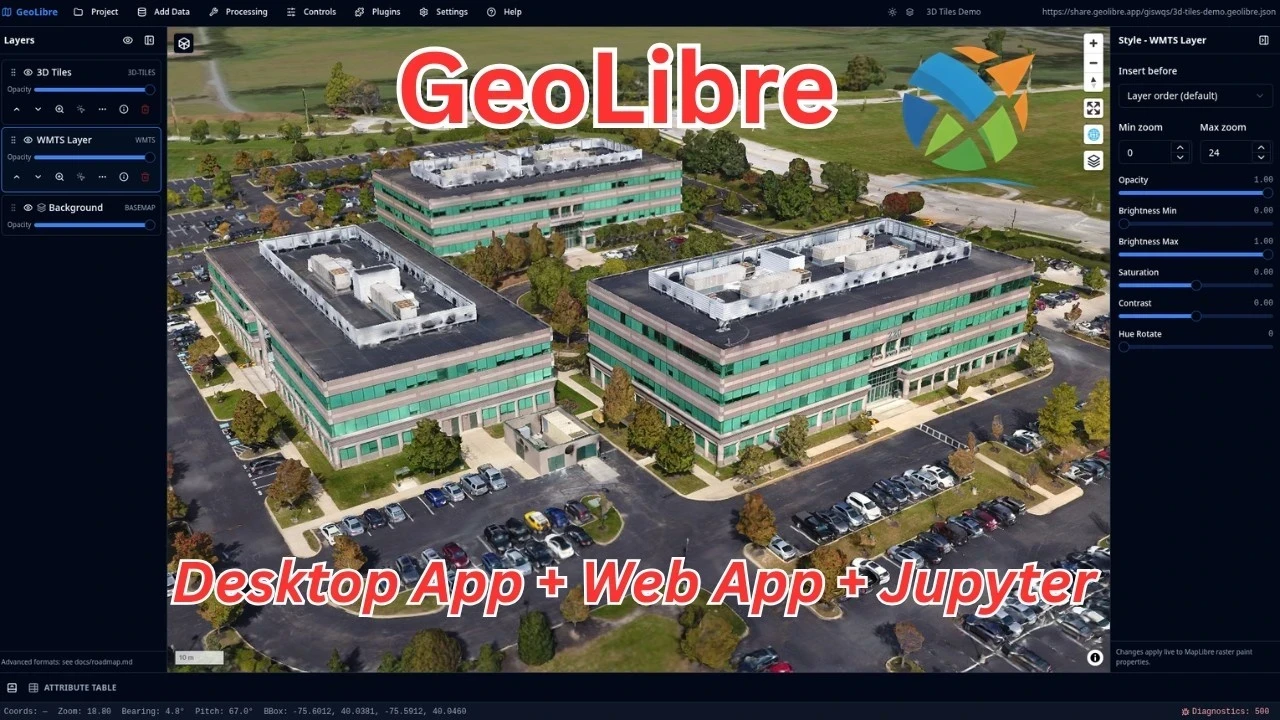
Qiusheng Wu's opengeos organization has released GeoLibre v3.0.0, which renders gaussian splat tilesets natively on a Cesium globe.
GeoLibre's first splat layer arrived in 0.5.0, drawn through the shared deck.gl overlay that backs the 2D map. That overlay has no Cesium interop, so on the globe a splat layer either failed to load or carried a 2D only badge.
GeoLibre now routes a gaussian splat layer whose asset is a 3D Tiles tileset through the tileset branch, where Cesium draws KHR_gaussian_splatting tiles natively. Raw ply, splat and spz files have no globe loader and keep the 2D only badge.
v3.0.0 also allows Cesium as the primary rendering engine, implemented as CesiumEngine behind a MapEngine interface whose capability flags the application drives and the UI gates on. Cesium3DTileStyle classifies 3D Tiles on the globe, Cesium Ion assets load by id, and the Add Data builder for deck.gl layers is disabled when the active engine lacks the customLayers capability.
The same work adds native I3S scene layers through Cesium's I3SDataProvider and decodes COPC archives in the browser, walking the octree breadth first to a ceiling of 400,000 points, reprojecting to WGS84 through the archive's WKT with proj4, and coloring by the points' own RGB or by height on a viridis ramp. EPT archives and plain LAS and LAZ stay 2D only.
Local 3D model import landed in the same release, with a georeferenced Shanghai sample, and native KML, CZML scenes and terrain profiles round out the Cesium path.


