
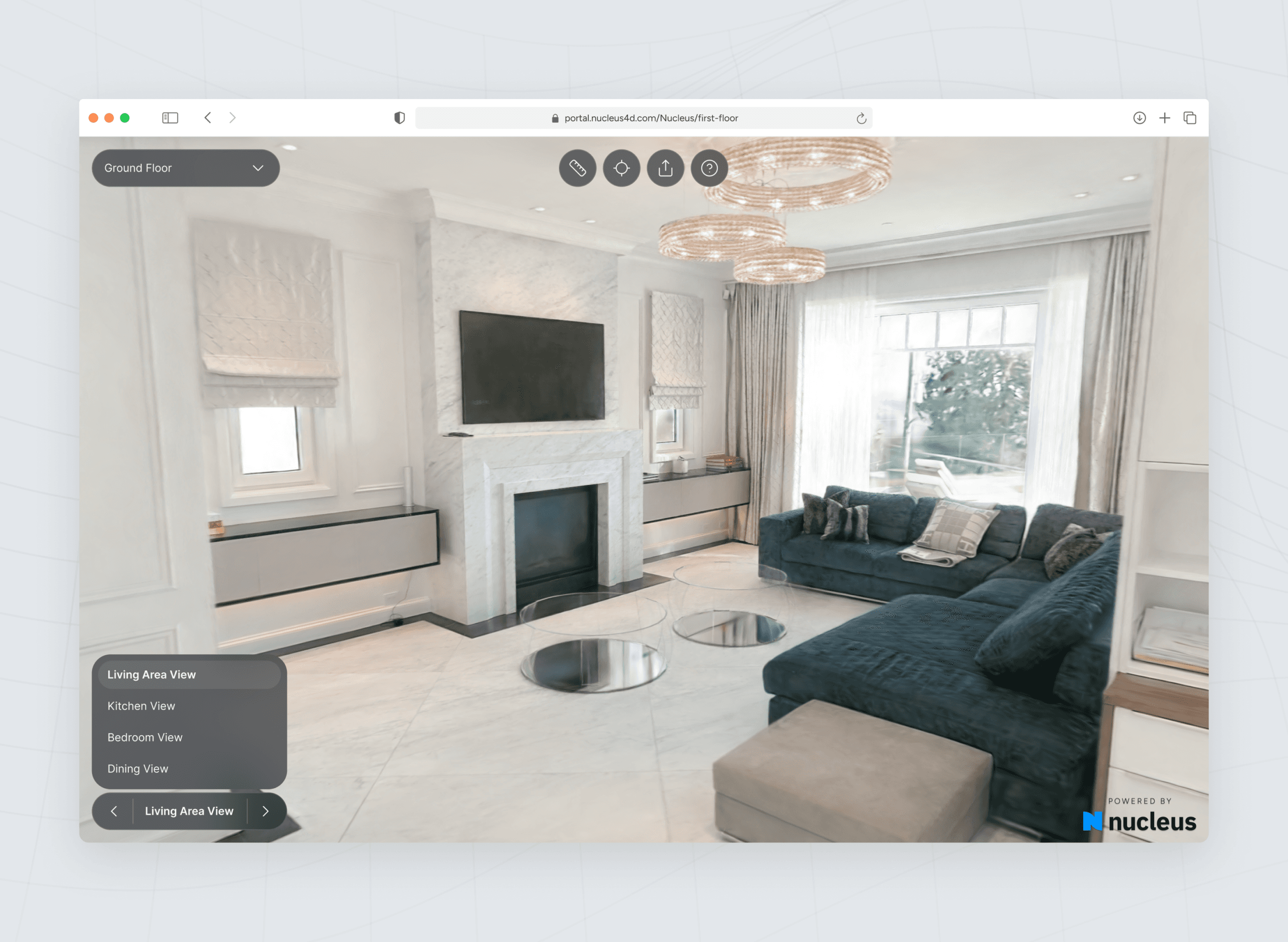
Spatial computing startup Nucleus4D has closed a $1.5 million pre-seed round, marking an early but notable funding milestone for one of the more commercially grounded deployments of Gaussian splatting to date. Backed by Antler and South Loop Ventures, with participation from strategic angels across real estate, AI, and immersive media, the round is aimed squarely at scaling a platform that treats physical space not as content, but as infrastructure.
Founded by Navjeet Chhina alongside Paulin Byusa and Miran Brajsa, Nucleus4D sits at the intersection of real estate media, immersive visualization, and machine readable spatial data. The company’s core thesis is that most of the tools used today to represent buildings were never designed to be accurate, reusable, or intelligible beyond a single viewing experience. Photos disappoint buyers.
Nucleus approaches the problem differently. Rather than producing one off tours, the platform uses gaussian splatting to create persistent digital twins of real world environments. A single on site capture can yield interactive walkthroughs, live virtual showings, cinematic outputs, floor plans, measurements, and structured spatial data.
Since launching in Q3 2025, the company reports more than 25 million square feet of residential, commercial, and hospitality space digitized on its platform. That traction has already translated into distribution leverage. Nucleus4D is currently the first spatial computing company approved to list immersive experiences directly inside Zillow’s 3D tour ecosystem.
In an interview with GamesBeat, Chhina framed Gaussian splatting not as a selling point, but as invisible infrastructure. The appeal, he argued, lies less in how scenes are rendered and more in how quickly they load, how closely they resemble reality, and how seamlessly they fit into existing workflows. Compared to traditional photogrammetry pipelines that can balloon into hundreds of gigabytes per scene, Nucleus’s splat based reconstructions are orders of magnitude lighter, making them practical for web delivery and enterprise reuse.
That emphasis on outcomes over technique appears to have resonated with investors. Antler partner Prerna Sharma described Nucleus as an end to end system. South Loop Ventures echoed the sentiment, pointing to the company’s longer term potential as spatial capture workflows extend beyond real estate into gaming, simulation, and physical AI.
Those broader ambitions are explicit. While real estate and hospitality remain the company’s near term focus, Nucleus4D positions its platform as a foundational spatial data layer. One capable of supporting world models, robotics training, and interactive environments where humans and machines operate on the same underlying representation of space. In that framing, digital twins become less about visualization and more about shared understanding.
The new capital will be used to expand engineering and product teams, scale capture and processing infrastructure, and accelerate development across the company’s web based viewer, live collaboration tools, and spatial data pipeline. It is still early, but the round underscores a larger shift that Gaussian splatting is increasingly moving out of research demos and into production systems.
Learn more about Nucleus from their website.


