
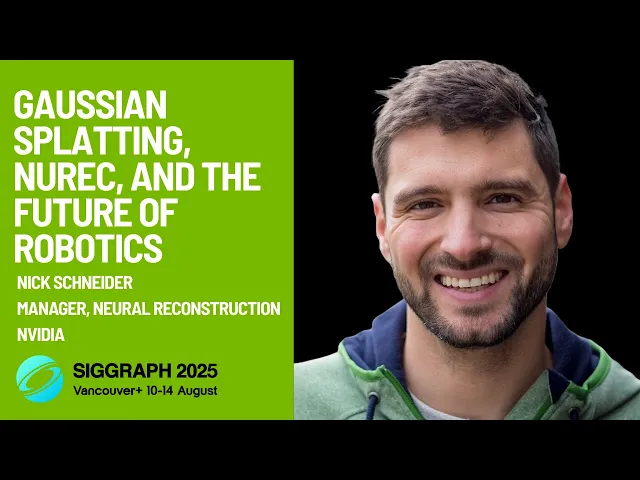
When NVIDIA first introduced NuRec at SIGGRAPH 2025, it was a glimpse at what a production grade gaussian splatting pipeline for autonomous driving simulation could look like. Developers could see the potential, but the technology was still finding its footing. At GTC 2026, NVIDIA announced that Omniverse NuRec is now generally available, accessible through the NGC catalog as a production-ready suite of 3D Gaussian Splatting reconstruction and rendering libraries.
NVIDIA considers NuRec ready for enterprise deployment, repeatable integration into data pipelines, and use in applications where reliability matters. The NGC catalog placement puts NuRec alongside NVIDIA’s other production AI frameworks, making it discoverable and deployable through the same channels that AV teams, simulation engineers, and physical AI developers already use for their stacks.
NuRec takes real world sensor data such as cameras, lidar, and recorded drive logs, and transforms it into interactive, reconstructed 3D environments. The underlying representation is a variant of 3D Gaussian Splatting, specifically 3DGUT (3D Gaussian Unscented Transform) that NVIDIA has developed internally to handle non-linear camera projections including fisheye and rolling shutter effects. For AV development, cameras in real production vehicles are rarely perfectly pinhole, and a reconstruction system that cannot handle distortion faithfully will produce training and testing data that drifts from reality.
This enables developers to now take a recorded drive from a real vehicle, feed that footage into NuRec, and within an afternoon have an explorable neural scene they can re-render from novel viewpoints, stress test under different conditions, or populate with synthetic agents. Rather than spending weeks building handcrafted simulation assets, teams get environments that are photorealistic precisely because they are derived from the physical world.
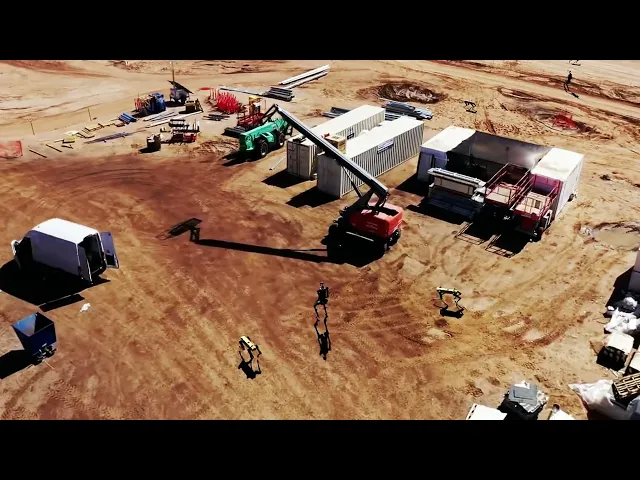
The adoption signals coming out of GTC 2026 confirm that practitioners across the autonomous systems space have been waiting for exactly this. Mcity, the AV research facility operated by the University of Michigan and widely used as a proving ground by automotive companies and academic researchers, is using NuRec to build a digital twin of its physical test track. A facility whose entire value proposition is realistic, reproducible AV testing is now backing its physical infrastructure with a radiance field that developers can query without booking track time. FieldAI, meanwhile, has integrated NuRec libraries into its Field Foundation Models for quadruped robots, using reconstructed environments as a substrate for teaching four-legged machines to navigate and map real terrain. Companies including dSPACE and Foretellix, both well established in the automotive validation space, are also building NuRec into their pipelines.
Additionally, the CARLA integration, which was announced in tandem with CARLA V0.9.16 and puts NuRec-quality neural rendering in front of the more than 150,000 developers who use CARLA as their primary AV simulation environment. That earlier announcement was already notable on its own, as covered previously on radiancefields.com.
There is a through-line from NuRec’s SIGGRAPH debut to this general availability that the radiance field community should find encouraging. Each step has moved in the same direction of broader access, more integration partners, more diverse application domains. NuRec started as an autonomous driving tool and has since absorbed robotics navigation, facility scale digital twins, and now the wider CARLA developer ecosystem. The 3DGUT representation that makes NuRec work, one that can be reconstructed from uncontrolled real world captures and re-rendered efficiently under novel conditions, turns out to be useful far beyond the AV use case it was designed for.
NuRec is now officially a catalog product, and the team of developers who can evaluate it, integrate it, and ship with it just grew considerably. Learn more here.