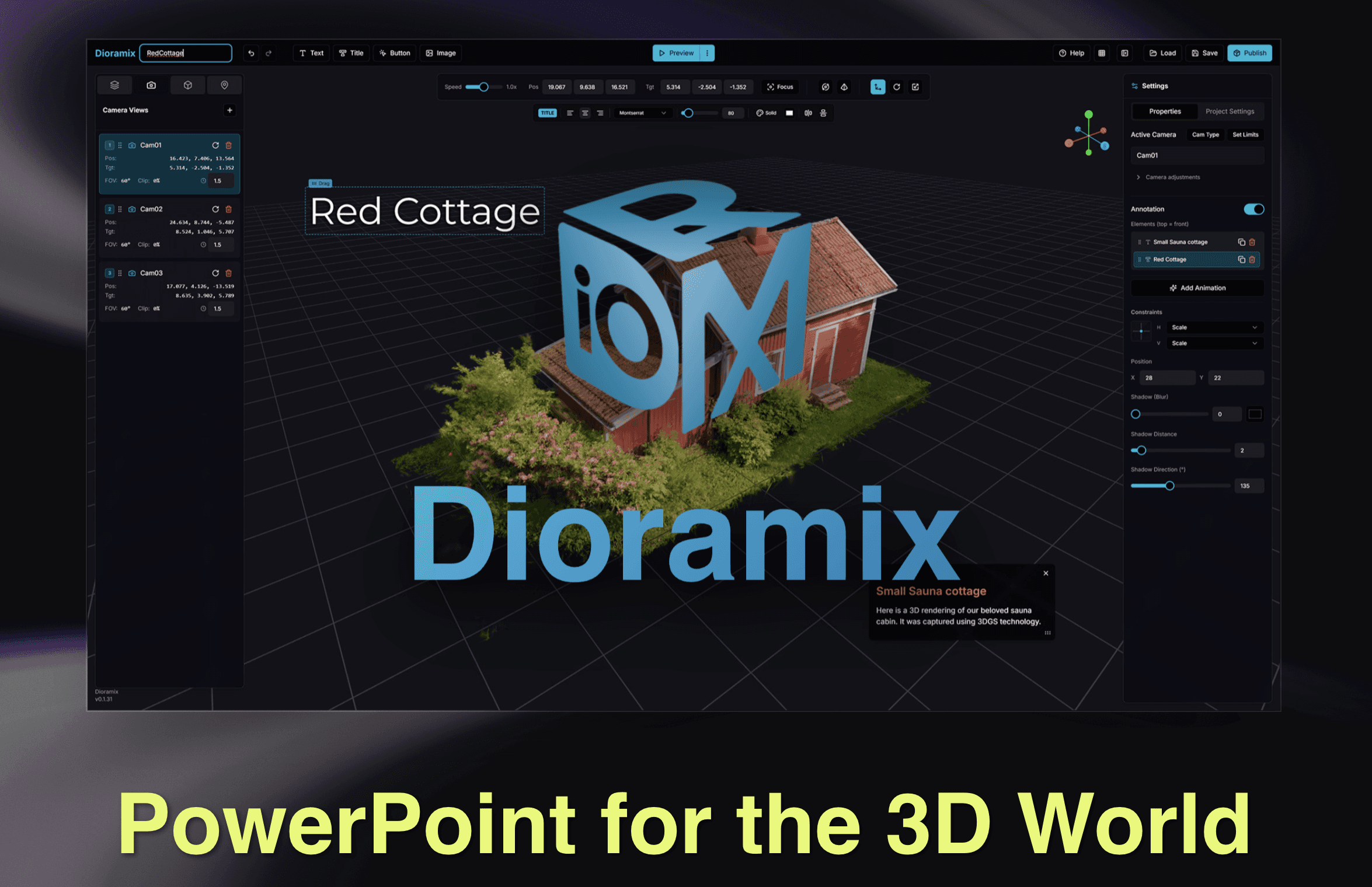
The hardest part of showing someone a Gaussian Splat has never been capturing it, it's been conveying what it means once the splat exists. You can orbit a scene endlessly and still not communicate what you're looking at or why it matters. Dioramix is a new browser based editor being developed by Olli Huttunen that treats the Gaussian Splat as a stage, not a destination.
Dioramix works like PowerPoint for 3D models. You load a capture, PLY, SPZ, or SOG formats are all supported, along with conventional mesh formats like GLB/GLTF and OBJ. Then define a series of camera views, each of which becomes a "slide." From there, you attach annotations, buttons, hotspots, image carousels, embedded videos, and PDF documents to build something that can be walked through rather than simply rotated.
In Dioramix, a button can navigate to a specific camera angle, change the current scene, launch an iframe, or link out entirely. Hotspots in 3D space can trigger media overlays. Multiple scenes, each containing different models, can live inside a single presentation, enabling transitions between locations without requiring the user to understand what a PLY file even is.
Dioramix is built on BabylonJS and leans into its WebGPU backend. BabylonJS's WebGPU path means the browser can access the GPU more directly, handling heavier scenes more responsively. It also means the editor runs locally without uploading anything to a server. Finished presentations are exported as self contained ZIP packages containing HTML, assets, and scene data, runnable offline or hostable anywhere the user chooses.
Dioramix is not publicly available yet. Olli Huttunen is developing it as a solo project, with a public beta planned for the near future. A sandbox version is available by request at dioramix.eu, where several live demos already show the range of what the tool can produce, from a T. rex skeleton walkthrough created with Gabriele Romagnoli to a synthetic city orthographic real estate presentation and a ski jumping complex tour.
No data is collected, no accounts are required, and nothing is stored outside the user's own machine. For museums, archives, and heritage organizations that have been cautious because of data handling concerns, this addresses those concerns.
Learn more on the Dioramix website.